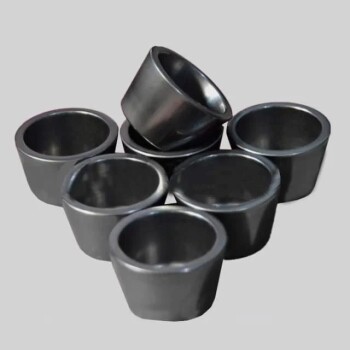
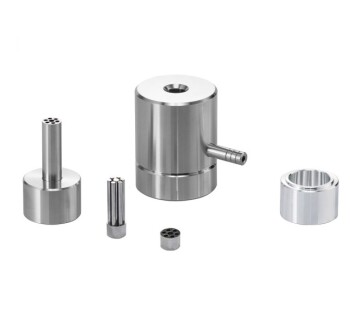
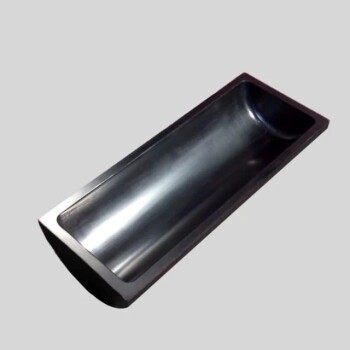
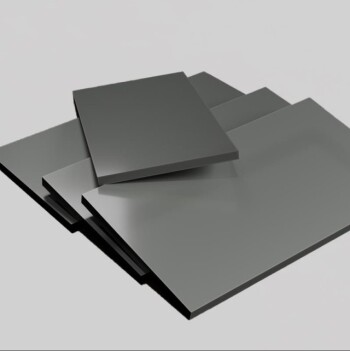
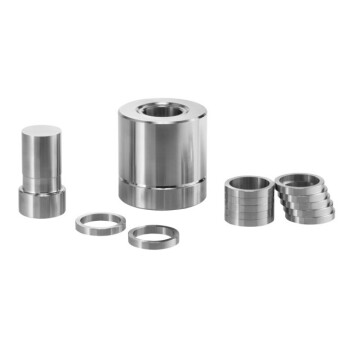
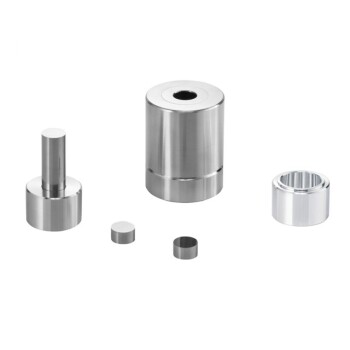
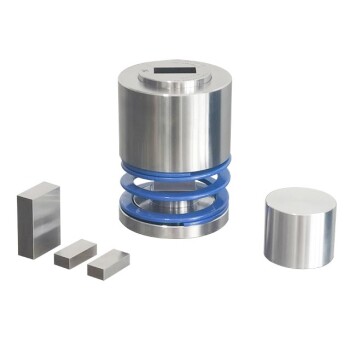
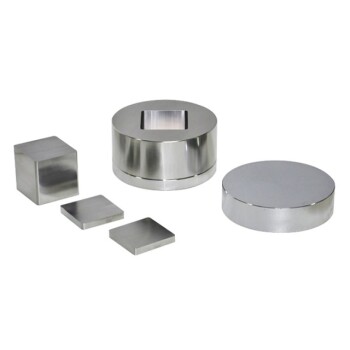
High-purity high-density graphite molds act as the operational heart of the sintering process. They do not merely hold material; they simultaneously perform three critical active functions: defining the component's shape, generating the necessary thermal energy through electrical resistance, and mechanically transmitting extreme pressure to densify the powder.
Core Takeaway In modern sintering techniques like SPS, the graphite mold is an active process component, not a passive container. It serves as a resistive heating element and a high-pressure transmission medium, relying on graphite’s unique ability to conduct electricity while maintaining structural integrity under immense heat and mechanical load.
The Active Roles of the Graphite Assembly
High-purity graphite is the material of choice because it solves the "Deep Need" of sintering: applying heat and pressure simultaneously without reacting with the sample or failing mechanically.
Precise Containment and Shaping
The most fundamental function of the mold is to serve as a forming die. It defines the macroscopic geometry (shape and size) of the final product.
The mold acts as a container for the loose ceramic or metallic mixed powders. It constrains the material, ensuring that as the powder consolidates, it conforms strictly to the designed volume and dimensions.
Efficient Thermal Energy Conversion
In the Spark Plasma Sintering (SPS) process, the mold functions as the primary resistive heating element.
Because the mold is electrically conductive, the pulsed direct current passes through the graphite. The material’s resistance efficiently converts this current into thermal energy (Joule heating).
This allows the mold to transfer heat uniformly to the sample inside. This is particularly critical for non-conductive ceramic powders, which rely entirely on the mold to receive thermal energy.
High-Pressure Transmission
High-density graphite is selected for its exceptional high-temperature mechanical strength.
During sintering, the system applies hydraulic force to densify the powder. The graphite mold must withstand axial pressures often reaching tens of megapascals (e.g., 30–40 MPa).
The mold acts as the transmission medium, ensuring this massive force is stably and uniformly transferred to the particles. This pressure drives plastic flow and diffusion, which are essential for achieving a high-density, void-free component.
Operational Constraints and Considerations
While graphite is versatile, it is not indestructible. Understanding its limitations is vital for process safety and cost control.
Vulnerability to Oxidation
Graphite oxidizes and degrades rapidly when exposed to air at sintering temperatures.
To prevent the mold from burning away or losing structural integrity, processes must occur in a vacuum or protective inert atmosphere. This minimizes oxidative loss and significantly extends the service life of the mold.
Mechanical Pressure Limits
Although high-density graphite is strong, it is brittle compared to tooling steel.
There is a finite limit to the pressure graphite can withstand before catastrophic fracture occurs. While it handles standard sintering pressures (up to ~80-100 MPa depending on grade/design), exceeding these limits requires specialized tool designs or alternative materials.
Making the Right Choice for Your Goal
The specific grade of graphite you choose should align with the most critical parameter of your sintering process.
- If your primary focus is Rapid Heating (SPS): Prioritize graphite with high electrical uniformity to ensure the mold acts as a stable heating element without creating hot spots.
- If your primary focus is High Density: Prioritize high-strength, high-density graphite grades capable of withstanding maximum hydraulic pressures (40+ MPa) without deformation.
- If your primary focus is Cost Efficiency: Ensure your vacuum or inert gas system is optimized to prevent oxidation, as this is the primary cause of premature mold wear.
The success of your sintering run depends on treating the graphite mold as an integrated part of your thermal and mechanical system.
Summary Table:
| Function | Description | Impact on Sintering |
|---|---|---|
| Shaping | Serves as a forming die for powders | Defines final component geometry and dimensions |
| Heating | Converts electrical current to thermal energy | Provides uniform Joule heating for rapid densification |
| Pressing | Transmits axial hydraulic force (30-100 MPa) | Drives plastic flow and diffusion for void-free parts |
| Strength | Maintains integrity under extreme heat | Ensures stable mechanical transmission during the cycle |
Maximize Your Sintering Precision with KINTEK
Unlock the full potential of your Spark Plasma Sintering (SPS) and Hot Pressing workflows with high-purity, high-density graphite solutions from KINTEK. As specialists in advanced laboratory equipment, we provide the robust tooling and thermal systems required for demanding material research.
From high-temperature furnaces and hydraulic pellet presses to specialized graphite molds and crucibles, our portfolio is designed to withstand extreme pressures and temperatures. Whether you are developing advanced ceramics or metallic alloys, KINTEK offers the technical expertise and high-performance consumables your lab needs to succeed.
Ready to optimize your material densification? Contact our specialists today to find the perfect mold grade for your application!
References
- Dewei Ni, Guo‐Jun Zhang. Advances in ultra-high temperature ceramics, composites, and coatings. DOI: 10.1007/s40145-021-0550-6
This article is also based on technical information from Kintek Solution Knowledge Base .
Related Products
- High Purity Pure Graphite Crucible for Evaporation
- High Purity Pure Graphite Crucible for Electron Beam Evaporation
- High Purity Alumina Granulated Powder for Engineering Advanced Fine Ceramics
- Horizontal High Temperature Graphite Vacuum Graphitization Furnace
- Ultra-High Temperature Graphite Vacuum Graphitization Furnace
People Also Ask
- Why are high-purity graphite crucibles preferred for sulfide solid electrolytes? Achieve Superior Material Purity
- Why is a high-purity graphite crucible required for Chromel-TaC composites? Ensure Peak Purity at 1400°C
- What role do high-purity graphite crucibles play in molten salt corrosion research? Ensure Reactor-Grade Precision
- Why are high-purity graphite crucibles used for magnesium distillation? Ensure 3N8 Purity & Thermal Stability
- Why is a high-purity graphite crucible ideal for nitrogen-doped graphene at 1500 °C? Maximize Purity and Stability