Knowledge muffle furnace What is dry ashing in a muffle furnace? A Guide to Precise Mineral Analysis
Author avatar

Tech Team · Kintek Solution

Updated 3 months ago

What is dry ashing in a muffle furnace? A Guide to Precise Mineral Analysis


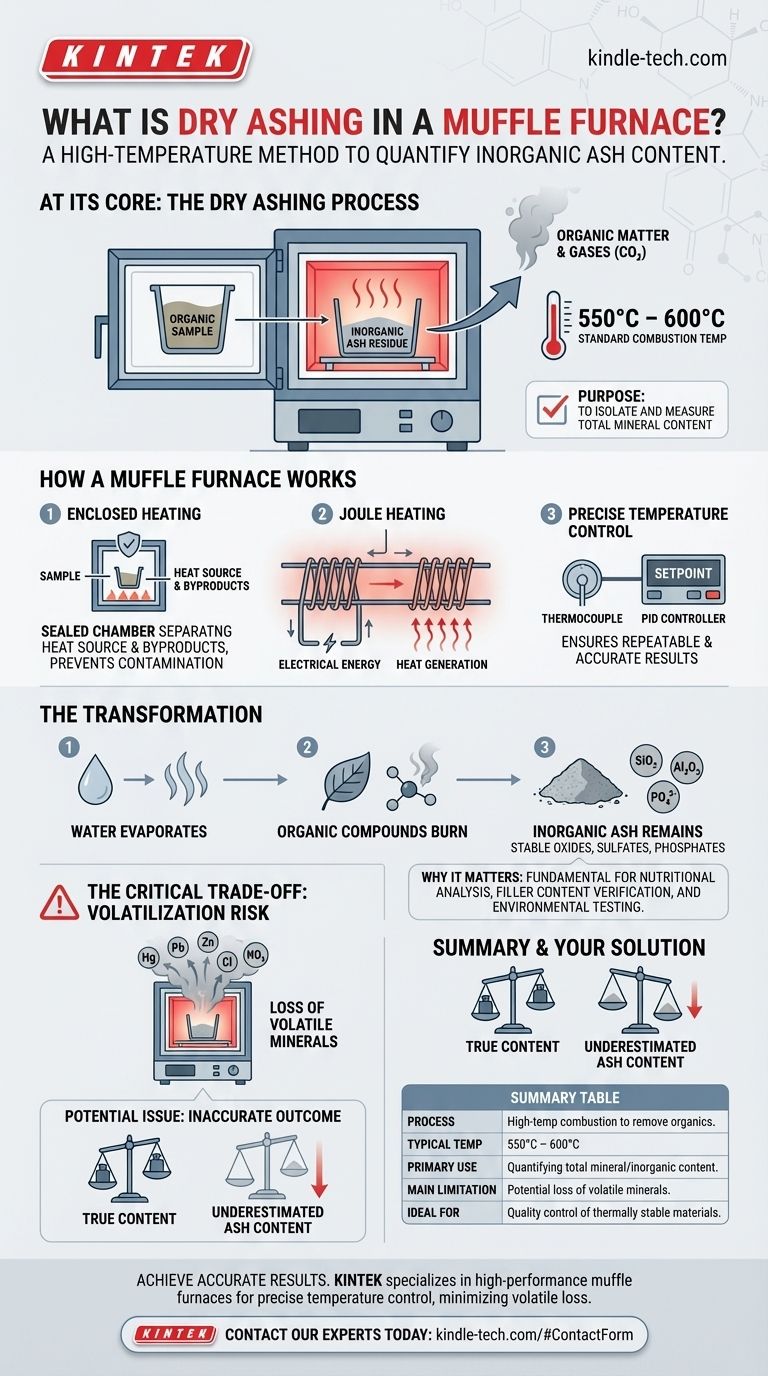
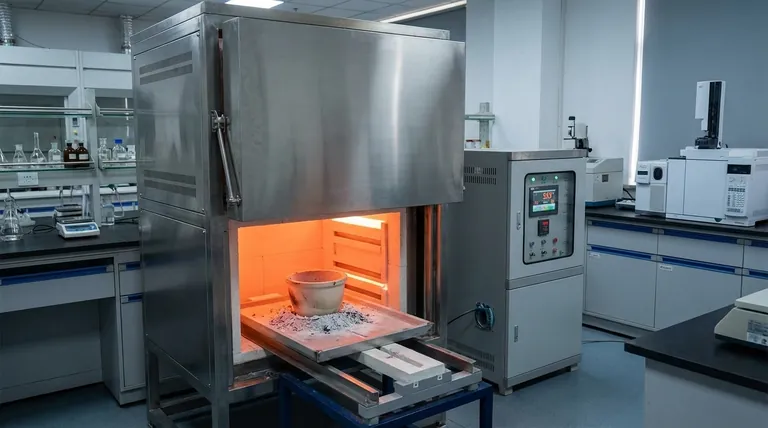
At its core, dry ashing is a high-temperature combustion method used to remove all organic matter from a sample, leaving behind only the inorganic, non-combustible residue known as ash. This process is performed in a muffle furnace, a specialized oven that can reach and maintain the very high temperatures required, typically between 550°C and 600°C, to ensure complete combustion.

Dry ashing is the standard technique for quantifying the total mineral (inorganic) content of a sample. However, its accuracy hinges on a critical trade-off: the high temperatures necessary for combustion can also cause certain volatile minerals to be lost, potentially skewing the results.

How a Muffle Furnace Works

A muffle furnace is not simply a high-temperature oven; its design is critical for achieving a clean and controlled analysis.

The Principle of Enclosed Heating

The term "muffle" refers to the furnace's design, which separates the sample being heated from the byproducts of the heat source. In modern electric furnaces, this means the sample sits inside a refractory chamber that is heated externally by electric coils.

This separation prevents any contamination and ensures the only chemical reaction occurring is the combustion of the sample itself.

Achieving and Controlling High Temperatures

A muffle furnace converts electrical energy into heat via Joule heating, where current is passed through high-resistance heating elements.

These elements, often made of materials like Nichrome, heat the chamber through radiation and convection. A thermocouple measures the internal temperature, which is regulated by a PID controller to maintain a precise setpoint. This control is essential for repeatable and accurate ashing procedures.

The Purpose of Dry Ashing

The goal of this process is to isolate and quantify the non-organic components of a substance.

The Transformation Process

When a sample is heated in the furnace, any water is the first thing to evaporate. As the temperature rises, all organic compounds (those containing carbon) are burned away, reacting with oxygen in the air to form gases like carbon dioxide.

The remaining material is the ash, which consists of stable inorganic compounds such as oxides, sulfates, and phosphates. The weight of this ash relative to the original sample weight gives you the total ash content.

Why Ash Content Matters

Measuring ash content is a fundamental quality control and analytical procedure in many fields. It serves as a direct measure of the total mineral content in a sample.

This is critical for nutritional analysis in food, verifying filler content in polymers and rubbers, and for geological or environmental testing.

Understanding the Key Limitation

While effective, dry ashing is not a perfect method for all scenarios. Its primary drawback is a direct consequence of the high temperatures it uses.

The Risk of Volatilization

The most significant limitation of dry ashing is the potential for loss of volatile minerals.

Elements like mercury, lead, and zinc, as well as certain mineral salts like chlorides and nitrates, can turn into vapor at the high temperatures used in the furnace (550-900°C). When these minerals volatilize, they are lost along with the combusted organic matter.

This leads to an inaccurate outcome, specifically an underestimation of the sample's true total mineral content. The final ash weight will be lower than it should be because these elements have escaped.

Making the Right Choice for Your Goal

The suitability of dry ashing depends entirely on your material and your analytical objectives.

  • If your primary focus is a general quality check on thermally stable materials (like polymers or rubber): Dry ashing is a reliable, efficient, and straightforward method for determining the total inorganic filler content.
  • If your primary focus is precise elemental analysis, especially for samples with potentially volatile minerals (common in food or environmental testing): You must account for the potential loss of these elements and understand that dry ashing may provide an incomplete mineral profile.

Ultimately, recognizing the principles and inherent limitations of dry ashing is the first step toward achieving accurate and meaningful analytical results.
What is dry ashing in a muffle furnace? A Guide to Precise Mineral Analysis

Summary Table:

Aspect Key Takeaway
Process High-temperature combustion to remove organic matter, leaving inorganic ash.
Typical Temperature 550°C to 600°C.
Primary Use Quantifying total mineral/inorganic content in a sample.
Main Limitation Potential loss of volatile minerals (e.g., lead, zinc), leading to underestimation.
Ideal For Quality control of thermally stable materials like polymers and rubbers.

Achieve accurate and reliable results in your lab.

Dry ashing is a fundamental technique, but its success depends on using the right equipment. KINTEK specializes in high-performance muffle furnaces and lab consumables designed for precise temperature control and repeatable analysis, helping you avoid the pitfalls of volatile mineral loss.

Whether you're in food science, materials testing, or environmental analysis, our solutions are built to meet your specific needs. Contact our experts today to find the perfect furnace for your application and ensure the integrity of your data.

#ContactForm

Visual Guide

What is dry ashing in a muffle furnace? A Guide to Precise Mineral Analysis Visual Guide

Related Products

People Also Ask

Related Products

1200℃ Muffle Furnace Oven for Laboratory

1200℃ Muffle Furnace Oven for Laboratory

Upgrade your lab with our 1200℃ Muffle Furnace. Achieve fast, precise heating with Japan alumina fibers and Molybdenum coils. Features TFT touch screen controller for easy programming and data analysis. Order now!

1800℃ Muffle Oven Furnace for Laboratory

1800℃ Muffle Oven Furnace for Laboratory

KT-18 muffle furnace with Japan Al2O3 polycrystalline fibe and Silicon Molybdenum heating element, up to 1900℃, PID temperature control and 7" smart touch screen. Compact design, low heat loss, and high energy efficiency. Safety interlock system and versatile functions.

1400℃ Muffle Oven Furnace for Laboratory

1400℃ Muffle Oven Furnace for Laboratory

Get precise high-temperature control up to 1500℃ with KT-14M Muffle furnace. Equipped with a smart touch screen controller and advanced insulation materials.

1700℃ Muffle Oven Furnace for Laboratory

1700℃ Muffle Oven Furnace for Laboratory

Get superior heat control with our 1700℃ Muffle Furnace. Equipped with intelligent temperature microprocessor, TFT touch screen controller & advanced insulation materials for precise heating up to 1700C. Order now!

High Temperature Muffle Oven Furnace for Laboratory Debinding and Pre Sintering

High Temperature Muffle Oven Furnace for Laboratory Debinding and Pre Sintering

KT-MD High temperature debinding and pre-sintering furnace for ceramic materials with various molding processes. Ideal for electronic components such as MLCC and NFC.

Laboratory Muffle Oven Furnace Bottom Lifting Muffle Furnace

Laboratory Muffle Oven Furnace Bottom Lifting Muffle Furnace

Efficiently produce batches with excellent temperature uniformity using our Bottom Lifting Furnace. Features two electric lifting stages and advanced temperature control up to 1600℃.

Molybdenum Vacuum Heat Treat Furnace

Molybdenum Vacuum Heat Treat Furnace

Discover the benefits of a high-configuration molybdenum vacuum furnace with heat shield insulation. Ideal for high-purity, vacuum environments like sapphire crystal growth and heat treatment.

Multi-zone Laboratory Tube Furnace

Multi-zone Laboratory Tube Furnace

Experience precise, efficient thermal testing with our Multi Zone Tube Furnace. Independent heating zones and temperature sensors allow for controlled high-temperature gradient heating fields. Order now for advanced thermal analysis!

Ultra-High Temperature Graphite Vacuum Graphitization Furnace

Ultra-High Temperature Graphite Vacuum Graphitization Furnace

The ultra-high temperature graphitization furnace utilizes medium frequency induction heating in a vacuum or inert gas environment. The induction coil generates an alternating magnetic field, inducing eddy currents in the graphite crucible, which heats up and radiates heat to the workpiece, bringing it to the desired temperature. This furnace is primarily used for graphitization and sintering of carbon materials, carbon fiber materials, and other composite materials.

Vacuum Hot Press Furnace Machine Heated Vacuum Press

Vacuum Hot Press Furnace Machine Heated Vacuum Press

Discover the advantages of Vacuum Hot Press Furnace! Manufacture dense refractory metals & compounds, ceramics, and composites under high temp and pressure.

Vacuum Heat Treat and Molybdenum Wire Sintering Furnace for Vacuum Sintering

Vacuum Heat Treat and Molybdenum Wire Sintering Furnace for Vacuum Sintering

A vacuum molybdenum wire sintering furnace is a vertical or bedroom structure, which is suitable for withdrawal, brazing, sintering and degassing of metal materials under high vacuum and high temperature conditions. It is also suitable for dehydroxylation treatment of quartz materials.

Multi Heating Zones CVD Tube Furnace Machine Chemical Vapor Deposition Chamber System Equipment

Multi Heating Zones CVD Tube Furnace Machine Chemical Vapor Deposition Chamber System Equipment

KT-CTF14 Multi Heating Zones CVD Furnace - Precise Temperature Control and Gas Flow for Advanced Applications. Max temp up to 1200℃, 4 channels MFC mass flow meter, and 7" TFT touch screen controller.

Graphite Vacuum Furnace High Thermal Conductivity Film Graphitization Furnace

Graphite Vacuum Furnace High Thermal Conductivity Film Graphitization Furnace

The high thermal conductivity film graphitization furnace has uniform temperature, low energy consumption and can operate continuously.

600T Vacuum Induction Hot Press Furnace for Heat Treat and Sintering

600T Vacuum Induction Hot Press Furnace for Heat Treat and Sintering

Discover the 600T Vacuum Induction Hot Press Furnace, designed for high-temperature sintering experiments in vacuum or protected atmospheres. Its precise temperature and pressure control, adjustable working pressure, and advanced safety features make it ideal for nonmetal materials, carbon composites, ceramics, and metal powders.

Lab-Scale Vacuum Induction Melting Furnace

Lab-Scale Vacuum Induction Melting Furnace

Get precise alloy composition with our Vacuum Induction Melting Furnace. Ideal for aerospace, nuclear energy, and electronic industries. Order now for effective smelting and casting of metals and alloys.

Mesh belt controlled atmosphere furnace

Mesh belt controlled atmosphere furnace

Discover our KT-MB mesh belt sintering furnace - perfect for high-temperature sintering of electronic components & glass insulators. Available for open air or controlled atmosphere environments.

Horizontal High Temperature Graphite Vacuum Graphitization Furnace

Horizontal High Temperature Graphite Vacuum Graphitization Furnace

Horizontal Graphitization Furnace: This type of furnace is designed with the heating elements placed horizontally, allowing for uniform heating of the sample. It's well-suited for graphitizing large or bulky samples that require precise temperature control and uniformity.

Vacuum Heat Treat and Pressure Sintering Furnace for High Temperature Applications

Vacuum Heat Treat and Pressure Sintering Furnace for High Temperature Applications

Vacuum pressure sintering furnaces are designed for high temperature hot pressing applications in metal and ceramic sintering. Its advanced features ensure precise temperature control, reliable pressure maintenance, and a robust design for seamless operation.

Vacuum Sealed Continuous Working Rotary Tube Furnace Rotating Tube Furnace

Vacuum Sealed Continuous Working Rotary Tube Furnace Rotating Tube Furnace

Experience efficient material processing with our vacuum-sealed rotary tube furnace. Perfect for experiments or industrial production, equipped with optional features for controlled feeding and optimized results. Order now.

1200℃ Controlled Atmosphere Furnace Nitrogen Inert Atmosphere Furnace

1200℃ Controlled Atmosphere Furnace Nitrogen Inert Atmosphere Furnace

Discover our KT-12A Pro Controlled atmosphere furnace - high precision, heavy duty vacuum chamber, versatile smart touch screen controller, and excellent temperature uniformity up to 1200C. Ideal for both laboratory and industrial application.


Leave Your Message