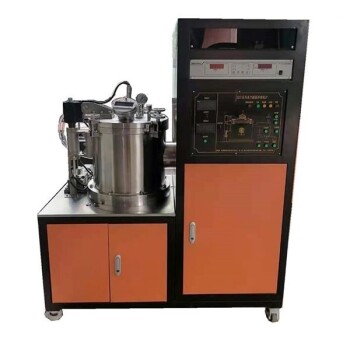
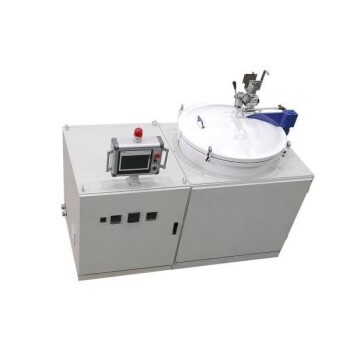
At its core, a high-frequency induction furnace is a highly efficient and clean furnace that melts conductive metals without using any flames, arcs, or external combustion. It works by passing a powerful alternating electrical current through a copper coil, which generates a strong magnetic field. This field induces internal electrical currents—known as eddy currents—directly within the metal charge, causing it to heat up rapidly and melt from the inside out.
The fundamental advantage of induction heating is that it generates heat directly within the material being melted. This eliminates the inefficiencies and contamination risks of traditional furnaces, offering unparalleled speed, precision, and cleanliness for melting metals and creating high-purity alloys.
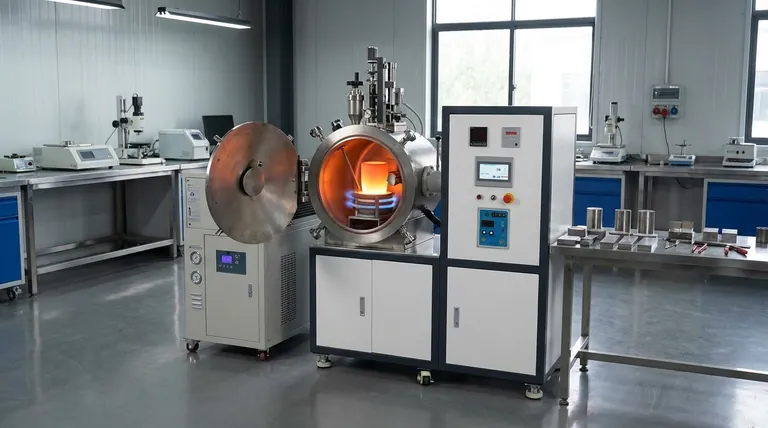
The Fundamental Principle: How Induction Generates Heat
To truly understand an induction furnace, you must grasp its unique method of heat generation. It is not about applying external heat; it is about creating it internally through electromagnetism.
The Role of the Coil and Current
The process begins with an induction power unit that sends a high-frequency alternating current (AC) to a water-cooled copper coil. This coil is typically wrapped around a container, known as a crucible, which holds the metal to be melted.
Creating the Magnetic Field
As the alternating current flows through the coil, it generates a powerful and rapidly fluctuating magnetic field in the space within and around the coil.
Inducing Eddy Currents
This magnetic field penetrates the electrically conductive metal placed inside the crucible. According to the principles of electromagnetism, the changing magnetic field induces circulating electrical currents within the metal itself. These internal currents are called eddy currents.
Heat from Resistance
The metal has a natural electrical resistance. As the strong eddy currents flow against this resistance, they generate immense friction and heat, a phenomenon known as Joule heating. This heat is what causes the metal to melt quickly and efficiently.
Key Advantages of the Induction Method
The unique heating principle of induction furnaces provides several distinct operational advantages over traditional fuel-fired or arc furnaces.
Unmatched Speed and Efficiency
Because heat is generated within the charge, the melting process is extremely fast. Very little energy is wasted heating the furnace chamber or the surrounding atmosphere, leading to high energy efficiency and lower operational costs.
Superior Purity and Control
The process requires no combustion, which means no byproducts like carbon can contaminate the melt. This is critical for producing high-purity alloys of exact composition. Temperature can be controlled with extreme precision, preventing the loss of valuable and volatile alloying elements.
Reduced Material Loss
The rapid melting and controlled atmosphere minimize oxidation and decarburization—the loss of metal to scale or chemical changes. This results in higher yields and saves raw material costs.
Enhanced Workplace Environment
Induction furnaces produce no smoke, waste gases, or excessive noise. This creates a cleaner, safer, and more pleasant working environment, improves conditions for workers, and helps meet stringent environmental regulations.
Understanding the Practical Trade-offs
While highly effective, induction technology is not a universal solution. Understanding its limitations is key to making an informed decision.
High Initial Capital Cost
The power electronics, precision coils, and control systems required for an induction furnace represent a significant upfront investment compared to simpler, more traditional furnace types.
Material Suitability
The entire process relies on the material's ability to conduct electricity. It is exceptionally effective for metals like iron, steel, copper, and aluminum but cannot directly heat non-conductive materials like ceramics or certain refractories.
Maintenance Complexity
The high-power electrical systems and water-cooling circuits are more complex than the components of a basic combustion furnace. Maintenance and repair require specialized technical expertise.
Making the Right Choice for Your Goal
The decision to use a high-frequency induction furnace depends entirely on your operational priorities and the materials you are processing.
- If your primary focus is material purity and precise alloy composition: The clean, contained, and highly controllable nature of induction melting is an ideal choice.
- If your primary focus is production speed and energy efficiency: The rapid, direct heating method minimizes both cycle times and wasted energy, making it a powerful production tool.
- If your primary focus is workplace safety and environmental compliance: The lack of emissions, open flames, and excessive noise makes it a superior choice for modern industrial facilities.
Ultimately, understanding this core principle of internal heating is the key to leveraging the distinct advantages of an induction furnace for your specific application.
Summary Table:
| Aspect | High-Frequency Induction Furnace |
|---|---|
| Heating Method | Internal heating via induced eddy currents |
| Key Advantages | High purity, rapid melting, energy efficiency, no combustion byproducts |
| Ideal For | Conductive metals (steel, copper, aluminum), high-purity alloys |
| Considerations | High initial cost, requires conductive materials, complex maintenance |
Ready to enhance your metal melting process with precision and efficiency? KINTEK specializes in advanced lab equipment, including high-frequency induction furnaces designed for laboratories that demand superior purity, speed, and control. Whether you're melting conductive metals or creating high-purity alloys, our solutions deliver unmatched performance. Contact us today to learn how KINTEK can meet your laboratory needs!
Visual Guide

Related Products
- 600T Vacuum Induction Hot Press Furnace for Heat Treat and Sintering
- Vacuum Arc Induction Melting Furnace
- Vacuum Heat Treat Furnace and Levitation Induction Melting Furnace
- Lab-Scale Vacuum Induction Melting Furnace
- Vertical High Temperature Graphite Vacuum Graphitization Furnace
People Also Ask
- What role does mechanical pressure play during the vacuum diffusion bonding of tungsten and copper? Keys to Solid Bonding
- What advantages does a vacuum hot press furnace provide for LSLBO ceramic electrolytes? Achieve 94% Relative Density
- How does a vacuum hot press furnace contribute to the molding process of UHMWPE/nano-HAP composites?
- Why is the gradient heating function of a vacuum hot press furnace essential? Enhance Graphite-Aluminum Composites
- How does the pressure system of a vacuum hot press furnace affect Cu-18Ni-2W alloys? Enhance Density & Performance