Knowledge Resources What is high temperature sintering? Boost Strength and Durability for Demanding Parts
Author avatar

Tech Team · Kintek Solution

Updated 2 months ago

What is high temperature sintering? Boost Strength and Durability for Demanding Parts


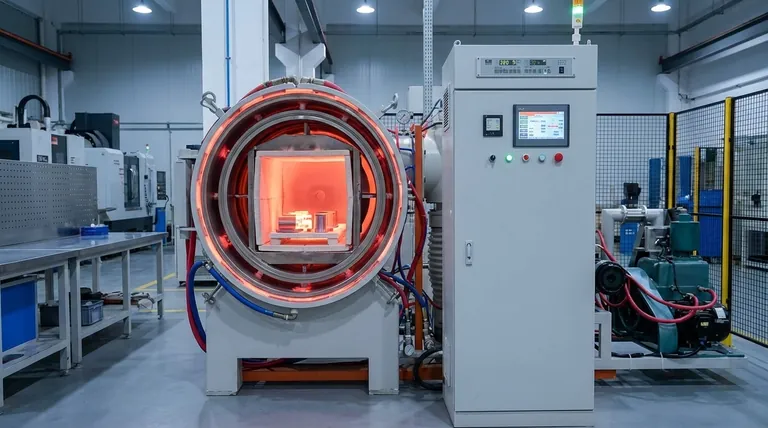
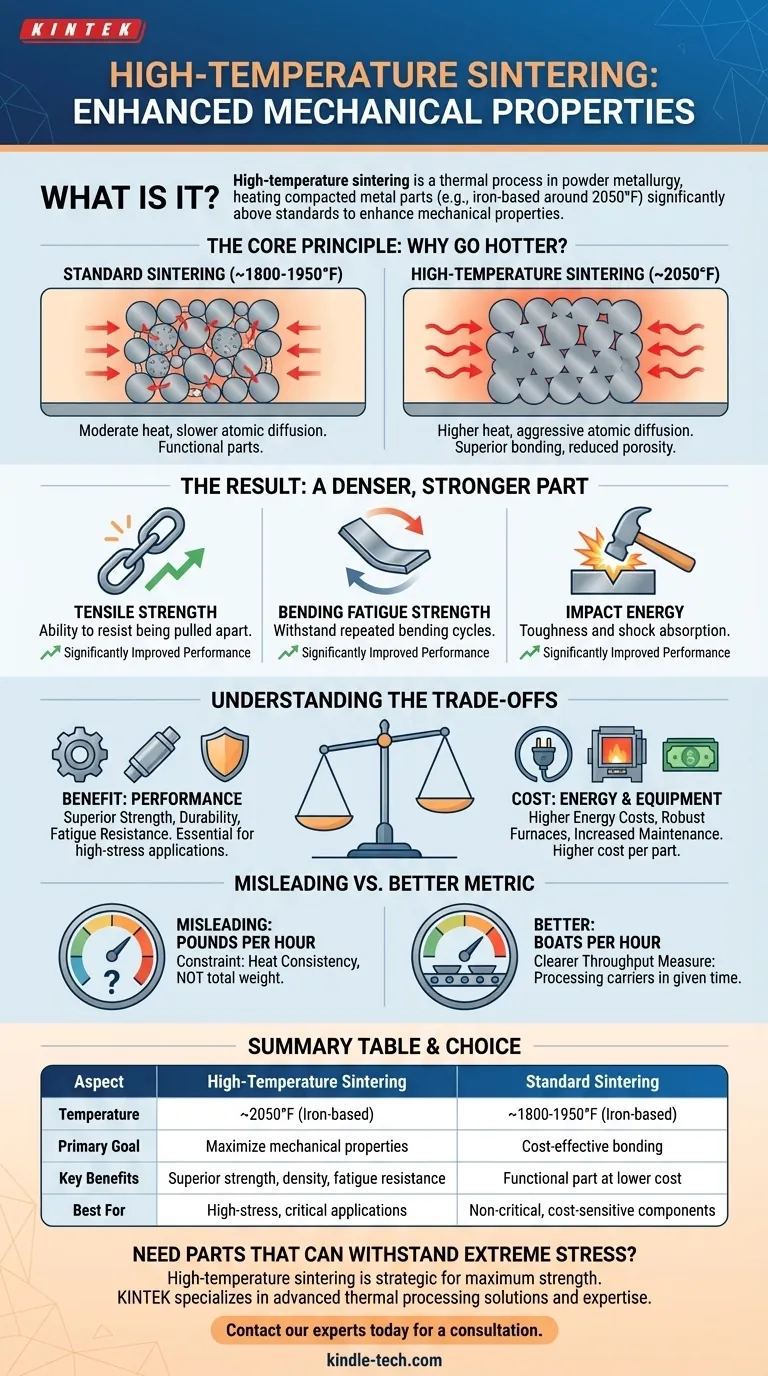
In essence, high-temperature sintering is a thermal process used in powder metallurgy where compacted metal parts are heated to temperatures significantly above conventional standards. For iron-based components, this means operating around 2050°F, approximately 100-250°F higher than normal. The primary goal is not just to fuse the metal particles but to fundamentally enhance the final part's mechanical properties.

While standard sintering creates a functional part, high-temperature sintering is a strategic investment. It trades higher energy costs for superior material strength, density, and fatigue resistance, enabling components to perform in more demanding applications.
What is high temperature sintering? Boost Strength and Durability for Demanding Parts

The Core Principle: Why Go Hotter?

Sintering works by using heat to encourage atoms to diffuse across the boundaries of individual metal powder particles, fusing them into a solid, coherent mass. Raising the temperature accelerates this process dramatically.

The Impact of Higher Temperatures

Increasing the heat energy in the furnace promotes more aggressive atomic diffusion. This allows the metal particles to bond more completely and reduces the size and number of internal voids, or pores, that are a natural byproduct of the powder metallurgy process.

The Result: A Denser, Stronger Part

This enhanced atomic bonding and reduced porosity directly translate to superior mechanical properties. A part that undergoes high-temperature sintering will exhibit significantly better performance characteristics compared to its conventionally sintered counterpart.

Key Performance Gains

Specifically, you can expect improvements in:

  • Tensile Strength: The ability to resist being pulled apart.
  • Bending Fatigue Strength: The capacity to withstand repeated bending cycles without failing.
  • Impact Energy: The toughness of the material and its ability to absorb a sudden shock.

Understanding the Trade-offs

Choosing this process requires a clear understanding of what you gain and what you sacrifice. It is a decision driven entirely by the final application's performance requirements.

The Primary Benefit: Unlocking Performance

The reason to select high-temperature sintering is straightforward: to create parts that are stronger, tougher, and more durable. This makes it essential for high-stress applications like automotive transmission gears or other components where failure is not an option.

The Inescapable Cost: Energy and Equipment

The primary drawback is cost. Maintaining temperatures around 2050°F requires substantially more energy. It also necessitates more robust and specialized furnaces, which increases capital and maintenance expenses, leading to a higher cost per part.

The Misleading Metric: "Pounds per Hour"

When evaluating production output, you will often hear furnaces discussed in terms of "pounds per hour." This can be a misleading metric. The furnace's true constraint is its ability to deliver consistent heat to the parts, not the total weight it can hold.

A Better Measure: "Boats per Hour"

A more meaningful indicator of throughput is "boats per hour." A "boat" is a tray or carrier that moves parts through the furnace. This metric measures how many of these carriers a furnace can process in a given time, providing a much clearer picture of its capacity regardless of part size, shape, or density.

Making the Right Choice for Your Application

The decision to use high-temperature sintering should be based on a clear cost-benefit analysis for your specific component.

  • If your primary focus is cost-effectiveness for non-critical components: Standard sintering is often the more economical and perfectly sufficient choice.
  • If your primary focus is maximum strength, fatigue resistance, and durability: The investment in high-temperature sintering is necessary to meet demanding performance requirements.
  • If you are evaluating manufacturing partners or equipment: Ask about throughput in "boats per hour" to get a more accurate assessment of production capacity.

Ultimately, choosing high-temperature sintering is a deliberate engineering decision to prioritize ultimate part performance over initial production cost.

Summary Table:

Aspect High-Temperature Sintering Standard Sintering
Temperature ~2050°F (Iron-based) ~1800-1950°F (Iron-based)
Primary Goal Maximize mechanical properties Cost-effective bonding
Key Benefits Superior strength, density, fatigue resistance Functional part at lower cost
Best For High-stress, critical applications (e.g., transmission gears) Non-critical, cost-sensitive components

Need parts that can withstand extreme stress?

High-temperature sintering is a strategic process for achieving maximum strength, density, and fatigue resistance in your metal components. If your application demands superior performance, the investment is essential.

KINTEK specializes in providing the advanced thermal processing solutions and expertise needed for high-performance sintering. We supply robust laboratory furnaces and consumables designed for demanding processes, helping you create durable, reliable parts.

Let's discuss your project requirements and how we can help you achieve optimal results.

Contact our experts today for a consultation.

Visual Guide
What is high temperature sintering? Boost Strength and Durability for Demanding Parts Visual Guide

Related Products

People Also Ask

Related Products

Vacuum Heat Treat and Pressure Sintering Furnace for High Temperature Applications

Vacuum Heat Treat and Pressure Sintering Furnace for High Temperature Applications

Vacuum pressure sintering furnaces are designed for high temperature hot pressing applications in metal and ceramic sintering. Its advanced features ensure precise temperature control, reliable pressure maintenance, and a robust design for seamless operation.

2200 ℃ Tungsten Vacuum Heat Treat and Sintering Furnace

2200 ℃ Tungsten Vacuum Heat Treat and Sintering Furnace

Experience the ultimate refractory metal furnace with our Tungsten vacuum furnace. Capable of reaching 2200℃, perfect for sintering advanced ceramics and refractory metals. Order now for high-quality results.

High Temperature Muffle Oven Furnace for Laboratory Debinding and Pre Sintering

High Temperature Muffle Oven Furnace for Laboratory Debinding and Pre Sintering

KT-MD High temperature debinding and pre-sintering furnace for ceramic materials with various molding processes. Ideal for electronic components such as MLCC and NFC.

2200 ℃ Graphite Vacuum Heat Treat Furnace

2200 ℃ Graphite Vacuum Heat Treat Furnace

Discover the power of the KT-VG Graphite Vacuum Furnace - with a maximum working temperature of 2200℃, it's perfect for vacuum sintering of various materials. Learn more now.

Ultra-High Temperature Graphite Vacuum Graphitization Furnace

Ultra-High Temperature Graphite Vacuum Graphitization Furnace

The ultra-high temperature graphitization furnace utilizes medium frequency induction heating in a vacuum or inert gas environment. The induction coil generates an alternating magnetic field, inducing eddy currents in the graphite crucible, which heats up and radiates heat to the workpiece, bringing it to the desired temperature. This furnace is primarily used for graphitization and sintering of carbon materials, carbon fiber materials, and other composite materials.

1700℃ Laboratory High Temperature Tube Furnace with Alumina Tube

1700℃ Laboratory High Temperature Tube Furnace with Alumina Tube

Looking for a high-temperature tube furnace? Check out our 1700℃ Tube Furnace with Alumina Tube. Perfect for research and industrial applications up to 1700C.

Vacuum Heat Treat and Sintering Furnace with 9MPa Air Pressure

Vacuum Heat Treat and Sintering Furnace with 9MPa Air Pressure

The air pressure sintering furnace is a high-tech equipment commonly used for the sintering of advanced ceramic materials. It combines vacuum sintering and pressure sintering techniques to achieve high-density and high-strength ceramics.

600T Vacuum Induction Hot Press Furnace for Heat Treat and Sintering

600T Vacuum Induction Hot Press Furnace for Heat Treat and Sintering

Discover the 600T Vacuum Induction Hot Press Furnace, designed for high-temperature sintering experiments in vacuum or protected atmospheres. Its precise temperature and pressure control, adjustable working pressure, and advanced safety features make it ideal for nonmetal materials, carbon composites, ceramics, and metal powders.

Vertical High Temperature Graphite Vacuum Graphitization Furnace

Vertical High Temperature Graphite Vacuum Graphitization Furnace

Vertical high temperature graphitization furnace for carbonization and graphitization of carbon materials up to 3100℃.Suitable for shaped graphitization of carbon fiber filaments and other materials sintered in a carbon environment.Applications in metallurgy, electronics, and aerospace for producing high-quality graphite products like electrodes and crucibles.

1400℃ Controlled Atmosphere Furnace with Nitrogen and Inert Atmosphere

1400℃ Controlled Atmosphere Furnace with Nitrogen and Inert Atmosphere

Achieve precise heat treatment with KT-14A controlled atmosphere furnace. Vacuum sealed with a smart controller, it's ideal for lab and industrial use up to 1400℃.

1700℃ Controlled Atmosphere Furnace Nitrogen Inert Atmosphere Furnace

1700℃ Controlled Atmosphere Furnace Nitrogen Inert Atmosphere Furnace

KT-17A Controlled atmosphere furnace: 1700℃ heating, vacuum sealing technology, PID temperature control, and versatile TFT smart touch screen controller for laboratory and industrial use.

1700℃ Muffle Oven Furnace for Laboratory

1700℃ Muffle Oven Furnace for Laboratory

Get superior heat control with our 1700℃ Muffle Furnace. Equipped with intelligent temperature microprocessor, TFT touch screen controller & advanced insulation materials for precise heating up to 1700C. Order now!

1200℃ Muffle Furnace Oven for Laboratory

1200℃ Muffle Furnace Oven for Laboratory

Upgrade your lab with our 1200℃ Muffle Furnace. Achieve fast, precise heating with Japan alumina fibers and Molybdenum coils. Features TFT touch screen controller for easy programming and data analysis. Order now!

Horizontal High Temperature Graphite Vacuum Graphitization Furnace

Horizontal High Temperature Graphite Vacuum Graphitization Furnace

Horizontal Graphitization Furnace: This type of furnace is designed with the heating elements placed horizontally, allowing for uniform heating of the sample. It's well-suited for graphitizing large or bulky samples that require precise temperature control and uniformity.

1200℃ Split Tube Furnace with Quartz Tube Laboratory Tubular Furnace

1200℃ Split Tube Furnace with Quartz Tube Laboratory Tubular Furnace

KT-TF12 split tube furnace: high-purity insulation, embedded heating wire coils, and max. 1200C. Widely used for new materials and chemical vapour deposition.

1400℃ Muffle Oven Furnace for Laboratory

1400℃ Muffle Oven Furnace for Laboratory

Get precise high-temperature control up to 1500℃ with KT-14M Muffle furnace. Equipped with a smart touch screen controller and advanced insulation materials.

Spark Plasma Sintering Furnace SPS Furnace

Spark Plasma Sintering Furnace SPS Furnace

Discover the benefits of Spark Plasma Sintering Furnaces for rapid, low-temperature material preparation. Uniform heating, low cost & eco-friendly.

Large Vertical Graphite Vacuum Graphitization Furnace

Large Vertical Graphite Vacuum Graphitization Furnace

A large vertical high-temperature graphitization furnace is a type of industrial furnace used for the graphitization of carbon materials, such as carbon fiber and carbon black. It is a high-temperature furnace that can reach temperatures of up to 3100°C.

Vacuum Heat Treat and Molybdenum Wire Sintering Furnace for Vacuum Sintering

Vacuum Heat Treat and Molybdenum Wire Sintering Furnace for Vacuum Sintering

A vacuum molybdenum wire sintering furnace is a vertical or bedroom structure, which is suitable for withdrawal, brazing, sintering and degassing of metal materials under high vacuum and high temperature conditions. It is also suitable for dehydroxylation treatment of quartz materials.

Graphite Vacuum Continuous Graphitization Furnace

Graphite Vacuum Continuous Graphitization Furnace

High-temperature graphitization furnace is a professional equipment for graphitization treatment of carbon materials. It is a key equipment for the production of high-quality graphite products. It has high temperature, high efficiency and uniform heating. It is suitable for various high-temperature treatments and graphitization treatments. It is widely used in metallurgy, electronics, aerospace, etc. industry.


Leave Your Message



















