Knowledge muffle furnace What is the advantage and disadvantage of heat treatment? A Guide to Material Enhancement Trade-offs
Author avatar

Tech Team · Kintek Solution

Updated 2 months ago

What is the advantage and disadvantage of heat treatment? A Guide to Material Enhancement Trade-offs


At its core, heat treatment is a highly controlled process used to fundamentally alter the physical and mechanical properties of a material, most commonly a metal like steel. The primary advantage is the ability to precisely tailor these properties—such as hardness, strength, and toughness—to meet specific engineering demands. However, these benefits come with disadvantages, including the risk of unwanted surface changes, material degradation, and distortion if the process is not managed correctly.

The central takeaway is that heat treatment is not a single process, but a category of techniques. Its "disadvantages" are often the specific trade-offs or limitations of a particular method, which can be mitigated by selecting a more advanced process like vacuum heat treatment.
What is the advantage and disadvantage of heat treatment? A Guide to Material Enhancement Trade-offs

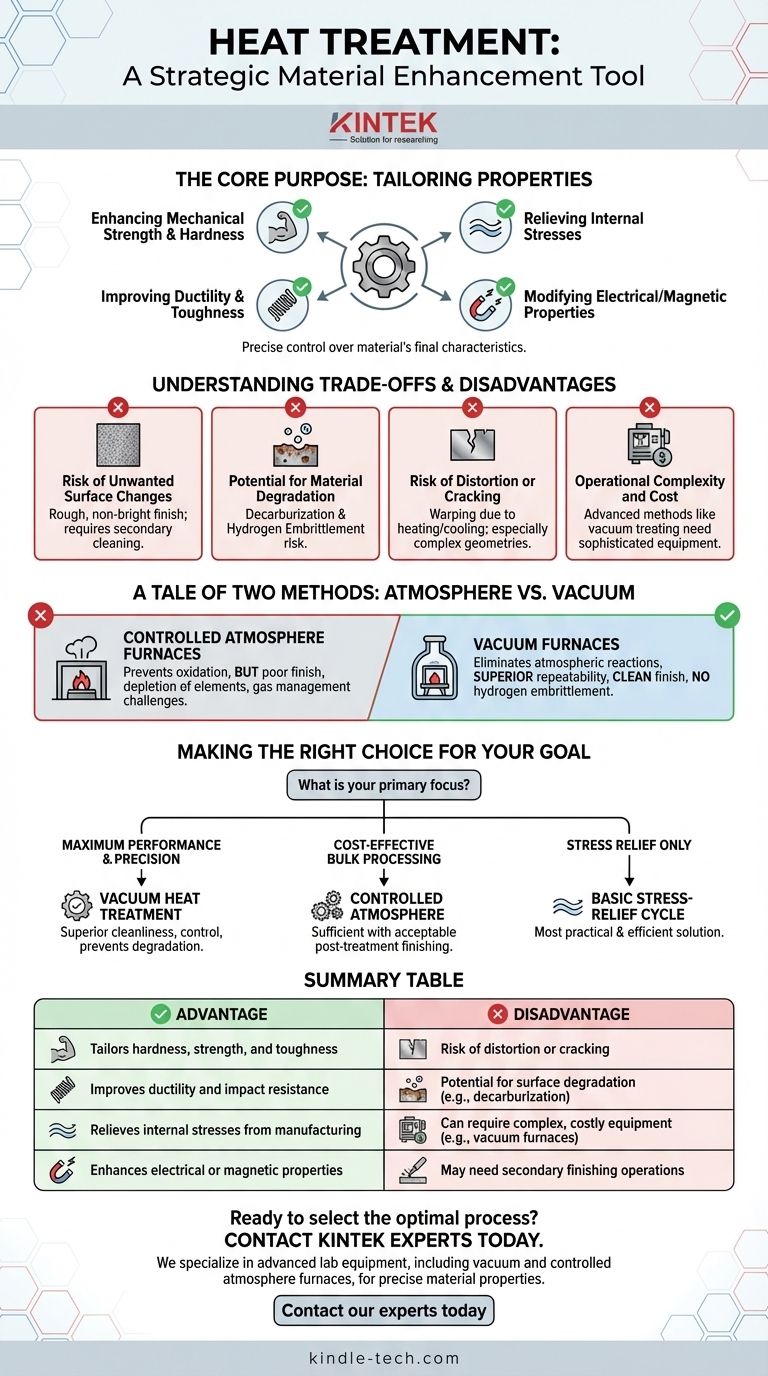
The Core Purpose: Tailoring Material Properties

Heat treatment gives engineers precise control over a material's final characteristics after it has been formed or machined. This allows for an optimal balance of properties that are often mutually exclusive in a raw material.

Enhancing Mechanical Strength and Hardness

A primary goal is to increase a material's strength and its resistance to wear and abrasion. This is critical for components like gears, tools, and bearings that must withstand significant mechanical stress.

Improving Ductility and Toughness

Conversely, some heat treatment processes are designed to soften a material, reduce its brittleness, and increase its toughness. This makes the component less likely to fracture under sudden impact or load.

Relieving Internal Stresses

Manufacturing processes like welding, casting, or heavy machining introduce significant internal stresses into a part. A stress-relief heat treatment cycle can normalize the material, preventing future distortion and making it more stable for subsequent operations.

Modifying Other Key Properties

Beyond mechanical traits, heat treatment can be used to enhance a material's electrical conductivity or magnetic properties, which is essential for components used in motors and electronics.

Understanding the Trade-offs and Disadvantages

The potential downsides of heat treatment are almost always tied to the specific method being used and the level of control applied. Choosing the wrong process for a given material or goal can introduce new problems.

Risk of Unwanted Surface Changes

Traditional methods, such as controlled atmosphere heat treatment, can leave a workpiece with a rough, non-bright surface finish. This often requires secondary cleaning or finishing operations, adding time and cost.

Potential for Material Degradation

Improper atmospheric control can lead to the depletion of key elements from the material's surface, a process known as decarburization in steel. Certain processes also carry the risk of hydrogen embrittlement, which can make high-strength materials brittle and prone to failure.

Risk of Distortion or Cracking

The very nature of heating and cooling materials can cause them to warp, distort, or even crack. This risk is especially high for complex geometries or thin sections if heating and cooling rates are not managed with extreme precision.

Operational Complexity and Cost

Advanced heat treatment methods that mitigate the risks above, such as vacuum treating, require sophisticated and expensive equipment. The processes themselves can be complex, involving challenges with gas management or maintaining a hard vacuum.

A Tale of Two Methods: Atmosphere vs. Vacuum

The evolution from atmosphere-based to vacuum-based heat treatment clearly illustrates the trade-offs.

Controlled Atmosphere Furnaces

This common method uses a controlled gas environment to prevent oxidation. However, as noted, it can result in poor surface finish, deplete surface elements, and presents challenges in managing and recovering the process gases.

Vacuum Furnaces

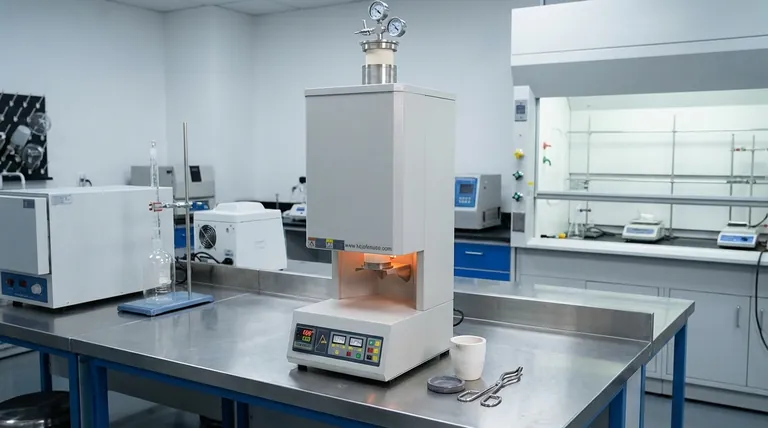
By performing the process in a vacuum, this method eliminates reactions with atmospheric gases entirely. This provides superior repeatability and a clean surface finish. It also completely avoids the risk of hydrogen embrittlement, making it a safer and more reliable choice for critical components.

Making the Right Choice for Your Goal

Selecting the appropriate heat treatment method requires balancing the desired outcome with the acceptable trade-offs in cost, complexity, and final finish.

  • If your primary focus is maximum performance and precision: A process like vacuum heat treatment is the superior choice for its cleanliness, control, and ability to prevent material degradation.
  • If your primary focus is cost-effective bulk processing: A controlled atmosphere process may be sufficient, provided that some post-treatment surface finishing is acceptable.
  • If your primary focus is simply relieving stress after fabrication: A basic stress-relief cycle, which is less complex than hardening or tempering, is often the most practical and efficient solution.

Ultimately, viewing heat treatment as a strategic tool for material enhancement allows you to select the right process that maximizes advantages while minimizing inherent risks.

Summary Table:

Advantage Disadvantage
Tailors hardness, strength, and toughness Risk of distortion or cracking
Improves ductility and impact resistance Potential for surface degradation (e.g., decarburization)
Relieves internal stresses from manufacturing Can require complex, costly equipment (e.g., vacuum furnaces)
Enhances electrical or magnetic properties May need secondary finishing operations

Ready to select the optimal heat treatment process for your materials?

At KINTEK, we specialize in providing advanced lab equipment, including vacuum and controlled atmosphere furnaces, to help you achieve precise material properties while minimizing risks like distortion and surface degradation. Our expertise ensures you get the right balance of performance, cost, and finish for your specific application.

Contact our experts today to discuss your laboratory's heat treatment needs and discover how our solutions can enhance your results.

Visual Guide
What is the advantage and disadvantage of heat treatment? A Guide to Material Enhancement Trade-offs Visual Guide

Related Products

People Also Ask

Related Products

Vacuum Heat Treat Furnace with Ceramic Fiber Liner

Vacuum Heat Treat Furnace with Ceramic Fiber Liner

Vacuum furnace with polycrystalline ceramic fiber insulation liner for excellent heat insulation and uniform temperature field. Choose from 1200℃ or 1700℃ max. working temperature with high vacuum performance and precise temperature control.

1400℃ Controlled Atmosphere Furnace with Nitrogen and Inert Atmosphere

1400℃ Controlled Atmosphere Furnace with Nitrogen and Inert Atmosphere

Achieve precise heat treatment with KT-14A controlled atmosphere furnace. Vacuum sealed with a smart controller, it's ideal for lab and industrial use up to 1400℃.

600T Vacuum Induction Hot Press Furnace for Heat Treat and Sintering

600T Vacuum Induction Hot Press Furnace for Heat Treat and Sintering

Discover the 600T Vacuum Induction Hot Press Furnace, designed for high-temperature sintering experiments in vacuum or protected atmospheres. Its precise temperature and pressure control, adjustable working pressure, and advanced safety features make it ideal for nonmetal materials, carbon composites, ceramics, and metal powders.

High Temperature Constant Temperature Heating Circulator Water Bath Chiller Circulator for Reaction Bath

High Temperature Constant Temperature Heating Circulator Water Bath Chiller Circulator for Reaction Bath

Efficient and reliable, KinTek KHB Heating Circulator is perfect for your lab needs. With a max. heating temperature of up to 300℃, it features accurate temperature control and fast heating.

Double Plate Heating Press Mold for Lab

Double Plate Heating Press Mold for Lab

Discover precision in heating with our Double Plate Heating Mold, featuring high-quality steel and uniform temperature control for efficient lab processes. Ideal for various thermal applications.

50L Heating Chilling Circulator Cooling Water Bath Circulator for High and Low Temperature Constant Temperature Reaction

50L Heating Chilling Circulator Cooling Water Bath Circulator for High and Low Temperature Constant Temperature Reaction

Experience versatile heating, chilling, and circulating capabilities with our KinTek KCBH 50L Heating Chilling Circulator. Ideal for labs and industrial settings, with efficient and reliable performance.

Heated Hydraulic Press Machine with Heated Plates for Vacuum Box Laboratory Hot Press

Heated Hydraulic Press Machine with Heated Plates for Vacuum Box Laboratory Hot Press

Enhance your lab's precision with our lab press for vacuum box. Press pills and powders with ease and precision in a vacuum environment, reducing oxidation and improving consistency. Compact and easy to use with a digital pressure gauge.

Heated Hydraulic Press Machine with Heated Plates Split Manual Laboratory Hot Press

Heated Hydraulic Press Machine with Heated Plates Split Manual Laboratory Hot Press

Efficiently prepare your samples with our Split Manual Heated Lab Press. With a pressure range up to 40T and heating plates up to 300°C, it's perfect for various industries.

Lab Infrared Press Mold

Lab Infrared Press Mold

Easily release samples from our lab infrared press mold for accurate testing. Ideal for battery, cement, ceramics, and other sample preparation research. Customizable sizes available.

Heated Hydraulic Press Machine with Heated Plates for Vacuum Box Laboratory Hot Press

Heated Hydraulic Press Machine with Heated Plates for Vacuum Box Laboratory Hot Press

The lab press for vacuum box is a specialized piece of equipment designed for laboratory use. Its main purpose is to press pills and powders according to specific requirements.

30L Heating Chilling Circulator Cooling Water Bath Circulator for High and Low Temperature Constant Temperature Reaction

30L Heating Chilling Circulator Cooling Water Bath Circulator for High and Low Temperature Constant Temperature Reaction

Get versatile lab performance with KinTek KCBH 30L Heating Chilling Circulator. With max. heating temp of 200℃ and max. chilling temp of -80℃, it's perfect for industrial needs.

Cylindrical Lab Electric Heating Press Mold for Laboratory Applications

Cylindrical Lab Electric Heating Press Mold for Laboratory Applications

Efficiently prepare samples with Cylindrical Lab Electric Heating Press Mold. Fast heating, high temp & easy operation. Custom sizes available. Perfect for battery, ceramic & biochemical research.

100L Heating Chilling Circulator Cooling Water Bath Circulator for High and Low Temperature Constant Temperature Reaction

100L Heating Chilling Circulator Cooling Water Bath Circulator for High and Low Temperature Constant Temperature Reaction

Get all-in-one heating, chilling, and circulating capabilities with our KinTek KCBH 80L Heating Chilling Circulator. High efficiency, reliable performance for labs and industrial applications.

Automatic Heated Hydraulic Press Machine with Heated Plates for Laboratory Hot Press

Automatic Heated Hydraulic Press Machine with Heated Plates for Laboratory Hot Press

The Automatic High Temperature Heat Press is a sophisticated hydraulic hot press designed for efficient temperature control and product quality processing.

20L Heating Chilling Circulator Cooling Water Bath Circulator for High and Low Temperature Constant Temperature Reaction

20L Heating Chilling Circulator Cooling Water Bath Circulator for High and Low Temperature Constant Temperature Reaction

Maximize lab productivity with KinTek KCBH 20L Heating Chilling Circulator. Its all-in-one design offers reliable heating, chilling, and circulating functions for industrial and lab use.

5L Heating Chilling Circulator Cooling Water Bath Circulator for High and Low Temperature Constant Temperature Reaction

5L Heating Chilling Circulator Cooling Water Bath Circulator for High and Low Temperature Constant Temperature Reaction

KinTek KCBH 5L Heating Chilling Circulator - Ideal for labs and industrial conditions with multi-functional design and reliable performance.

Electric Heated Hydraulic Vacuum Heat Press for Lab

Electric Heated Hydraulic Vacuum Heat Press for Lab

The Electric Vacuum Heat Press is a specialized heat press equipment that operates in a vacuum environment, utilizing advanced infrared heating and precise temperature control for high quality, rugged and reliable performance.

Manual High Temperature Heated Hydraulic Press Machine with Heated Plates for Lab

Manual High Temperature Heated Hydraulic Press Machine with Heated Plates for Lab

The High Temperature Hot Press is a machine specifically designed for pressing, sintering and processing materials in a high temperature environment. It is capable of operating in the range of hundreds of degrees Celsius to thousands of degrees Celsius for a variety of high temperature process requirements.

Manual Heated Hydraulic Press Machine with Heated Plates for Laboratory Hot Press

Manual Heated Hydraulic Press Machine with Heated Plates for Laboratory Hot Press

The Manual Heat Press is a versatile piece of equipment suitable for a variety of applications, operated by a manual hydraulic system that applies controlled pressure and heat to the material placed on the piston.

Automatic High Temperature Heated Hydraulic Press Machine with Heated Plates for Lab

Automatic High Temperature Heated Hydraulic Press Machine with Heated Plates for Lab

The High Temperature Hot Press is a machine specifically designed for pressing, sintering and processing materials in a high temperature environment. It is capable of operating in the range of hundreds of degrees Celsius to thousands of degrees Celsius for a variety of high temperature process requirements.


Leave Your Message