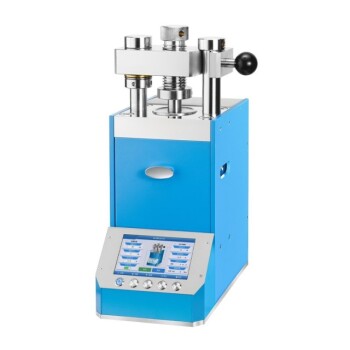
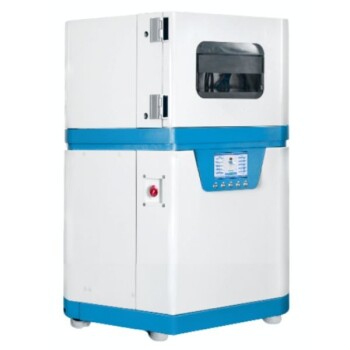
Hot Isostatic Pressing (HIP) fundamentally outperforms atmospheric sintering for zircon-based glass-ceramics by applying heat and omnidirectional gas pressure simultaneously. This dual-action process achieves complete densification, resulting in a pore-free composite matrix that exhibits significantly higher mechanical strength and a lower leaching rate of radionuclides.
The Core Insight: While atmospheric sintering relies primarily on heat to bond particles, often leaving microscopic voids, Hot Isostatic Pressing physically forces the material together from all directions. This creates a nearly perfect, impermeable barrier essential for high-stress or containment applications.
The Mechanics of Superior Densification
Simultaneous Heat and Pressure
Unlike atmospheric sintering, which occurs at ambient pressure, HIP subjects the material to elevated temperatures while compressing it with gas.
Eliminating Porosity
The primary limitation of atmospheric sintering is residual porosity—small air gaps left between particles.
HIP creates a pore-free structure. The omnidirectional pressure collapses internal voids, ensuring the glass and oxide mixtures are completely densified.
Homogeneous Microstructure
The process promotes a uniform internal structure. By squeezing out impurities and preventing segregation, HIP creates a consistent matrix without the structural weak points often found in cast or sintered materials.
Performance Advantages Over Atmospheric Sintering
Significantly Higher Mechanical Strength
Porosity acts as a crack initiation point in ceramics. Because HIP removes these defects, the resulting material is far more robust.
The densified matrix provides superior static and dynamic strength, making the ceramic capable of withstanding higher loads and stress without fracturing.
Enhanced Environmental Safety
For zircon-based glass-ceramics, particularly those used for waste immobilization, containment is critical.
HIP-synthesized materials demonstrate a lower leaching rate of radionuclides into the environment. The lack of interconnected pores prevents fluids from penetrating the matrix and extracting hazardous elements.
Understanding the Trade-offs
Process Complexity vs. Material Integrity
While HIP produces superior results, it is inherently more complex than atmospheric sintering.
Atmospheric sintering is generally faster and less equipment-intensive. However, it sacrifices maximum density. HIP requires specialized pressurized vessels and longer cycle times to achieve its near-perfect consolidation.
When "Good Enough" Isn't Enough
If the application tolerates minor porosity, atmospheric sintering is cost-effective. However, for critical components—such as nuclear waste forms or structural parts in extreme environments—the defects inherent in atmospheric sintering can lead to catastrophic failure, making HIP the necessary choice.
Making the Right Choice for Your Goal
To decide between these synthesis methods, evaluate your primary performance criteria:
- If your primary focus is Environmental Safety (Waste Containment): Choose HIP to ensure minimum leaching of radionuclides through a pore-free, impermeable matrix.
- If your primary focus is Structural Reliability: Choose HIP to maximize mechanical strength and fatigue resistance by eliminating internal voids that cause fractures.
- If your primary focus is Cost and Speed: Choose Atmospheric Sintering if the component is non-critical and can tolerate lower density and minor internal porosity.
Ultimately, HIP is the definitive solution when the integrity of the material is non-negotiable.
Summary Table:
| Feature | Atmospheric Sintering | Hot Isostatic Pressing (HIP) |
|---|---|---|
| Pressure Type | Ambient (1 atm) | Omnidirectional Gas Pressure |
| Porosity | Residual Microscopic Voids | Zero/Pore-Free Structure |
| Density | Moderate | Maximum Theoretical Density |
| Mechanical Strength | Lower (crack-prone) | Significantly Higher/Robust |
| Leaching Resistance | Higher (interconnected pores) | Superior (impermeable barrier) |
| Ideal Application | Low-cost, Non-critical Parts | High-stress & Waste Containment |
Elevate Your Material Integrity with KINTEK Solutions
When your research or production demands non-negotiable structural reliability and perfect densification, KINTEK’s advanced processing technology delivers. We specialize in high-performance laboratory equipment, including Hot Isostatic Presses (HIP), hydraulic presses, and high-temperature furnaces designed for the most rigorous synthesis requirements.
Whether you are immobilizing radionuclides or developing high-strength zircon-based ceramics, our expertise in high-temperature high-pressure reactors and crushing/milling systems ensures your materials meet the highest standards of safety and performance.
Ready to eliminate porosity and maximize mechanical strength? Contact KINTEK today to find the perfect HIP or sintering solution for your lab!
References
- S. V. Yudintsev, V. I. Malkovsky. Thermal Effects and Glass Crystallization in Composite Matrices for Immobilization of the Rare-Earth Element–Minor Actinide Fraction of High-Level Radioactive Waste. DOI: 10.3390/jcs8020070
This article is also based on technical information from Kintek Solution Knowledge Base .
Related Products
- Warm Isostatic Press for Solid State Battery Research
- Electric Split Lab Cold Isostatic Press CIP Machine for Cold Isostatic Pressing
- Manual Cold Isostatic Pressing Machine CIP Pellet Press
- Automatic High Temperature Heated Hydraulic Press Machine with Heated Plates for Lab
- Isostatic Molding Pressing Molds for Lab
People Also Ask
- What is the temperature of a warm isostatic press? Achieve Optimal Densification for Your Materials
- What is the function of a Warm Isostatic Press (WIP) in all-solid-state pouch cells? Optimize Battery Density
- Why are Warm Isostatic Presses (WIP) necessary for solid-state batteries? Achieve Atomic-Level Contact
- What advantages does a warm isostatic press offer over a traditional uniaxial press for Li6PS5Cl electrolyte sheets?
- How do warm isostatic presses improve dry electrode performance? Enhance ASSB Conductivity with Heat & Pressure