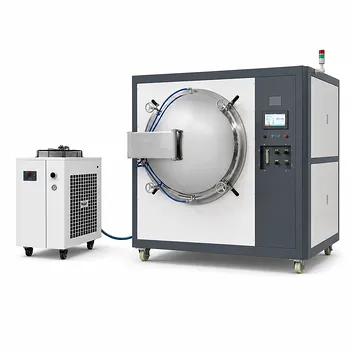
The primary advantage of using a vacuum hot pressing sintering furnace for nanocrystalline Fe3Al is the ability to achieve high material density while preserving the delicate nanostructure. By applying axial mechanical pressure simultaneously with heat, this method forces particle consolidation through plastic flow and diffusion, bypassing the need for the prolonged high-temperature exposure that typically destroys nanocrystalline properties in conventional furnaces.
Core Takeaway Conventional sintering relies solely on thermal energy to close pores, which often leads to excessive grain growth before full density is reached. Vacuum hot pressing substitutes thermal energy with mechanical force (pressure), allowing for rapid densification that "locks in" the nanocrystalline structure before the grains have time to coarsen.
The Mechanics of Pressure-Assisted Sintering
Simultaneous Heat and Pressure
Unlike conventional furnaces that rely only on temperature, a vacuum hot press applies significant axial pressure (e.g., 25 MPa) while heating the material to temperatures such as 1200°C.
Promoting Plastic Flow
The applied mechanical force acts as a catalyst for densification. It actively promotes plastic flow and accelerates diffusion between the Fe3Al particles.
Rapid Pore Elimination
This pressure-assisted mechanism physically forces particles to rearrange and deform. This effectively closes internal pores and bridges gaps between particles much faster than thermal sintering alone.
Achieving High Density
The result is a bulk material with a density exceeding 96%. This level of consolidation is difficult to achieve in conventional sintering without utilizing temperatures or durations that would degrade the material.
Preserving Nanocrystalline Characteristics
The Grain Growth Challenge
In nanostructured materials, the primary risk during processing is "coarsening," where small grains merge into larger ones. This destroys the unique mechanical properties associated with the nano-scale structure.
Inhibiting Grain Growth
Vacuum hot pressing effectively inhibits excessive grain growth. Because the mechanical pressure drives densification, the process requires less time at peak temperature compared to conventional methods.
Short Sintering Duration
The efficiency of the pressure-assisted diffusion allows the material to reach full density in a relatively short time. This limited thermal exposure ensures the Fe3Al retains its nanocrystalline structural characteristics.
The Role of the Vacuum Environment
Oxidation Prevention
While pressure handles the density, the vacuum environment is critical for purity. It prevents the oxidation of metallic elements (Iron and Aluminum) which are reactive at high temperatures.
Gas Removal
The vacuum aids in removing adsorbed gases from the powder surface. This elimination of impurities further contributes to the elimination of pores and the overall structural integrity of the bulk material.
Understanding the Trade-offs
Geometry Limitations
Vacuum hot pressing typically utilizes uniaxial pressure (pressure from one direction). This limits the production capability to simple shapes like discs or cylinders, whereas conventional sintering can handle complex geometries.
Production Throughput
This process is generally a batch operation, meaning parts are processed one at a time or in small stacks. It offers superior material properties but generally has a lower throughput compared to continuous conventional sintering furnaces.
Making the Right Choice for Your Goal
If you are deciding between a conventional furnace and a vacuum hot press for Fe3Al, consider the following:
- If your primary focus is strictly maintaining the nanocrystalline structure: The vacuum hot press is the superior choice because it achieves density quickly before grains can grow.
- If your primary focus is maximizing density (eliminating porosity): The vacuum hot press is recommended as it uses mechanical force to physically close pores that thermal energy might miss.
- If your primary focus is complex part geometry: You may face limitations with hot pressing and might need to consider if a slightly lower density or coarser grain structure (via conventional sintering) is acceptable for your design.
Summary: Vacuum hot pressing is the definitive method for consolidating nanocrystalline Fe3Al when the priority is achieving near-theoretical density without sacrificing the material's nano-scale microstructure.
Summary Table:
| Feature | Vacuum Hot Pressing Furnace | Conventional Sintering Furnace |
|---|---|---|
| Primary Force | Heat + Axial Mechanical Pressure | Thermal Energy Only |
| Densification Level | High (>96% Density) | Variable (Harder to reach full density) |
| Microstructure | Preserves Nanocrystalline Structure | Risks Excessive Grain Coarsening |
| Sintering Time | Short (Rapid Densification) | Prolonged |
| Environment | Vacuum (Prevents Oxidation) | Varies (Often Atmospheric/Inert) |
| Part Geometry | Simple Shapes (Discs, Cylinders) | Complex Geometries Possible |
Elevate Your Material Research with KINTEK Precision
Unlock the full potential of your advanced materials with KINTEK’s high-performance vacuum hot pressing systems. Whether you are working on nanocrystalline Fe3Al or complex alloys, our furnaces provide the precise control over pressure and temperature needed to achieve near-theoretical density without sacrificing microstructure.
Our laboratory expertise includes:
- Advanced Furnaces: Vacuum, hot pressing, muffle, tube, and CVD/PECVD systems.
- Processing Equipment: Crushing, milling, and high-pressure hydraulic presses.
- Specialized Reactors: High-temperature high-pressure reactors and autoclaves.
- Lab Consumables: High-purity ceramics, crucibles, and PTFE products.
Don't let grain growth compromise your results. Contact our technical experts today to find the perfect sintering solution for your lab!
Related Products
- 600T Vacuum Induction Hot Press Furnace for Heat Treat and Sintering
- Vacuum Heat Treat and Sintering Furnace with 9MPa Air Pressure
- Vacuum Heat Treat and Pressure Sintering Furnace for High Temperature Applications
- 2200 ℃ Tungsten Vacuum Heat Treat and Sintering Furnace
- Vacuum Hot Press Furnace Heated Vacuum Press Machine Tube Furnace
People Also Ask
- What role does an induction vacuum hot pressing furnace play in sintering? Achieve 98% Density in Carbide Blocks
- What advantages does a vacuum hot press furnace provide for LSLBO ceramic electrolytes? Achieve 94% Relative Density
- What role does a Vacuum Hot Press (VHP) furnace play in the densification of austenitic stainless steel 316 composites?
- What are the advantages of a vacuum hot press furnace for W-50%Cu? Achieve 99.6% Density at Lower Temperatures
- What role does mechanical pressure play during the vacuum diffusion bonding of tungsten and copper? Keys to Solid Bonding