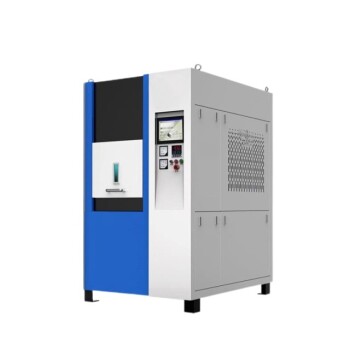
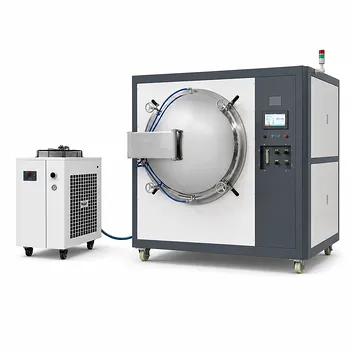
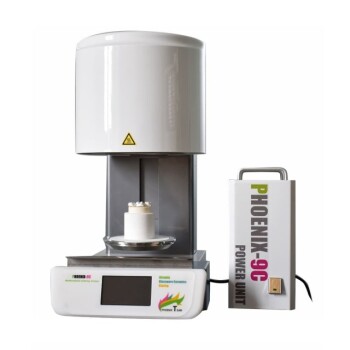
The core function of a hot-pressing sintering furnace is to generate a superior sintering driving force by simultaneously applying high thermal energy and uniaxial mechanical pressure.
By subjecting the silicon nitride powder to temperatures around 1680°C while exerting physical pressure of 20-30 MPa, the furnace forces particle consolidation far more effectively than heat alone. This mechanical advantage allows for the production of ceramics with near-theoretical density and exceptional mechanical properties.
The hot-pressing process leverages external pressure to mechanically accelerate particle rearrangement and phase transformation, enabling the production of high-density silicon nitride at significantly lower temperatures than conventional pressureless methods.
The Mechanics of Densification
Simultaneous Heat and Pressure
Unlike conventional sintering, which relies solely on thermal energy to bond particles, hot-pressing introduces a second variable: uniaxial mechanical pressure.
The powder is typically placed in a graphite press mold where it undergoes heating and pressing at the same time. This combination provides a massive driving force that overcomes the natural resistance of the material to densify.
Accelerating Particle Rearrangement
The applied external pressure physically forces ceramic particles to slide past one another and pack more tightly.
This mechanical compression significantly accelerates particle rearrangement, reducing the time and temperature required to eliminate voids between granules.
Impact on Microstructure
Promoting Phase Transformation
High-density silicon nitride relies on a specific crystalline structure for its strength.
Hot-pressing speeds up the critical phase transformation from alpha-Si3N4 to long rod-shaped beta-Si3N4. These rod-shaped grains act like reinforcing fibers within the material, drastically improving its fracture toughness and strength.
Eliminating Porosity via Liquid Phase
During sintering, a liquid phase forms between the solid ceramic particles.
The external pressure promotes the flow of this liquid phase, forcing it to fill microscopic pores and voids throughout the structure. This results in a final product with near-theoretical density, virtually eliminating the porosity that weakens standard ceramics.
Understanding the Trade-offs
Process Complexity and Cost
While hot-pressing yields superior material properties, it introduces significant complexity compared to pressureless sintering.
The requirement for specialized graphite molds and the inability to process parts in a continuous flow make this a batch process, often leading to higher production costs.
Geometric Limitations
The nature of uniaxial pressure (pressure applied in a single direction) imposes constraints on the shapes that can be produced.
This method is ideal for simple geometries like plates or discs. Complex shapes with undercuts or intricate details are difficult to form evenly using a uniaxial hot press and may require alternative methods like Gas Pressure Sintering (GPS) or post-machining.
Making the Right Choice for Your Goal
When evaluating sintering methods for silicon nitride, consider your specific performance requirements:
- If your primary focus is maximum mechanical strength: Hot-pressing is the optimal choice, as the driving force ensures near-perfect density and ideal grain structure.
- If your primary focus is complex part geometry: You may need to assess if the simple shapes allowed by uniaxial pressing can be machined into your final form, or if a gas-pressure method is more suitable.
Ultimately, hot-pressing is the definitive solution when microstructural integrity and density cannot be compromised.
Summary Table:
| Feature | Hot-Pressing Sintering | Conventional Sintering |
|---|---|---|
| Driving Force | Thermal Energy + Uniaxial Pressure | Thermal Energy Only |
| Densification | Near-Theoretical (High) | Standard |
| Microstructure | Rod-shaped β-Si3N4 grains | Varies by temperature |
| Typical Pressure | 20-30 MPa | Atmospheric |
| Ideal Geometry | Simple shapes (plates, discs) | Complex shapes |
| Main Advantage | Maximum mechanical strength | Lower production cost |
Elevate Your Material Performance with KINTEK Precision
Unlock the full potential of your ceramic research and production with KINTEK’s advanced thermal processing solutions. Whether you are aiming for near-theoretical density in silicon nitride or developing next-generation composites, our hot-pressing sintering furnaces and hydraulic presses provide the precise control you need.
KINTEK specializes in a comprehensive range of laboratory equipment designed for high-performance environments, including:
- High-temperature furnaces (Muffle, Tube, Vacuum, and CVD/PECVD)
- Advanced Sintering Systems (Hot-pressing and Spark Plasma Sintering)
- Crushing, milling, and sieving equipment for powder preparation
- Consumables (Graphite molds, ceramics, and crucibles)
Ready to achieve superior microstructural integrity? Contact our technical experts today to find the perfect sintering solution tailored to your specific material requirements and laboratory goals.
Related Products
- 600T Vacuum Induction Hot Press Furnace for Heat Treat and Sintering
- Vacuum Heat Treat and Pressure Sintering Furnace for High Temperature Applications
- Vacuum Heat Treat and Sintering Furnace with 9MPa Air Pressure
- 2200 ℃ Tungsten Vacuum Heat Treat and Sintering Furnace
- High Temperature Muffle Oven Furnace for Laboratory Debinding and Pre Sintering
People Also Ask
- What role does an induction vacuum hot pressing furnace play in sintering? Achieve 98% Density in Carbide Blocks
- What advantages does a vacuum hot press furnace provide for LSLBO ceramic electrolytes? Achieve 94% Relative Density
- What role does a Vacuum Hot Press (VHP) furnace play in the densification of austenitic stainless steel 316 composites?
- What role does mechanical pressure play during the vacuum diffusion bonding of tungsten and copper? Keys to Solid Bonding
- What are the advantages of a vacuum hot press furnace for W-50%Cu? Achieve 99.6% Density at Lower Temperatures