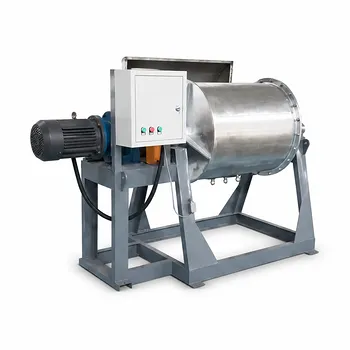
The critical function of a high-energy ball milling system is to drive the mechanical alloying process through the application of intense high-frequency impact and shear forces. This equipment physically forces alloying elements—specifically Yttrium (Y), Titanium (Ti), and Oxygen (O)—into a solid solution or a uniform distribution within an iron-based matrix.
By enabling atomic-level mixing that is impossible through standard melting, high-energy ball milling creates the precursor state required to form high-density, ultra-fine Y-Ti-O nano-clusters, which are the defining feature responsible for the alloy's performance.
The Mechanics of Atomic Integration
Generating Impact and Shear Forces
The primary mechanism of the ball milling system involves subjecting metal powders to extreme mechanical energy. The system utilizes high-frequency impacts to repeatedly fracture and cold-weld the powder particles.
Forcing Solid Solution
Under normal equilibrium conditions, elements like Yttrium and Titanium may not dissolve easily into an iron matrix. The high mechanical energy overrides these thermodynamic barriers, forcing these elements and Oxygen into a solid solution.
Achieving Uniform Distribution
This process ensures a homogeneous dispersion of elements at the nanometric level. It prevents the clumping of oxide particles, ensuring that the foundational components are evenly spread throughout the ferritic matrix.
The Consequence: Nano-Oxide Formation
Creating Ultra-Fine Particles
The direct output of this mechanical alloying phase is the formation of Y-Ti-O rich nano-oxide particles. These particles are exceptionally small, measuring less than 5 nm in diameter.
Achieving High Particle Density
The process is tuned to achieve a specific particle density, approximately 6 x 10^23 m^-3. This high density is critical for arresting dislocation movement within the material.
Enhancing Reactivity
Beyond mixing, the milling process introduces significant microscopic defects into the powder. This increases the internal energy and reactivity of the material, establishing a necessary foundation for successful densification during the subsequent sintering stage.
Understanding the Critical Dependencies
The Link to Thermal Stability
The uniform distribution of nano-oxides acts as a pinning mechanism within the alloy's microstructure. Without the intensive milling stage, these particles would not form correctly, compromising the material's ability to withstand high temperatures.
The Basis for Radiation Resistance
The specific size and density of the Y-Ti-O particles are what grant 14YWT alloys their resistance to radiation damage. The milling process is the sole determinant of this microstructure; if the milling is insufficient, the radiation resistance is lost.
Making the Right Choice for Your Goal
The effectiveness of your 14YWT preparation hinges on how well the ball milling process controls the dispersion of Yttrium, Titanium, and Oxygen.
- If your primary focus is Radiation Resistance: Ensure the milling energy is sufficient to drive the particle size down to <5 nm, as this specific scale is required to mitigate radiation-induced defects.
- If your primary focus is Sintering Density: Focus on the introduction of microscopic defects during milling, as this increased reactivity is essential for achieving full densification in the final consolidation steps.
The high-energy ball milling system is not merely a mixer; it is a reactor that synthesizes the microstructure required for extreme-environment performance.
Summary Table:
| Process Mechanism | Key Function & Impact | Desired Outcome for 14YWT |
|---|---|---|
| Mechanical Alloying | High-frequency impact & shear forces | Atomic-level solid solution of Y, Ti, and O |
| Particle Size Control | Repeated fracture and cold-welding | Ultra-fine Y-Ti-O clusters (<5 nm) |
| Dispersion Control | Homogeneous distribution in Fe matrix | High particle density (6 x 10^23 m^-3) |
| Defect Introduction | Increasing internal energy/reactivity | Enhanced sintering density & thermal stability |
Elevate Your Material Synthesis with KINTEK Precision
Achieving the extreme-environment performance required for 14YWT alloys demands more than just mixing—it requires a high-performance high-energy ball milling system that can precisely control microstructure at the nanometric level.
KINTEK specializes in advanced laboratory equipment, including robust crushing and milling systems, high-temperature furnaces, and hydraulic presses designed for the rigorous demands of nuclear and aerospace material research. Our solutions empower you to reach critical particle densities and superior radiation resistance with ease.
Ready to optimize your alloy preparation? Contact our technical experts today to find the perfect milling and sintering solutions for your laboratory's needs.
References
- Eda Aydogan, S.A. Maloy. Effect of High-Density Nanoparticles on Recrystallization and Texture Evolution in Ferritic Alloys. DOI: 10.3390/cryst9030172
This article is also based on technical information from Kintek Solution Knowledge Base .
Related Products
- High-Energy Omnidirectional Planetary Ball Mill Milling Machine for Laboratory
- High Energy Planetary Ball Mill Milling Machine for Laboratory
- High Energy Planetary Ball Mill Milling Machine for Laboratory
- High Energy Planetary Ball Mill for Laboratory Horizontal Tank Type Milling Machine
- High-Energy Omnidirectional Planetary Ball Mill Machine for Laboratory
People Also Ask
- What is the role of a planetary ball mill in preparing doped high-nickel cathode materials? Enhance Battery Stability
- How does a planetary ball mill solve mixing challenges with PEO? Unlock solid-state synthesis for insoluble dopants
- Why is a planetary ball mill used for LNMO precursor powders? Optimize Particle Uniformity & Battery Performance
- What is the function of a planetary ball mill in the solid-state synthesis of LiTa2PO8? Achieve High-Purity Electrolytes
- What is the role of a planetary ball mill in sulfide-based solid-state batteries? Engineer High-Performance Cathodes