Knowledge muffle furnace What is the difference between electric oven and muffle furnace? Choose the Right High-Temp Lab Equipment
Author avatar

Tech Team · Kintek Solution

Updated 2 months ago

What is the difference between electric oven and muffle furnace? Choose the Right High-Temp Lab Equipment


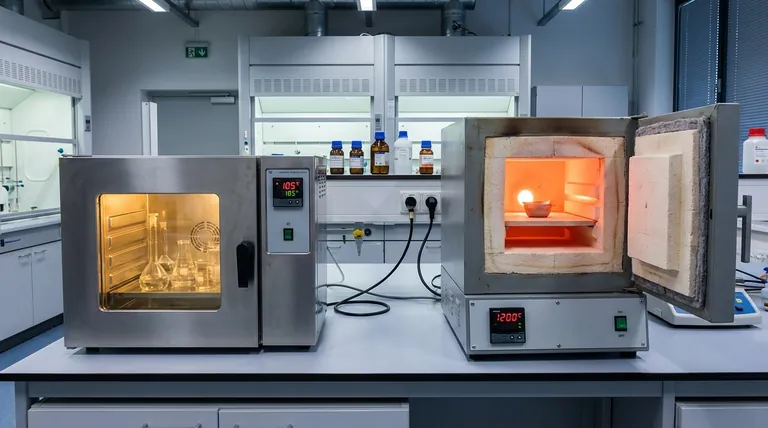
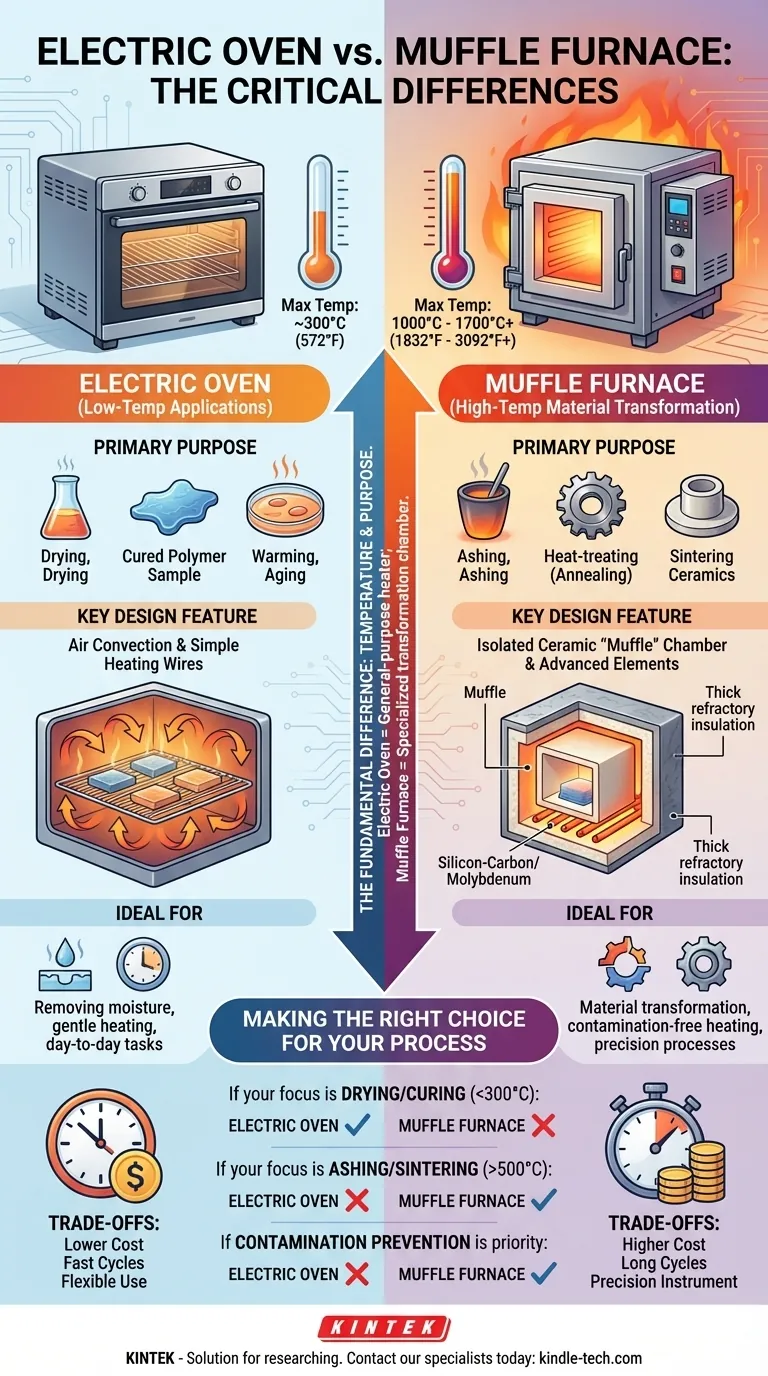
At their core, an electric oven and a muffle furnace are distinguished by their maximum temperature and fundamental design purpose. While both use electricity to generate heat, an electric oven is designed for low-temperature applications like drying and warming, whereas a muffle furnace is a specialized instrument built for high-temperature material processing and transformation.

The critical difference lies not in the power source, but in the purpose. An electric oven is a general-purpose heater, while a muffle furnace is a high-temperature, contamination-free chamber designed to fundamentally change the properties of the materials placed inside it.
What is the difference between electric oven and muffle furnace? Choose the Right High-Temp Lab Equipment

The Fundamental Difference: Temperature and Purpose

The most significant distinction between these two devices is the temperature range they operate in and the tasks they are designed to perform.

Electric Ovens: Low-Temperature Applications

An electric laboratory oven, often called a drying or convection oven, typically operates in a range from slightly above ambient temperature up to around 300°C (572°F).

Their primary function is not to alter the chemical nature of a substance but to perform tasks like drying glassware, removing moisture from samples, curing polymers, or conducting gentle aging tests.

Muffle Furnaces: High-Temperature Material Transformation

A muffle furnace is engineered for extremely high temperatures, commonly starting around 1000°C and capable of reaching 1700°C (3092°F) or higher.

Their purpose is to induce significant chemical or physical changes in a material. Common applications include ashing samples to determine inorganic content, heat-treating metals (annealing), and sintering ceramics.

A Closer Look at Design and Construction

The dramatic difference in temperature capability is a direct result of fundamental differences in how each device is built.

The "Muffle": Isolating the Sample

The defining feature of a muffle furnace is the "muffle" itself—an inner chamber, typically made of high-temperature ceramic.

This chamber isolates the sample from the raw heating elements. This design serves two critical functions: it prevents any contamination of the sample from the elements and ensures incredibly uniform heating through radiation within the chamber.

Heating Elements and Insulation

Electric ovens use simple heating wires, but muffle furnaces require more advanced components to reach and sustain extreme temperatures.

According to temperature requirements, these can be electric heating wires (up to 1200°C), silicon-carbon rods (up to 1400°C), or silicon molybdenum rods (up to 1700°C). This is paired with thick, multi-layered refractory insulation to contain the intense heat safely and efficiently.

Atmosphere Control

In a standard oven, air is simply circulated, meaning any fumes or outgassing from samples is spread throughout the chamber.

In a muffle furnace, the isolated muffle provides a more controlled environment. This is essential for processes where reacting with atmospheric gases or contaminants from heating elements would ruin the result.

Understanding the Trade-offs

Choosing the wrong instrument is not just inefficient; it can compromise your results.

Cost and Energy Consumption

Muffle furnaces are significantly more expensive to purchase and operate. Reaching and maintaining temperatures over 1000°C requires a tremendous amount of electrical energy compared to the modest needs of a 200°C oven.

Process Time and Flexibility

Due to their massive thermal insulation, muffle furnaces have very long heat-up and cool-down cycles. They are typically used for long, pre-programmed batch processes.

An electric oven, by contrast, heats and cools relatively quickly, making it more flexible for varied, day-to-day laboratory tasks.

Precision vs. General Use

Using a muffle furnace for a simple drying task is extreme overkill. It is an inefficient use of a precision instrument. Likewise, attempting to ash a sample in a standard lab oven is impossible, as it simply cannot generate the required heat.

Making the Right Choice for Your Process

Your choice should be dictated entirely by the temperature and environmental control your specific process requires.

  • If your primary focus is drying, curing, or sterilizing below 300°C: An electric laboratory oven is the correct and most efficient choice.
  • If your primary focus is determining ash content, heat-treating metals, or sintering ceramics (above 500°C): You require a muffle furnace for its high-temperature capability.
  • If preventing sample contamination from heating elements is your top priority: The isolated chamber of a muffle furnace is non-negotiable, even for lower-temperature applications.

Understanding this distinction ensures you select not just a heating device, but the precise instrument your scientific process demands.

Summary Table:

Feature Electric Laboratory Oven Muffle Furnace
Primary Purpose Drying, curing, warming Ashing, heat-treating, sintering
Max Temperature ~300°C (572°F) 1000°C - 1700°C+ (1832°F - 3092°F+)
Key Design Feature Air convection Isolated ceramic muffle chamber
Ideal For Removing moisture, gentle heating Material transformation, contamination-free heating

Still unsure which heating equipment is right for your lab's specific processes?

KINTEK specializes in precision lab equipment and consumables, serving diverse laboratory needs. Our experts can help you select the perfect instrument—whether a standard electric oven for drying or a high-temperature muffle furnace for advanced material testing—ensuring efficiency, accuracy, and safety for your applications.

Contact our specialists today for a personalized consultation and discover the right solution for your laboratory!

Visual Guide
What is the difference between electric oven and muffle furnace? Choose the Right High-Temp Lab Equipment Visual Guide

Related Products

People Also Ask

Related Products

1200℃ Muffle Furnace Oven for Laboratory

1200℃ Muffle Furnace Oven for Laboratory

Upgrade your lab with our 1200℃ Muffle Furnace. Achieve fast, precise heating with Japan alumina fibers and Molybdenum coils. Features TFT touch screen controller for easy programming and data analysis. Order now!

1800℃ Muffle Oven Furnace for Laboratory

1800℃ Muffle Oven Furnace for Laboratory

KT-18 muffle furnace with Japan Al2O3 polycrystalline fibe and Silicon Molybdenum heating element, up to 1900℃, PID temperature control and 7" smart touch screen. Compact design, low heat loss, and high energy efficiency. Safety interlock system and versatile functions.

1400℃ Muffle Oven Furnace for Laboratory

1400℃ Muffle Oven Furnace for Laboratory

Get precise high-temperature control up to 1500℃ with KT-14M Muffle furnace. Equipped with a smart touch screen controller and advanced insulation materials.

1700℃ Muffle Oven Furnace for Laboratory

1700℃ Muffle Oven Furnace for Laboratory

Get superior heat control with our 1700℃ Muffle Furnace. Equipped with intelligent temperature microprocessor, TFT touch screen controller & advanced insulation materials for precise heating up to 1700C. Order now!

High Temperature Muffle Oven Furnace for Laboratory Debinding and Pre Sintering

High Temperature Muffle Oven Furnace for Laboratory Debinding and Pre Sintering

KT-MD High temperature debinding and pre-sintering furnace for ceramic materials with various molding processes. Ideal for electronic components such as MLCC and NFC.

Laboratory Muffle Oven Furnace Bottom Lifting Muffle Furnace

Laboratory Muffle Oven Furnace Bottom Lifting Muffle Furnace

Efficiently produce batches with excellent temperature uniformity using our Bottom Lifting Furnace. Features two electric lifting stages and advanced temperature control up to 1600℃.

Molybdenum Vacuum Heat Treat Furnace

Molybdenum Vacuum Heat Treat Furnace

Discover the benefits of a high-configuration molybdenum vacuum furnace with heat shield insulation. Ideal for high-purity, vacuum environments like sapphire crystal growth and heat treatment.

Multi-zone Laboratory Tube Furnace

Multi-zone Laboratory Tube Furnace

Experience precise, efficient thermal testing with our Multi Zone Tube Furnace. Independent heating zones and temperature sensors allow for controlled high-temperature gradient heating fields. Order now for advanced thermal analysis!

Ultra-High Temperature Graphite Vacuum Graphitization Furnace

Ultra-High Temperature Graphite Vacuum Graphitization Furnace

The ultra-high temperature graphitization furnace utilizes medium frequency induction heating in a vacuum or inert gas environment. The induction coil generates an alternating magnetic field, inducing eddy currents in the graphite crucible, which heats up and radiates heat to the workpiece, bringing it to the desired temperature. This furnace is primarily used for graphitization and sintering of carbon materials, carbon fiber materials, and other composite materials.

Vacuum Hot Press Furnace Machine Heated Vacuum Press

Vacuum Hot Press Furnace Machine Heated Vacuum Press

Discover the advantages of Vacuum Hot Press Furnace! Manufacture dense refractory metals & compounds, ceramics, and composites under high temp and pressure.

Vacuum Heat Treat and Molybdenum Wire Sintering Furnace for Vacuum Sintering

Vacuum Heat Treat and Molybdenum Wire Sintering Furnace for Vacuum Sintering

A vacuum molybdenum wire sintering furnace is a vertical or bedroom structure, which is suitable for withdrawal, brazing, sintering and degassing of metal materials under high vacuum and high temperature conditions. It is also suitable for dehydroxylation treatment of quartz materials.

Multi Heating Zones CVD Tube Furnace Machine Chemical Vapor Deposition Chamber System Equipment

Multi Heating Zones CVD Tube Furnace Machine Chemical Vapor Deposition Chamber System Equipment

KT-CTF14 Multi Heating Zones CVD Furnace - Precise Temperature Control and Gas Flow for Advanced Applications. Max temp up to 1200℃, 4 channels MFC mass flow meter, and 7" TFT touch screen controller.

Graphite Vacuum Furnace High Thermal Conductivity Film Graphitization Furnace

Graphite Vacuum Furnace High Thermal Conductivity Film Graphitization Furnace

The high thermal conductivity film graphitization furnace has uniform temperature, low energy consumption and can operate continuously.

600T Vacuum Induction Hot Press Furnace for Heat Treat and Sintering

600T Vacuum Induction Hot Press Furnace for Heat Treat and Sintering

Discover the 600T Vacuum Induction Hot Press Furnace, designed for high-temperature sintering experiments in vacuum or protected atmospheres. Its precise temperature and pressure control, adjustable working pressure, and advanced safety features make it ideal for nonmetal materials, carbon composites, ceramics, and metal powders.

Lab-Scale Vacuum Induction Melting Furnace

Lab-Scale Vacuum Induction Melting Furnace

Get precise alloy composition with our Vacuum Induction Melting Furnace. Ideal for aerospace, nuclear energy, and electronic industries. Order now for effective smelting and casting of metals and alloys.

Horizontal High Temperature Graphite Vacuum Graphitization Furnace

Horizontal High Temperature Graphite Vacuum Graphitization Furnace

Horizontal Graphitization Furnace: This type of furnace is designed with the heating elements placed horizontally, allowing for uniform heating of the sample. It's well-suited for graphitizing large or bulky samples that require precise temperature control and uniformity.

Mesh belt controlled atmosphere furnace

Mesh belt controlled atmosphere furnace

Discover our KT-MB mesh belt sintering furnace - perfect for high-temperature sintering of electronic components & glass insulators. Available for open air or controlled atmosphere environments.

Vacuum Heat Treat and Pressure Sintering Furnace for High Temperature Applications

Vacuum Heat Treat and Pressure Sintering Furnace for High Temperature Applications

Vacuum pressure sintering furnaces are designed for high temperature hot pressing applications in metal and ceramic sintering. Its advanced features ensure precise temperature control, reliable pressure maintenance, and a robust design for seamless operation.

Vacuum Sealed Continuous Working Rotary Tube Furnace Rotating Tube Furnace

Vacuum Sealed Continuous Working Rotary Tube Furnace Rotating Tube Furnace

Experience efficient material processing with our vacuum-sealed rotary tube furnace. Perfect for experiments or industrial production, equipped with optional features for controlled feeding and optimized results. Order now.

1200℃ Controlled Atmosphere Furnace Nitrogen Inert Atmosphere Furnace

1200℃ Controlled Atmosphere Furnace Nitrogen Inert Atmosphere Furnace

Discover our KT-12A Pro Controlled atmosphere furnace - high precision, heavy duty vacuum chamber, versatile smart touch screen controller, and excellent temperature uniformity up to 1200C. Ideal for both laboratory and industrial application.


Leave Your Message



















