Knowledge What is the difference between gravity and pre vacuum autoclave? Choose the Right Sterilization Method
Author avatar

Tech Team · Kintek Solution

Updated 6 days ago

What is the difference between gravity and pre vacuum autoclave? Choose the Right Sterilization Method


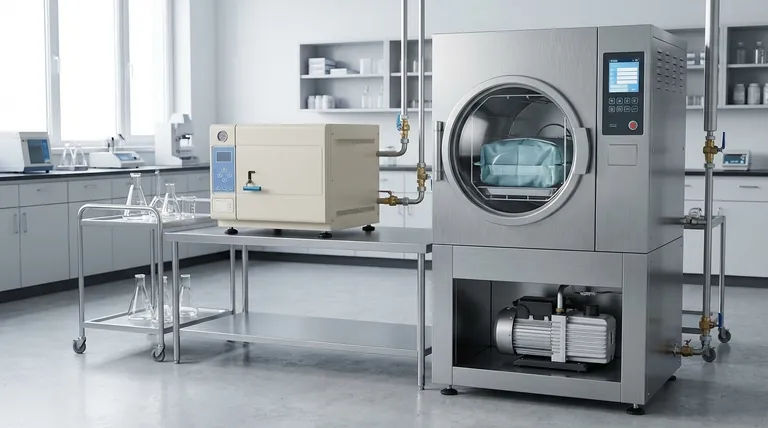
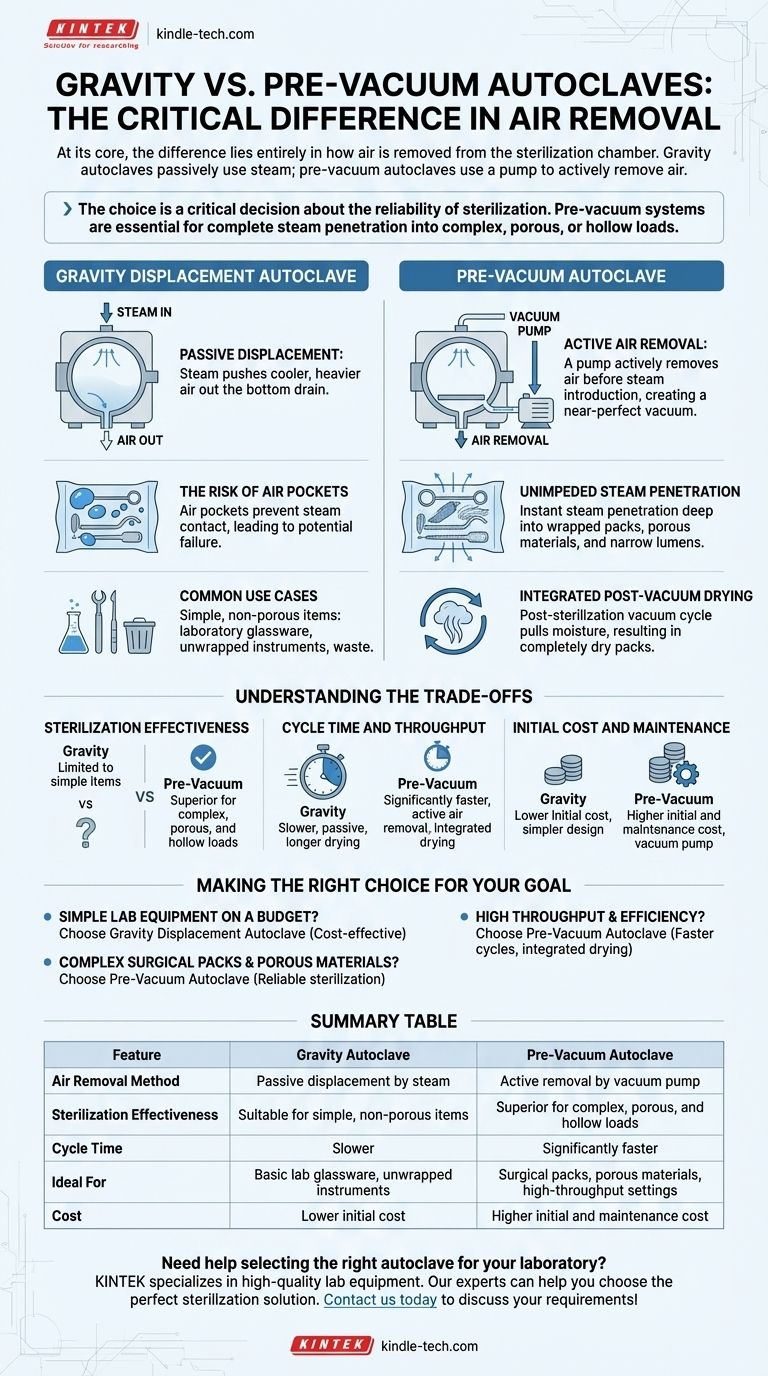
At its core, the difference between a gravity autoclave and a pre-vacuum autoclave lies entirely in how air is removed from the sterilization chamber. A gravity autoclave passively uses steam to push colder air out the bottom, while a pre-vacuum autoclave uses a pump to actively and forcefully remove air before steam is ever introduced. This single difference in air removal method dictates their speed, effectiveness, and the types of materials they can reliably sterilize.

The choice between gravity and pre-vacuum is not simply a matter of cost; it is a critical decision about the reliability of sterilization. Gravity autoclaves are sufficient for simple, non-porous items, but pre-vacuum systems are essential for ensuring complete steam penetration into complex, porous, or hollow loads.
What is the difference between gravity and pre vacuum autoclave? Choose the Right Sterilization Method

How a Gravity Displacement Autoclave Works

A gravity displacement autoclave operates on a simple, reliable principle derived from basic physics. It is the most common type found in basic laboratory settings.

The Principle of Displacement

Steam is generated and piped into the chamber. Because steam is less dense than cool air, it fills the chamber from the top down.

This incoming steam gradually displaces the colder, heavier air, pushing it downward and out through a temperature-sensitive drain port at the bottom of the chamber. Sterilization time begins only after enough air has been displaced for the chamber to reach the target temperature.

The Risk of Air Pockets

The primary limitation of this passive method is the potential for trapped air. Air pockets can get stuck within complex instrument packs, porous textiles, or hollow tubes.

Since trapped air prevents steam from making direct contact with surfaces, these areas will not be sterilized, leading to a potential cycle failure.

Common Use Cases

Gravity autoclaves are best suited for sterilizing non-porous items with simple surfaces. This includes laboratory glassware, unwrapped metal instruments, waste, and some media solutions.

How a Pre-Vacuum Autoclave Works

Pre-vacuum (or prevac) autoclaves, also known as high-speed or Class B sterilizers, represent a more advanced approach. They are the standard in most medical and surgical settings.

The Power of Active Air Removal

Before steam is introduced, a vacuum pump actively removes the air from the chamber. This is often done in a series of pulses, alternating between vacuum and steam, to ensure all air is evacuated from even the most challenging loads.

Unimpeded Steam Penetration

By creating a near-perfect vacuum, the system ensures there is no residual air to act as a barrier. When steam is finally injected, it can instantly penetrate the entire load, reaching deep inside wrapped packs, porous materials, and long, narrow lumens.

Integrated Post-Vacuum Drying

Most pre-vacuum models also include a post-sterilization vacuum cycle. This final phase pulls moisture from the load, resulting in instrument packs that are completely dry and ready for storage or immediate use.

Understanding the Trade-offs

The choice between these two technologies involves clear trade-offs in performance, speed, and cost.

Sterilization Effectiveness

A pre-vacuum autoclave offers superior and more reliable sterilization for a wider range of materials, especially complex surgical kits and porous loads. Gravity systems are effective but limited to simpler items.

Cycle Time and Throughput

Pre-vacuum cycles are significantly faster. Active air removal and post-vacuum drying drastically reduce the total time compared to the slow, passive displacement and longer drying times required by gravity units.

Initial Cost and Maintenance

Gravity autoclaves have a lower initial purchase price due to their simpler design. Pre-vacuum systems are more expensive and require more maintenance due to the addition of a vacuum pump and more complex controls.

Making the Right Choice for Your Goal

Your decision should be driven by the specific materials you need to sterilize and your operational requirements for speed and reliability.

  • If your primary focus is sterilizing simple lab equipment like glassware or unwrapped metal tools on a budget: A gravity displacement autoclave is a cost-effective and perfectly suitable choice.
  • If your primary focus is sterilizing complex surgical packs, porous materials, or hollow instruments: A pre-vacuum autoclave is the necessary standard for ensuring complete and reliable sterilization.
  • If your primary focus is high throughput and efficiency in a clinical or production setting: The faster cycle times and integrated drying of a pre-vacuum system provide a clear advantage that justifies the higher cost.

Understanding this fundamental difference in air removal empowers you to select the precise sterilization technology that your application demands.

Summary Table:

Feature Gravity Autoclave Pre-Vacuum Autoclave
Air Removal Method Passive displacement by steam Active removal by vacuum pump
Sterilization Effectiveness Suitable for simple, non-porous items Superior for complex, porous, and hollow loads
Cycle Time Slower Significantly faster
Ideal For Basic lab glassware, unwrapped instruments Surgical packs, porous materials, high-throughput settings
Cost Lower initial cost Higher initial and maintenance cost

Need help selecting the right autoclave for your laboratory?

KINTEK specializes in providing high-quality lab equipment and consumables, including both gravity and pre-vacuum autoclaves. Our experts can help you choose the perfect sterilization solution based on your specific needs—whether you're processing simple glassware or complex surgical instruments.

Contact us today to discuss your requirements and ensure reliable, efficient sterilization for your laboratory!

Visual Guide
What is the difference between gravity and pre vacuum autoclave? Choose the Right Sterilization Method Visual Guide

Related Products

People Also Ask

Related Products

Desktop Fast Laboratory Autoclave Sterilizer 35L 50L 90L for Lab Use

Desktop Fast Laboratory Autoclave Sterilizer 35L 50L 90L for Lab Use

The desktop fast steam sterilizer is a compact and reliable device used for rapid sterilization of medical, pharmaceutical, and research items. It efficiently sterilizes surgical instruments, glassware, medicines, and resistant materials, making it suitable for various applications.

Laboratory Sterilizer Lab Autoclave Vertical Pressure Steam Sterilizer for Liquid Crystal Display Automatic Type

Laboratory Sterilizer Lab Autoclave Vertical Pressure Steam Sterilizer for Liquid Crystal Display Automatic Type

Liquid crystal display automatic vertical sterilizer is a safe, reliable and automatic control sterilization equipment, which is composed of heating system, microcomputer control system and overheating and overvoltage protection system.

Laboratory Sterilizer Lab Autoclave Pulse Vacuum Lifting Sterilizer

Laboratory Sterilizer Lab Autoclave Pulse Vacuum Lifting Sterilizer

The pulse vacuum lifting sterilizer is a state-of-the-art equipment for efficient and precise sterilization. It uses pulsating vacuum technology, customizable cycles, and a user-friendly design for easy operation and safety.

Benchtop Laboratory Vacuum Freeze Dryer

Benchtop Laboratory Vacuum Freeze Dryer

Benchtop laboratory freeze dryer for efficient lyophilization of biological, pharmaceutical, and food samples. Features intuitive touchscreen, high-performance refrigeration, and durable design. Preserve sample integrity—consult now!

Laboratory Test Sieves and Sieving Machines

Laboratory Test Sieves and Sieving Machines

Precision lab test sieves & sieving machines for accurate particle analysis. Stainless steel, ISO-compliant, 20μm-125mm range. Request specs now!

Benchtop Laboratory Freeze Dryer for Lab Use

Benchtop Laboratory Freeze Dryer for Lab Use

Premium benchtop laboratory freeze dryer for lyophilization, preserving samples with ≤ -60°C cooling. Ideal for pharmaceuticals & research.

Small Vacuum Heat Treat and Tungsten Wire Sintering Furnace

Small Vacuum Heat Treat and Tungsten Wire Sintering Furnace

The small vacuum tungsten wire sintering furnace is a compact experimental vacuum furnace specially designed for universities and scientific research institutes. The furnace features a CNC welded shell and vacuum piping to ensure leak-free operation. Quick-connect electrical connections facilitate relocation and debugging, and the standard electrical control cabinet is safe and convenient to operate.

Custom PTFE Teflon Parts Manufacturer for Centrifuge Tube Racks

Custom PTFE Teflon Parts Manufacturer for Centrifuge Tube Racks

The precision-made PTFE test tube racks are completely inert and, due to the high temperature properties of PTFE, these test tube racks can be sterilized (autoclaved) without any problems.

Custom PTFE Teflon Parts Manufacturer for PTFE Mesh F4 Sieve

Custom PTFE Teflon Parts Manufacturer for PTFE Mesh F4 Sieve

PTFE mesh sieve is a specialized test sieve designed for particle analysis in various industries, featuring a non-metallic mesh woven from PTFE filament. This synthetic mesh is ideal for applications where metal contamination is a concern . PTFE sieves are crucial for maintaining the integrity of samples in sensitive environments, ensuring accurate and reliable results in particle size distribution analysis.

1200℃ Split Tube Furnace with Quartz Tube Laboratory Tubular Furnace

1200℃ Split Tube Furnace with Quartz Tube Laboratory Tubular Furnace

KT-TF12 split tube furnace: high-purity insulation, embedded heating wire coils, and max. 1200C. Widely used for new materials and chemical vapour deposition.

Anti-Cracking Press Mold for Lab Use

Anti-Cracking Press Mold for Lab Use

The anti-cracking press mold is a specialized equipment designed for molding various shapes and sizes of film using high pressure and electric heating.

915MHz MPCVD Diamond Machine Microwave Plasma Chemical Vapor Deposition System Reactor

915MHz MPCVD Diamond Machine Microwave Plasma Chemical Vapor Deposition System Reactor

915MHz MPCVD Diamond Machine and its multi-crystal effective growth, the maximum area can reach 8 inches, the maximum effective growth area of single crystal can reach 5 inches. This equipment is mainly used for the production of large-size polycrystalline diamond films, the growth of long single crystal diamonds, the low-temperature growth of high-quality graphene, and other materials that require energy provided by microwave plasma for growth.

1700℃ Laboratory Quartz Tube Furnace with Alumina Tube Tubular Furnace

1700℃ Laboratory Quartz Tube Furnace with Alumina Tube Tubular Furnace

Looking for a high-temperature tube furnace? Check out our 1700℃ Tube Furnace with Alumina Tube. Perfect for research and industrial applications up to 1700C.

HFCVD Machine System Equipment for Drawing Die Nano-Diamond Coating

HFCVD Machine System Equipment for Drawing Die Nano-Diamond Coating

The nano-diamond composite coating drawing die uses cemented carbide (WC-Co) as the substrate, and uses the chemical vapor phase method ( CVD method for short ) to coat the conventional diamond and nano-diamond composite coating on the surface of the inner hole of the mold.

Laboratory Vibratory Sieve Shaker Machine Slap Vibrating Sieve

Laboratory Vibratory Sieve Shaker Machine Slap Vibrating Sieve

KT-T200TAP is a slapping and oscillating sieving instrument for laboratory desktop use, with 300 rpm horizontal circular motion and 300 vertical slapping motions to simulate manual sieving to help sample particles pass through better.

Vacuum Sealed Continuous Working Rotary Tube Furnace Rotating Tube Furnace

Vacuum Sealed Continuous Working Rotary Tube Furnace Rotating Tube Furnace

Experience efficient material processing with our vacuum-sealed rotary tube furnace. Perfect for experiments or industrial production, equipped with optional features for controlled feeding and optimized results. Order now.

Multi Zone Laboratory Quartz Tube Furnace Tubular Furnace

Multi Zone Laboratory Quartz Tube Furnace Tubular Furnace

Experience precise, efficient thermal testing with our Multi Zone Tube Furnace. Independent heating zones and temperature sensors allow for controlled high-temperature gradient heating fields. Order now for advanced thermal analysis!

Electric Rotary Kiln Continuous Working Small Rotary Furnace Heating Pyrolysis Plant

Electric Rotary Kiln Continuous Working Small Rotary Furnace Heating Pyrolysis Plant

Efficiently calcine and dry bulk powder and lump fluid materials with an electric heating rotary furnace. Ideal for processing lithium ion battery materials and more.

Variable Speed Peristaltic Pump

Variable Speed Peristaltic Pump

KT-VSP Series Smart Variable Speed Peristaltic Pumps offer precise flow control for labs, medical, and industrial applications. Reliable, contamination-free liquid transfer.

Custom PTFE Teflon Parts Manufacturer Corrosion Resistant Cleaning Rack Flower Basket

Custom PTFE Teflon Parts Manufacturer Corrosion Resistant Cleaning Rack Flower Basket

The PTFE cleaning rack, also known as the PTFE flower basket cleaning flower basket, is a specialized laboratory tool designed for the efficient cleaning of PTFE materials. This cleaning rack ensures thorough and safe cleaning of PTFE items, maintaining their integrity and performance in laboratory settings.


Leave Your Message