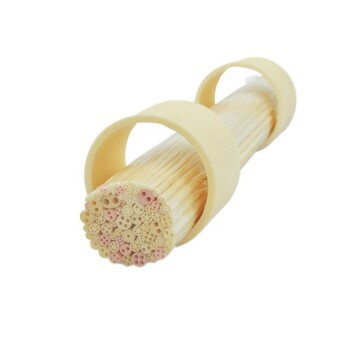
The primary function of a corundum furnace tube is to serve as a hermetically sealed, chemically inert reaction chamber within a high-temperature tube reactor. It isolates metal specimens from the external environment while containing highly corrosive gases, such as hydrogen chloride (HCl) and chlorine (Cl2), ensuring the structural integrity of the experiment at temperatures exceeding 650°C.
Core Takeaway: The corundum tube acts as a critical barrier that decouples the corrosive reaction zone from the furnace's heating elements. This isolation guarantees that experimental data reflects only the interaction between the specimen and the simulated atmosphere, free from external contamination.
The Deep Need: Why Corundum is Essential
While the furnace provides the heat, the corundum tube provides the integrity. In simulated chlorine corrosion experiments, the environment is hostile enough to destroy standard equipment. The tube serves two distinct, deep-level needs: chemical resistance and thermal precision.
High-Temperature Chemical Inertness
Standard materials degrade rapidly when exposed to oxidative or chlorinated gases at high heat. Corundum offers exceptional stability against chemical erosion.
This resistance allows the tube to withstand prolonged exposure to aggressive agents like HCl and Cl2 without degrading. This ensures the tube itself does not participate in the reaction, keeping the focus entirely on the metal specimen.
Stability of the Simulated Atmosphere
For corrosion data to be valid, the concentration of the flue gas components must remain constant.
Because corundum is chemically inert, it does not consume or alter the corrosive gases injected into the system. This maintains a stable chemical baseline throughout the duration of the experiment.
System Isolation and Equipment Protection
Beyond holding the sample, the tube plays a vital role in protecting the wider laboratory apparatus.
Shielding Heating Elements
The furnace heating elements are often vulnerable to active salts and corrosive gases.
As noted in high-temperature refractory experiments, the corundum tube prevents volatile compounds (like potassium salts) from escaping the reaction zone. This prevents these agents from reacting with and damaging the furnace's heating coils.
Ensuring Data Credibility
Scientific rigor requires that all corrosion products found on a sample originate strictly from the intended variables.
By creating a "sealed system," the tube ensures that collected corrosion products result exclusively from the interaction between the aggressive agents and the sample material. This eliminates the risk of cross-contamination from the furnace materials.
Common Pitfalls and Operational Risks
Understanding the limits of the system is just as important as understanding its capabilities. Here are the critical operational factors to consider.
The Risk of Component Interaction
A common error in high-temperature testing is assuming the vessel is passive. If a non-inert tube is used, it may react with the gas or the sample.
This leads to skewed analytical data, as the corrosion kinetics will be influenced by the degradation of the tube rather than the sample alone.
Thermal Field Uniformity
While the tube is robust, it relies on the furnace to generate the thermal field.
The tube must be positioned correctly within the constant-temperature zone of the furnace. Misalignment can lead to temperature gradients that skew the "precise constant-temperature reaction zone" required for accurate kinetic studies.
Making the Right Choice for Your Experiment
To ensure the validity of your corrosion data, you must align the equipment's capabilities with your specific experimental goals.
- If your primary focus is Data Purity: Prioritize the integrity of the corundum tube seal to ensure corrosion products are derived exclusively from the specimen-gas interaction, not the vessel.
- If your primary focus is Equipment Longevity: Ensure the tube creates a complete barrier between the corrosive chloride gases and the furnace's sensitive heating elements.
Ultimately, the corundum tube is not just a container; it is the guarantor of experimental isolation, protecting both the accuracy of your data and the lifespan of your reactor.
Summary Table:
| Feature | Function in Chlorine Corrosion Experiments |
|---|---|
| Material | High-purity Corundum ($Al_2O_3$) |
| Chemical Role | Chemically inert; resists $HCl$ and $Cl_2$ erosion |
| Containment | Hermetically seals the reaction zone from the environment |
| Protection | Shields furnace heating elements from corrosive gases |
| Data Integrity | Prevents cross-contamination for accurate kinetic studies |
| Thermal Limit | Maintains structural stability at temperatures >650°C |
Elevate Your Corrosion Research with KINTEK Precision
Maximize the accuracy of your high-temperature experiments and protect your laboratory investment with KINTEK’s industry-leading solutions. Whether you are conducting simulated chlorine corrosion tests or complex material synthesis, our comprehensive range of corundum furnace tubes, high-temperature tube and vacuum furnaces, and chemical-resistant consumables are engineered for uncompromising durability and purity.
From high-temperature high-pressure reactors to precision crushing and milling systems, KINTEK provides the specialized tools needed to ensure your data is always credible and your equipment remains protected.
Ready to optimize your thermal processing environment? Contact KINTEK Today to Consult with Our Experts
References
- Yongzheng Wang, Yungang Li. Reaction Kinetics of Chlorine Corrosion to Heating Surfaces during Coal and Biomass Cofiring. DOI: 10.1155/2020/2175795
This article is also based on technical information from Kintek Solution Knowledge Base .
Related Products
- High Temperature Aluminum Oxide (Al2O3) Protective Tube for Engineering Advanced Fine Ceramics
- 1400℃ Laboratory High Temperature Tube Furnace with Alumina Tube
- 1700℃ Laboratory High Temperature Tube Furnace with Alumina Tube
- High Temperature Alumina (Al2O3) Furnace Tube for Engineering Advanced Fine Ceramics
- 1200℃ Split Tube Furnace with Quartz Tube Laboratory Tubular Furnace
People Also Ask
- What is the process of alumina tube manufacturing? From Powder to High-Performance Ceramic
- What is the heating rate for alumina tubes? A Variable Schedule to Prevent Thermal Shock
- How do alumina ceramic tubes address technical challenges in electrochemical devices? Ensure Peak Signal Integrity.
- What is the working temperature of alumina tube? Achieve Safe & Reliable High-Temp Processing
- What is the maximum temperature for alumina tube? Unlock Its Full Potential with High Purity