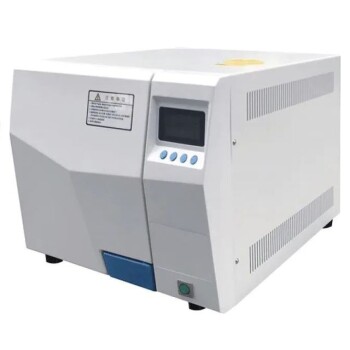
The high-temperature laboratory oven is used to dry high-purity gadolinium oxide (Gd2O3) powder at 500 °C for approximately four hours. This pretreatment step is critical for removing absorbed moisture that naturally adheres to the powder's surface. By eliminating this variable weight, researchers can ensure accurate raw material ratios and facilitate a high degree of homogeneity during the subsequent dry mechanical mixing phase.
The oven acts as a stabilization tool that ensures the chemical integrity of the sample by removing atmospheric water. This process transforms the Gd2O3 powder into a predictable, free-flowing state, which is necessary for the precise doping of UO2.
The Role of Thermal Pretreatment in Material Accuracy
Eliminating Adsorbed Moisture
High-purity powders like Gd2O3 are often hygroscopic, meaning they readily absorb water from the air. Heating the material to 500 °C ensures that even tightly bound water molecules are evaporated, leaving behind only the pure oxide.
Ensuring Stoichiometric Precision
In nuclear material science, the ratio of dopant to base material must be exact. Removing moisture ensures that the weight measured on the scale represents actual gadolinium oxide rather than a combination of the oxide and water weight.
Facilitating Particle Flow
Moisture often causes fine powders to aggregate or clump together. The drying process restores the powder's flowability, which is a prerequisite for achieving an even distribution of particles during the mixing stage.
Impact on Downstream Processing
Achieving High Homogeneity
A uniform mixture of Gd2O3-doped UO2 is essential for consistent performance and analysis. Dry, non-clumped powders distribute more evenly throughout the matrix during dry mechanical mixing, preventing localized concentrations of the dopant.
Standardizing the Preparation Cycle
Using a standardized temperature of 500 °C for a set duration of four hours creates a repeatable baseline for all samples. This consistency allows for accurate comparisons between different experimental batches.
Preventing Internal Pressure Issues
While specific to this process for moisture removal, thermal pretreatment generally prevents internal pressure buildup. In other high-temperature applications, failing to remove moisture beforehand can lead to specimen cracking or delamination during high-heat firing.
Understanding the Trade-offs
Time and Energy Requirements
The requirement for a four-hour soak at high temperatures adds significant time to the pretreatment workflow. While essential for precision, it increases the energy footprint and the overall duration of the sample preparation cycle.
Risk of Re-hydration
Once the powder is removed from the oven, it begins to cool and can immediately start re-absorbing atmospheric moisture. To maintain the benefits of the oven treatment, the powder must be moved to the mixing phase or stored in a desiccator immediately.
Temperature Sensitivity
If the oven is not accurately calibrated, temperatures exceeding the target could potentially alter the surface morphology of the powder. Conversely, temperatures lower than 500 °C might fail to remove all chemically bound water, leading to weighing errors.
Applying Thermal Pretreatment to Your Workflow
The use of a high-temperature oven is a fundamental step in ensuring the quality of doped ceramic samples. To achieve the best results, the timing and temperature must be strictly controlled according to the material's specific properties.
- If your primary focus is absolute stoichiometric precision: The 500 °C drying step is mandatory to ensure that your mass calculations are not skewed by hidden water weight.
- If your primary focus is material homogeneity: Use the oven treatment to eliminate powder clumping, which ensures the Gd2O3 particles disperse evenly throughout the UO2.
- If your primary focus is process repeatability: Standardize the cooling and storage procedures post-drying to prevent the powder from re-absorbing moisture before it can be mixed.
Rigorous moisture control through high-temperature drying is the foundation of reliable and reproducible Gd2O3-doped UO2 sample preparation.
Summary Table:
| Parameter | Process Requirement | Primary Benefit |
|---|---|---|
| Target Temperature | 500 °C | Complete evaporation of bound moisture |
| Soak Duration | ~4 Hours | Ensures chemical integrity & stabilization |
| Material State | Free-flowing powder | Prevents clumping for high homogeneity |
| Precision Goal | Stoichiometric Accuracy | Eliminates variable water weight for exact ratios |
| Post-Process | Immediate mixing/Desiccation | Prevents re-absorption of atmospheric moisture |
Elevate Your Research Precision with KINTEK
Achieving perfect homogeneity in nuclear material science and ceramic doping requires equipment that offers absolute thermal stability. KINTEK specializes in high-performance laboratory solutions designed for rigorous pretreatment workflows.
Whether you require precise high-temperature furnaces (muffle, tube, or vacuum) for moisture removal, crushing and milling systems for particle preparation, or hydraulic pellet presses for sample formation, our portfolio is engineered for excellence. We also provide essential crucibles and ceramics to maintain sample purity during high-heat cycles.
Ready to standardize your preparation cycle and enhance material accuracy?
Contact KINTEK Today to consult with our experts on the ideal furnace or high-pressure reactor system for your specific application. Let us help you achieve reliable, reproducible results every time.
References
- Sonia García-Gómez, Joan de Pablo Ribas. Oxidative dissolution mechanism of both undoped and Gd<sub>2</sub>O<sub>3</sub>-doped UO<sub>2</sub>(s) at alkaline to hyperalkaline pH. DOI: 10.1039/d3dt01268a
This article is also based on technical information from Kintek Solution Knowledge Base .
Related Products
- Laboratory Scientific Electric Heating Blast Drying Oven
- 23L Laboratory Vacuum Drying Oven
- 56L Vertical Laboratory Vacuum Drying Oven
- 1200℃ Muffle Furnace Oven for Laboratory
- 1700℃ Muffle Oven Furnace for Laboratory
People Also Ask
- How does a laboratory electric drying oven contribute to the formation of the initial coating? Expert Insights
- What role does a precision laboratory drying oven play in the synthesis of GO-PANI nanocomposites? Protect Material Integrity
- What role does a laboratory drying oven play in the preparation of zinc oxide nanoparticle precursors?
- What is the necessity of using a laboratory drying oven when processing MoO3/GO composite nanopowders? Find out here.
- What is the role of a laboratory drying oven in cellulose citrate production? Ensure Material Stability & Purity