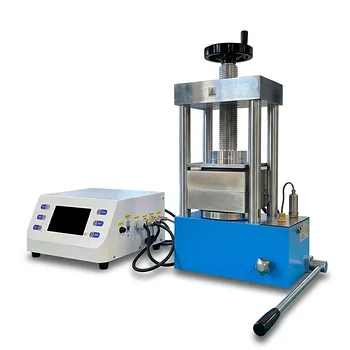
In the preparation of alumina from aluminum ash, a laboratory hydraulic press serves the critical function of compressing dried aluminum hydroxide intermediate powder into compact cylindrical ingots. This mechanical consolidation is a necessary pre-treatment that transforms loose, inconsistent powder into distinct samples, such as 0.3g pellets, ready for high-temperature processing.
Core Insight: The hydraulic press does not merely shape the material; it fundamentally alters the sample's thermal properties. By densifying the powder into a uniform pellet, the press significantly enhances heat conduction efficiency during subsequent plasma calcination, ensuring reaction consistency that loose powder cannot achieve.
Transforming Intermediate Powders into Green Bodies
The process of recovering alumina from aluminum ash involves isolating aluminum hydroxide intermediates. The hydraulic press bridges the gap between this raw powder and the final sintered product.
Creation of Consistent Samples
The press applies force to compress specific masses of dried aluminum hydroxide (e.g., 0.3g) into ingots of uniform dimensions.
This standardization is vital for experimental accuracy. It ensures that every sample undergoing thermal treatment has the same geometric surface area and volume.
Enhancing Thermal Conductivity
Loose powders contain significant amounts of air, which acts as a thermal insulator.
By compressing the powder into a dense pellet, the hydraulic press eliminates these air gaps. This allows heat to transfer more efficiently through the material during high-temperature thermal treatments or plasma calcination.
The Physics of Densification
While the primary goal is shaping, the underlying physical changes driven by the press are essential for the material's structural integrity.
Elimination of Internal Voids
The application of hydraulic pressure forces particles closer together, mechanically interlocking them and reducing porosity.
This reduction in void space increases the initial "green" density of the compact. Higher initial density is often a prerequisite for successful sintering or melting in later stages.
Mechanical Strength for Handling
The "green body" (the pressed but unfired pellet) must be strong enough to withstand transport from the press to the furnace.
The hydraulic press provides sufficient consolidation to prevent the pellet from crumbling, delaminating, or losing mass during handling and storage.
Understanding the Trade-offs
While hydraulic pressing is essential for consistency, incorrect application can introduce new variables to your experiment.
Density Gradients
If the pressure is not applied uniformly, the pellet may have varying densities across its cross-section.
This can lead to uneven heating during calcination, potentially causing the sample to warp or react incompletely in specific zones.
Over-Pressing Risks
Applying excessive pressure can cause "capping" or lamination, where the top of the pellet separates from the main body due to trapped air trying to escape.
This structural failure compromises the sample before thermal treatment even begins.
Making the Right Choice for Your Goal
To maximize the effectiveness of the laboratory hydraulic press in your alumina preparation workflow, consider your specific experimental objectives.
- If your primary focus is experimental reproducibility: Prioritize precision in the mass of the powder loaded (e.g., exactly 0.3g) to ensure every ingot has identical thermal behavior.
- If your primary focus is process efficiency: Optimize the pressure settings to achieve the highest possible density without lamination, thereby maximizing heat conduction during calcination.
The hydraulic press is not just a shaping tool; it is a thermal management device that dictates how effectively your aluminum ash intermediate will respond to heat.
Summary Table:
| Process Stage | Function of Hydraulic Press | Impact on Result |
|---|---|---|
| Pre-Treatment | Mechanical Consolidation | Converts loose powder into uniform 0.3g cylindrical ingots |
| Sample Prep | Standardization | Ensures consistent geometric surface area and volume for accuracy |
| Thermal Prep | Void Elimination | Removes insulating air gaps to significantly increase heat conduction |
| Handling | Green Body Strength | Provides mechanical integrity to prevent crumbling during furnace transport |
Elevate Your Materials Research with KINTEK Precision
Ready to transform your aluminum ash recovery and alumina preparation? KINTEK specializes in high-performance laboratory equipment designed for the most demanding research environments. Our precision hydraulic presses (pellet, hot, and isostatic) ensure your samples achieve the perfect green density for superior thermal processing.
From high-temperature muffle and vacuum furnaces to essential PTFE and ceramic consumables, we provide the end-to-end solutions your lab needs for consistent, reproducible results.
Maximize your lab's efficiency and sample integrity—Contact KINTEK today for a tailored quote!
References
- Wen‐chang Lin, Yi‐Ming Kuo. Recycling of aluminum dross for producing calcinated alumina by microwave plasma. DOI: 10.1186/s42834-022-00160-9
This article is also based on technical information from Kintek Solution Knowledge Base .
Related Products
- Laboratory Hydraulic Pellet Press for XRF KBR FTIR Lab Applications
- Automatic Laboratory Hydraulic Pellet Press Machine for Lab Use
- Automatic Laboratory Hydraulic Press for XRF & KBR Pellet Press
- Laboratory Manual Hydraulic Pellet Press for Lab Use
- Laboratory Hydraulic Press Split Electric Lab Pellet Press
People Also Ask
- What is the role of a laboratory hydraulic pellet press and stainless steel molds in the fabrication of RuO2/NbC anodes?
- How does a laboratory hydraulic pellet press contribute to SiCw/2024 aluminum composite preforms? Optimize Densification
- What is the necessity of using a laboratory hydraulic pellet press in the preparation of biomass fuel pellets? Guide
- What is the significance of applying 200 MPa of pressure with a laboratory hydraulic pellet press for composite ceramics?
- What key role does a laboratory pellet press play in FTIR analysis? Master KBr Sample Preparation Excellence