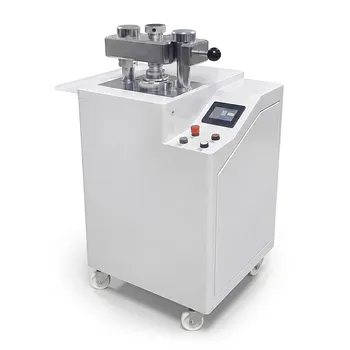
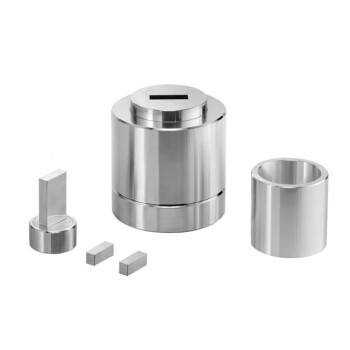
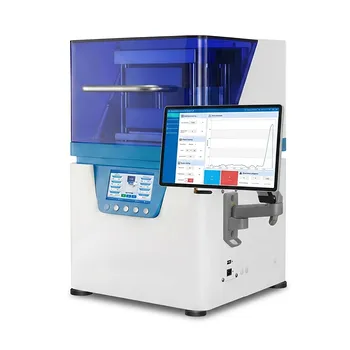
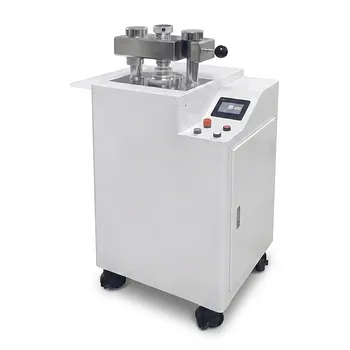
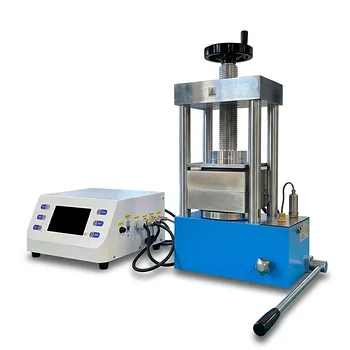
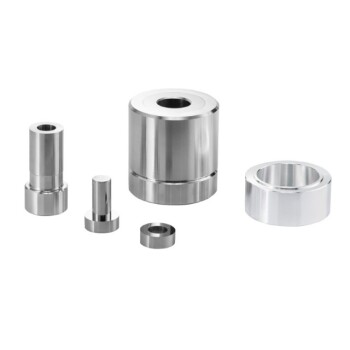
A laboratory hydraulic press serves as the critical instrument for densifying powdered Nickel-62 into solid, high-precision pellets. By applying controlled axial pressure to the isotope powder within a mold, the press creates "green bodies" that possess the specific dimensions, density, and structural integrity required for use as experimental target materials.
The primary function of the hydraulic press is to transform loose Nickel-62 powder into a cohesive solid through mechanical compaction. This process ensures the consistent density and geometric accuracy necessary for predictable performance in subsequent thermal or nuclear applications.
The Mechanics of Isotope Compaction
Precision Dimensional Control
The hydraulic press, used in conjunction with high-tolerance molds, ensures that each Nickel-62 pellet meets strict geometric specifications. This repeatability is essential for experiments where the volume and shape of the target material must be standardized across multiple trials.
Transformation to a Green Body
By applying high-intensity pressure, the press forces powder particles into tight physical contact. This results in a "green body," a compacted pellet that has sufficient mechanical strength to be handled and transported without crumbling or losing its shape.
Ensuring Structural Integrity and Density
Eliminating Internal Voids
Uniform pressure application is vital for minimizing internal density gradients within the Nickel-62 pellet. High-precision control allows the operator to eliminate air pockets and voids, which increases the relative density of the material and establishes efficient pathways for ion or heat transport.
Enhancing Particle Diffusion
The press ensures intimate contact between individual metal particles, which is a prerequisite for solid-state reactions. This physical bonding is critical for downstream processes, as it facilitates the rapid diffusion of gases or the movement of electrons and ions through the material.
Preparation for Downstream Processing
Prevention of Thermal Failure
Accurate compaction is necessary to prevent deformation or cracking during subsequent high-temperature sintering or cryogenic treatments. By creating a uniform internal structure, the hydraulic press ensures the pellet can withstand the intense stress caused by extreme temperature variations.
Optimizing Target Performance
In the context of isotope research, the volumetric energy density of the target is often a key variable. The hydraulic press allows researchers to achieve high area loading, reducing the ohmic resistance and increasing the overall efficiency of the Nickel-62 target during experimental bombardment or reduction.
Understanding the Trade-offs
Pressure Limits and Material Stress
Applying excessive pressure can lead to internal stress accumulation, causing the pellet to fracture or "cap" upon release from the die. Conversely, insufficient pressure results in a fragile pellet that may fail to meet the density requirements for high-temperature reactions.
The Role of Binders and Contamination
While some powders require binders (like water or acids) to improve structural stability, these additives can introduce impurities. In high-purity Nickel-62 applications, the press must be capable of achieving high density without the use of binders to maintain the chemical integrity of the isotope.
Making the Right Choice for Your Goal
Recommendations for Pellet Preparation
- If your primary focus is isotope purity: Utilize high-pressure molding without binders to ensure the Nickel-62 remains uncontaminated, even if it requires more precise control of the hydraulic ramp speed.
- If your primary focus is structural durability: Prioritize minimizing density gradients through slow, uniform pressure application to prevent cracking during subsequent sintering at temperatures exceeding 1400°C.
- If your primary focus is experimental repeatability: Use a press with digital pressure monitoring to ensure every pellet is compacted to the exact same density and thickness.
A laboratory hydraulic press is the foundational tool that translates raw Nickel-62 powder into a technically viable, high-density target material.
Summary Table:
| Key Stage | Press Function | Outcome for Nickel-62 |
|---|---|---|
| Compaction | Applies controlled axial pressure | Transformation from powder to cohesive green body |
| Dimensional Control | High-tolerance mold integration | Geometric accuracy and experimental repeatability |
| Densification | Elimination of internal voids | Enhanced ion transport and volumetric energy density |
| Structural Prep | Uniform internal bonding | Prevention of thermal failure during high-temp sintering |
Elevate Your Isotope Research with KINTEK Precision
Achieving the perfect Nickel-62 pellet requires more than just pressure; it requires absolute precision. KINTEK specializes in advanced laboratory equipment designed for the most demanding research environments. Our comprehensive range of manual and automated hydraulic presses (including pellet, hot, and isostatic models) ensures you achieve maximum density and structural integrity without compromising isotope purity.
From high-performance crushing and milling systems to high-temperature furnaces and essential ceramic consumables, KINTEK provides the end-to-end tools needed for successful material preparation.
Ready to optimize your pellet production? Contact our technical experts today to find the ideal compaction solution for your laboratory’s specific needs!
References
- C.A. Foster, Mike Zach. Spanning the Periodic Table: Select examples of stable isotope target fabrication at Oak Ridge National Laboratory. DOI: 10.1051/epjconf/202328506002
This article is also based on technical information from Kintek Solution Knowledge Base .
Related Products
- Automatic Laboratory Hydraulic Pellet Press Machine for Lab Use
- Laboratory Manual Hydraulic Pellet Press for Lab Use
- Laboratory Manual Hydraulic Pellet Press for Lab Use
- kbr pellet press 2t
- Automatic Laboratory Hydraulic Press for XRF & KBR Pellet Press
People Also Ask
- What is the role of a laboratory hydraulic pellet press and stainless steel molds in the fabrication of RuO2/NbC anodes?
- What role does a laboratory pellet press play in the enhancement of biomass energy products? Optimize Fuel Efficiency
- What is the purpose of using a laboratory pellet press when evaluating the electronic conductivity of carbon powders? Guide
- How does a laboratory hydraulic pellet press contribute to SiCw/2024 aluminum composite preforms? Optimize Densification
- What is the significance of applying 200 MPa of pressure with a laboratory hydraulic pellet press for composite ceramics?