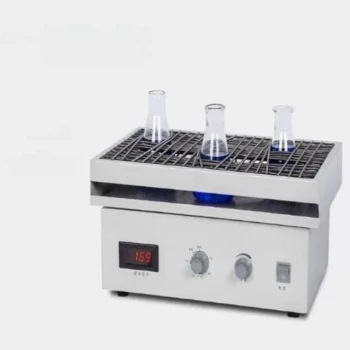
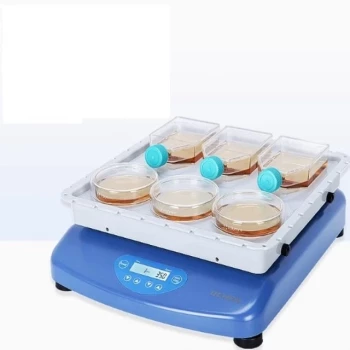
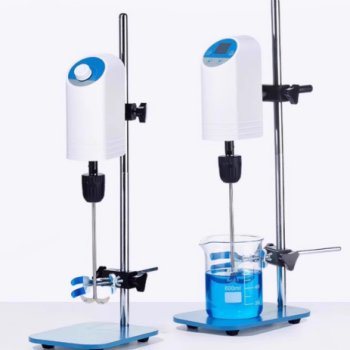
The function of a mechanical shaker is to serve as the precise driver of kinetic energy in solvent extraction experiments. It ensures that the immiscible organic and aqueous phases are forced into contact through controlled oscillation (often at specific rates like 330 r/min), which is the physical prerequisite for chemical separation.
Core Takeaway: The mechanical shaker is critical for overcoming the natural separation of liquids to maximize interfacial contact. By driving the system to chemical equilibrium, it ensures that the resulting distribution coefficients and separation factors are chemically accurate and reproducible.
The Mechanics of Phase Interaction
Overcoming Liquid Separation
In zirconium-hafnium extraction, you are working with two distinct liquid phases: the aqueous phase (containing the metal ions) and the organic phase (containing the extractant).
naturally, these liquids resist mixing. The mechanical shaker provides the kinetic energy necessary to disrupt this resistance.
Enhancing Mass Exchange
The primary physical goal is to increase the efficiency of mass exchange.
By oscillating the mixture, the shaker disperses droplets of one phase into the other. This drastically increases the surface area—or interface—where the two liquids touch.
It is at this interface that the actual chemical work occurs. Zirconium and hafnium ions transfer from the aqueous solution to bind with extractant molecules in the organic layer.
The Impact on Chemical Equilibrium
Driving the System to Saturation
Extraction is not instantaneous. The system requires a specific duration of contact to reach chemical equilibrium.
This is the state where the transfer of ions between phases has stabilized. The shaker maintains constant agitation to ensure this state is reached within the allotted experimental time.
Ensuring Data Integrity
The ultimate output of these experiments are metrics like distribution coefficients and separation factors.
These numbers measure how effectively zirconium is separated from hafnium. If the shaker fails to mix the phases thoroughly, equilibrium is not reached.
Consequently, the calculated coefficients would be artificially low or inconsistent, rendering the experimental data invalid.
Operational Considerations and Trade-offs
The Importance of Precision
"Shaking" implies randomness, but this equipment requires controlled oscillation.
The reference highlights a specific frequency of 330 r/min. Maintaining a specific, constant frequency is vital for reproducibility.
Balancing Energy and Separation
While high kinetic energy is needed for mixing, the parameters must be optimized.
Insufficient shaking leads to poor contact and incomplete extraction. Conversely, the shaking must be controlled enough to allow the phases to settle back apart effectively after the process is stopped.
Making the Right Choice for Your Goal
To ensure your zirconium-hafnium extraction data is reliable, consider the following regarding your agitation equipment:
- If your primary focus is data accuracy: Verify that your shaking duration is sufficient to reach full chemical equilibrium, preventing premature sampling.
- If your primary focus is reproducibility: strictly monitor the oscillation frequency (e.g., 330 r/min) to ensure every sample receives identical kinetic energy input.
Reliable separation data depends entirely on the consistent, mechanical efficiency of the phase contact.
Summary Table:
| Feature | Role in Zr-Hf Extraction | Impact on Experimental Outcomes |
|---|---|---|
| Kinetic Energy Driver | Overcomes natural resistance between aqueous and organic phases | Facilitates efficient mass exchange and ion transfer |
| Interfacial Area | Increases surface contact through controlled oscillation | Maximizes extraction efficiency of metal ions |
| Equilibrium Control | Maintains agitation until chemical saturation is reached | Ensures valid distribution coefficients and separation factors |
| Oscillation Precision | Provides consistent frequency (e.g., 330 r/min) | Guarantees reproducibility across experimental trials |
Optimize Your Lab’s Extraction Efficiency with KINTEK
Precision is the backbone of reliable separation data. KINTEK specializes in high-performance laboratory equipment designed to meet the rigorous demands of chemical research. From our advanced mechanical shakers and homogenizers that ensure perfect phase contact to our robust high-temperature furnaces, crushing systems, and hydraulic presses, we provide the tools needed for excellence in material science.
Whether you are performing zirconium-hafnium solvent extraction or advancing battery research, KINTEK offers a comprehensive range of consumables including PTFE products, ceramics, and crucibles, alongside specialized electrolytic cells and cooling solutions.
Ready to achieve superior reproducibility and data integrity? Contact our experts today to find the perfect solution for your lab!
References
- Leon de Beer, Henning M. Krieg. Solvent extraction and separation of hafnium from zirconium using Ionquest 801. DOI: 10.17159/2411-9717/2016/v116n1a14
This article is also based on technical information from Kintek Solution Knowledge Base .
Related Products
- Laboratory Multifunctional Small Speed-Adjustable Horizontal Mechanical Shaker for Lab
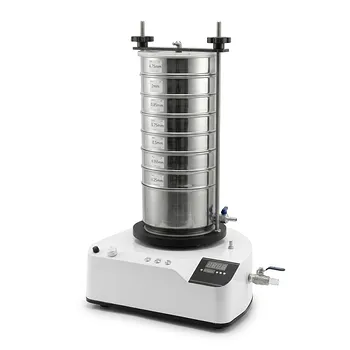
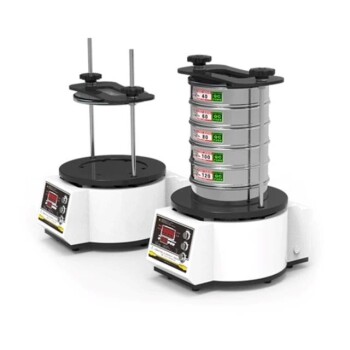
- Laboratory Vibratory Sieve Shaker Machine for Dry and Wet Three-Dimensional Sieving
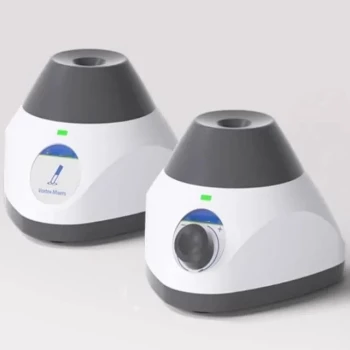
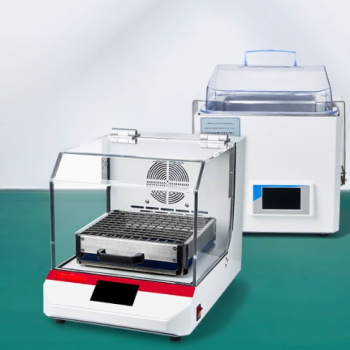
- Laboratory Vortex Mixer Orbital Shaker Multifunctional Rotation Oscillation Mixer
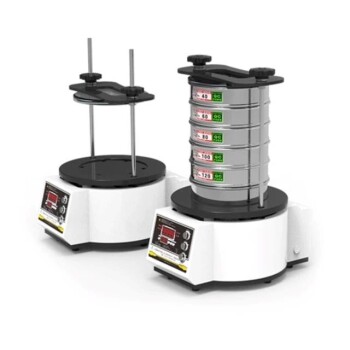
- Laboratory Vibratory Sieve Shaker Machine Slap Vibrating Sieve
- Laboratory Test Sieves and Vibratory Sieve Shaker Machine
People Also Ask
- How do static culture and shaking culture affect the morphology of BC? Optimize Lab Shaker Results
- What is the role of a laboratory shaker in silane sol preparation? Master Uniform Aramid Fabric Coating
- Why is a laboratory shaker required for continuous 24-hour catalyst treatment? Achieve Deep Uniform Impregnation
- What is the function of a laboratory shaker in evaluating Fe-C@C nanoparticles? Optimize Methylene Blue Adsorption
- How do laboratory shakers or stirrers influence the efficiency of hydrogen production during dark fermentation?