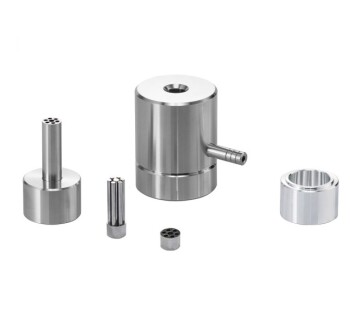
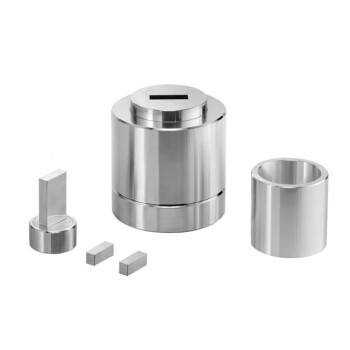
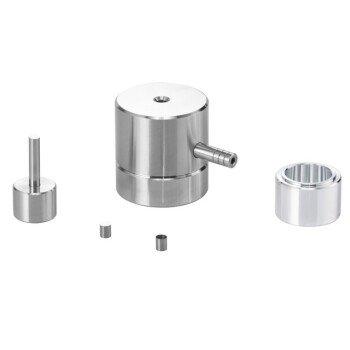
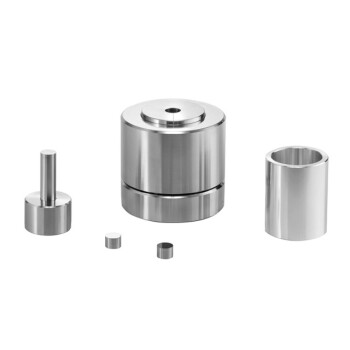
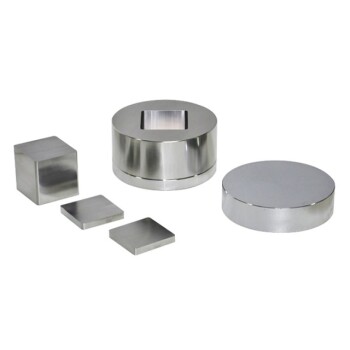
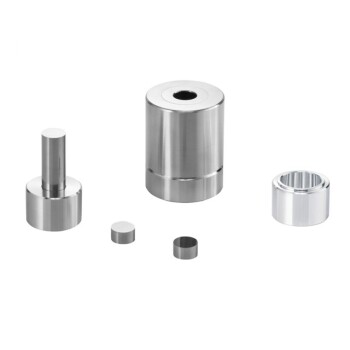
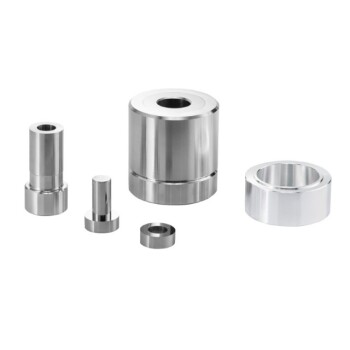
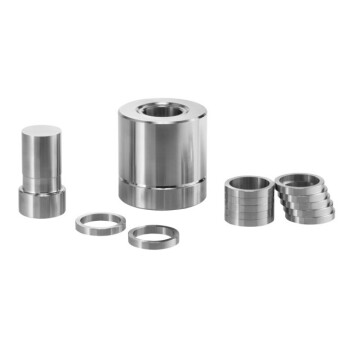
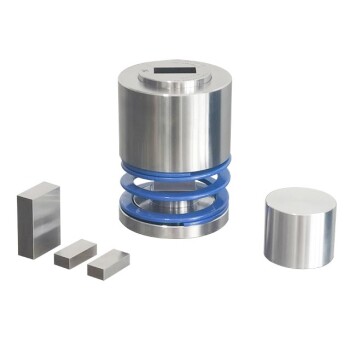
The primary function of a metal mold during the cold press forming of Al2O3/ZrO2 gradient ceramics is to act as a rigid geometric constraint that transforms loose powder into a cohesive unit. It withstands the significant mechanical force exerted by a pellet press to compress the ceramic material into a "green body" with a precise diameter and defined shape.
Core Insight: The metal mold is the foundational tool for establishing initial dimensional accuracy. While it does not facilitate the final chemical bonding (sintering), it determines the structural integrity and edge quality of the pre-sintered green body.
The Mechanics of Cold Press Forming
Providing Precise Geometric Constraints
In the initial stage of processing gradient ceramics, the raw material exists as loose powder. The metal mold confines this powder within a specific boundary.
This confinement ensures that when pressure is applied, the energy is directed toward compacting the powder rather than displacing it, defining the exact geometry of the sample.
Withstanding High Mechanical Pressure
The cold press process utilizes a pellet press to generate substantial force. The metal mold is engineered to possess high mechanical strength.
It must absorb this external stress without yielding or deforming. This rigidity is essential to transfer the pressure effectively into the ceramic powder, forcing the particles to pack tightly together.
Creating the "Green Body"
The result of this process is the formation of a solid green body. This is the unsintered, compacted ceramic object.
The metal mold ensures this body is cohesive enough to be handled and moved to the next processing stage (sintering) without crumbling or losing its shape.
Defining Edge Quality and Accuracy
The surface finish and tolerance of the metal mold directly dictate the initial quality of the ceramic.
A high-quality metal mold ensures sharp edge quality and consistent diameter, minimizing the need for extensive machining or shaping after the material has been hardened by sintering.
Operational Context and Distinctions
Cold Press vs. Hot Press Requirements
It is critical to distinguish between the forming stage and the sintering stage. The metal mold is strictly utilized for the cold press forming stage.
It serves to shape the powder at room temperature or low heat, focusing purely on mechanical compaction and geometric definition.
Why Metal is Not Used for Sintering
While metal is ideal for cold pressing, it is unsuitable for the subsequent high-temperature densification processes, such as vacuum hot press sintering.
As noted in comparative processing data, sintering often exceeds 1500°C. At these temperatures, a metal mold would deform or melt. Consequently, graphite molds are used during sintering due to their superior thermal stability and high-temperature strength.
Making the Right Choice for Your Goal
To ensure the successful fabrication of Al2O3/ZrO2 gradient ceramics, you must apply the correct tooling at the correct stage.
- If your primary focus is initial shaping and dimensioning: Prioritize a high-precision metal mold capable of withstanding high mechanical loads without deformation during the cold press stage.
- If your primary focus is high-temperature densification: Transition the green body to a graphite mold, which acts as the core consumable to transmit pressure and maintain shape at temperatures exceeding 1500°C.
The metal mold builds the structure; the sintering process builds the strength.
Summary Table:
| Feature | Metal Mold (Cold Press) | Graphite Mold (Sintering) |
|---|---|---|
| Primary Function | Mechanical compaction & shaping | High-temperature densification |
| Operating Temp | Room temperature / Low heat | High temperatures (>1500°C) |
| Key Strength | Rigid geometric constraint | Thermal stability & conductivity |
| Outcome | Cohesive green body | Dense, high-strength ceramic |
Elevate Your Material Research with KINTEK Precision Solutions
Achieving the perfect gradient ceramic starts with the right tools. KINTEK specializes in high-performance laboratory equipment designed for the most demanding material science applications. Whether you need high-precision metal molds and hydraulic pellet presses for initial cold forming, or advanced vacuum hot press furnaces and graphite tooling for high-temperature sintering, we have the expertise to support your workflow.
Our Value to You:
- Comprehensive Range: From crushing and milling systems to high-pressure reactors and autoclaves.
- Precision Engineering: Ensure dimensional accuracy and edge quality with our durable ceramic and PTFE consumables.
- Expert Support: Our team helps you select the right equipment—from ULT freezers for cooling to induction melting furnaces for advanced metallurgy.
Don't compromise on your material integrity. Contact KINTEK today to discuss your project requirements!
Related Products
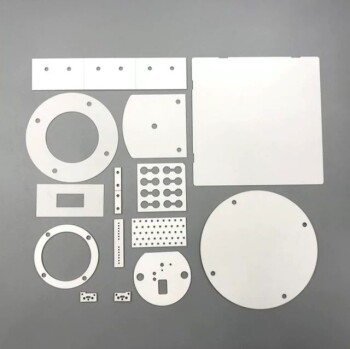
- Custom-Made Alumina Zirconia Special-Shaped Ceramic Plates for Engineering Advanced Fine Ceramics Processing
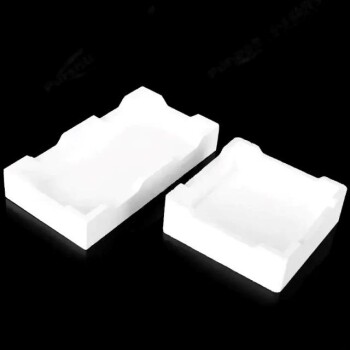
- Advanced Engineering Fine Ceramics Alumina Ceramic Saggar for Fine Corundum
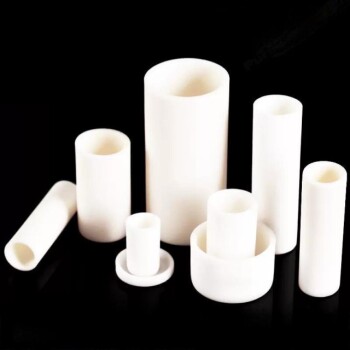
- Engineering Advanced Fine Ceramics Alumina Al2O3 Crucible With Lid Cylindrical Laboratory Crucible
- Anti-Cracking Press Mold for Lab Use
- Engineering Advanced Fine Ceramics Alumina Crucibles (Al2O3) for Thermal Analysis TGA DTA
People Also Ask
- What function do alumina ceramic plates serve as supports in the preparation of molecular sieve membranes?
- Why are ceramics more resistant to corrosion? Unlock the Secret to Unmatched Chemical Stability
- What are the process advantages of selecting an alumina plate for CuO nanofilm synthesis? Achieve Superior Purity
- How is alumina ceramic made? A Guide to Manufacturing Methods and Material Properties
- What are the applications of zirconia ceramics? Unlock High-Performance Solutions for Extreme Environments