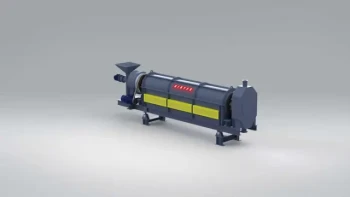
Precise control of thermal conditions defines the function of these two components during pre-carbonization. The rotary furnace continuously tumbles the rice husk to ensure uniform heat transfer throughout the material batch. Simultaneously, the injection of argon gas creates a protective, inert atmosphere that prevents the biomass from burning (oxidizing) at temperatures between 523 K and 573 K.
The mechanical rotation and inert gas injection work together to transform raw biomass into stable carbonized rice husk without reducing it to ash. This controlled environment is essential for preparing the material for subsequent activation steps.
The Role of the Rotary Furnace
Achieving Uniform Heat Distribution
The primary challenge in heating biomass is avoiding uneven temperature gradients. A rotary furnace solves this by continuously tumbling the rice husk during the heating process.
This mechanical motion ensures that every particle is exposed to the heat source for the same duration. It eliminates the risk of "cold spots" where material might remain under-processed.
Preventing Localized Overheating
Stationary heating methods often result in hot spots that can degrade the material structure. The rotary action dissipates heat evenly across the entire batch.
By maintaining thermal consistency, the furnace ensures the resulting carbonized rice husk (CRH) has a homogeneous structure. This uniformity is critical for the efficiency of downstream activation processes.
The Function of Argon Gas Injection
Creating an Inert Environment
At operating temperatures ranging from 523 K to 573 K, rice husk is highly susceptible to combustion if oxygen is present. Argon gas is injected to displace oxygen within the furnace chamber.
This creates an inert atmosphere that creates a safety barrier against oxidative combustion. Without this barrier, the valuable carbon structure would simply burn away into ash.
Facilitating Partial Organic Breakdown
The goal of pre-carbonization is not total destruction, but a controlled modification of the material. Argon allows for the partial breakdown of the rice husk's organic structure.
This specific level of decomposition converts the raw biomass into CRH. It stabilizes the carbon framework, making it ready for further processing and activation.
Understanding the Trade-offs
Complexity vs. Material Quality
Using a rotary furnace with inert gas injection is significantly more complex than simple static carbonization. It requires precise control systems and consumables (argon) that increase operational costs.
However, the trade-off is necessary for high-performance applications. Simple open-air or static heating cannot achieve the structural integrity and purity required for advanced carbon materials.
Optimizing the Pre-Carbonization Process
To achieve the best results in converting rice husk biomass, consider how these variables align with your processing goals.
- If your primary focus is material uniformity: Rely on the rotary furnace’s constant tumbling action to eliminate thermal gradients and ensure consistent quality.
- If your primary focus is preventing yield loss: Maintain a strict flow of argon gas to completely exclude oxygen and prevent the biomass from turning to ash.
Mastering these two control mechanisms ensures a high-quality precursor that is fully prepared for effective activation.
Summary Table:
| Feature | Function in Pre-Carbonization | Impact on Rice Husk |
|---|---|---|
| Rotary Motion | Continuous tumbling & heat transfer | Ensures homogeneous material structure |
| Argon Injection | Displaces oxygen (Inert atmosphere) | Prevents combustion/oxidation into ash |
| Temp Control | Stable 523 K to 573 K range | Facilitates partial organic breakdown |
| Process Synergy | Controlled thermal environment | High-quality carbonized rice husk (CRH) |
Elevate Your Biomass Processing with KINTEK Precision
Unlock the full potential of your carbon materials with KINTEK’s advanced thermal solutions. Whether you are refining rice husk or developing next-generation battery materials, our high-performance rotary furnaces and precise gas control systems provide the uniformity and inert protection your research demands.
From advanced high-temperature furnaces and crushing systems to high-pressure reactors and specialized lab consumables, KINTEK is your partner in laboratory excellence. We empower researchers and manufacturers with the tools needed for consistent, high-purity results.
Ready to optimize your carbonization yield? Contact our technical experts today to find the perfect equipment for your laboratory or industrial scale-up.
References
- Makpal Seitzhanova, Ronny Berndtsson. Production of Graphene Membranes from Rice Husk Biomass Waste for Improved Desalination. DOI: 10.3390/nano14020224
This article is also based on technical information from Kintek Solution Knowledge Base .
Related Products
- Rotary Tube Furnace Split Multi Heating Zone Rotating Tube Furnace
- Laboratory Vacuum Tilt Rotary Tube Furnace Rotating Tube Furnace
- Vacuum Sealed Continuous Working Rotary Tube Furnace Rotating Tube Furnace
- Electric Rotary Kiln Small Rotary Furnace for Activated Carbon Regeneration
- Electric Rotary Kiln Small Rotary Furnace Biomass Pyrolysis Plant
People Also Ask
- What are the advantages of using a rotary tube furnace for MoVOx catalysts? Elevate Uniformity and Crystallinity
- What are the process advantages of using a rotary tube furnace for WS2 powder? Achieve Superior Material Crystallinity
- Why is a rotary tube furnace recommended for the calcination stage of potassium vanadium oxide catalysts? Optimize Purity
- Why is a rotary tube furnace preferred over a fixed tube furnace for the carbonization of asphaltenes? Superior Quality
- What is a rotary tube furnace? Achieve Superior Uniformity for Powders and Granules