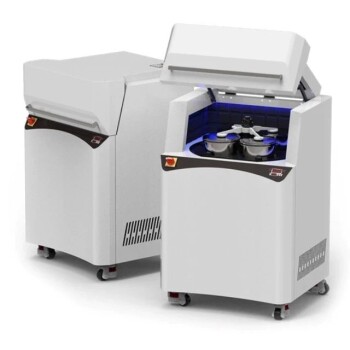
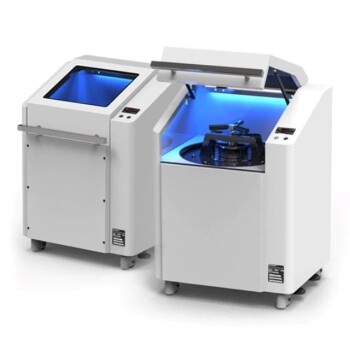
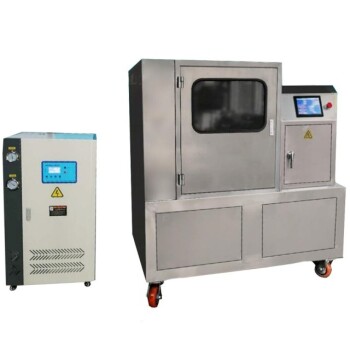
The primary function of a vibratory ball mill in this context is to perform intense mechanical mixing and activation of raw powder materials. specifically lanthanum oxide, lithium hydroxide, and tungsten or tellurium oxides. By utilizing high-frequency vibratory impacts, the device breaks down agglomerates and ensures a uniform distribution of these components at a microscopic scale. This mechanical processing is the prerequisite step that enables the synthesis of lithium-rich double perovskite precursors.
The vibratory ball mill acts as a "mechanical activator." It does not merely blend ingredients; it refines particle sizes to increase surface area, creating the necessary reactivity for successful solid-state reactions.
The Mechanics of Precursor Preparation
High-Frequency Impact Force
Unlike standard mixing, a vibratory ball mill applies intense mechanical energy through rapid vibration. This high-frequency motion causes the grinding media to impact the powder repeatedly. This action forces the distinct raw materials to mix intimately rather than settling or segregating.
Refining Particle Size
The intense impact reduces the geometric size of the raw powder particles. By pulverizing the material, the mill eliminates large clusters or agglomerates that could hinder chemical progression. This results in a fine, consistent powder that behaves predictably during processing.
Enhancing Chemical Reactivity
Increasing Contact Area
The reduction in particle size leads to a significant increase in specific surface area. In solid-state chemistry, reaction rates are limited by the contact area between solid particles. By maximizing this area, the mill ensures that lithium, lanthanum, and other ions are physically close enough to react.
Establishing the Reaction Foundation
The primary output of this process is a "precursor" mixture with heightened reaction activity. This mechanically activated state lowers the energy barrier for the subsequent heating stages. It ensures that the final crystal structure forms uniformly during the high-temperature solid-state reaction.
Understanding the Trade-offs
Risk of Impurity Introduction
The same intense impact that refines the powder causes wear on the grinding media (balls and jar). Over-milling can introduce trace impurities from the jar lining or balls into the precursor mixture. This contamination can be detrimental to the electronic properties of high-purity perovskites.
Heat Generation
High-frequency vibration generates significant frictional heat within the milling chamber. While mechanical activation is desired, uncontrolled heat can sometimes trigger premature or unwanted surface reactions. Process parameters must be managed to maintain the correct temperature balance.
Making the Right Choice for Your Goal
When integrating vibratory ball milling into your synthesis workflow, prioritize your specific output requirements:
- If your primary focus is Phase Purity: Ensure the milling duration is sufficient to achieve complete microscopic homogeneity, as unmixed pockets will lead to secondary phases during calcination.
- If your primary focus is Reactivity: Focus on the intensity of the vibration to maximize particle refinement and surface area, reducing the time or temperature required for the subsequent solid-state reaction.
The success of your lithium-rich double perovskite synthesis depends entirely on the quality of this initial mechanical mixing step.
Summary Table:
| Feature | Function in Synthesis | Benefit to Precursor |
|---|---|---|
| High-Frequency Impact | Mechanical Activation | Increases surface area & lowers reaction energy barrier |
| Particle Refinement | De-agglomeration | Ensures consistent powder size and predictable processing |
| Intimate Mixing | Microscopic Distribution | Prevents secondary phase formation during calcination |
| Process Control | Parameter Management | Balances reactivity while minimizing impurity introduction |
Optimize Your Advanced Material Synthesis with KINTEK
Achieving the perfect precursor homogeneity is critical for high-performance lithium-rich double perovskites. KINTEK provides the high-precision tools necessary for every stage of your workflow.
Our extensive portfolio includes:
- Crushing and Milling Systems: Including high-energy vibratory mills for superior mechanical activation.
- High-Temperature Furnaces: Muffle, tube, and atmosphere furnaces for precise solid-state reactions.
- Advanced Reactors: High-temperature and high-pressure reactors and autoclaves for complex synthesis.
- Laboratory Essentials: Electrolytic cells, hydraulic presses, and high-purity ceramic crucibles.
Whether you are focused on battery research or advanced ceramic development, KINTEK’s equipment ensures purity, consistency, and efficiency. Contact our technical team today to discuss how our solutions can enhance your lab's output!
Related Products
- Hybrid High Energy Vibratory Ball Mill for Lab Use
- High Energy Vibratory Ball Mill for Lab Use
- High Energy Vibratory Laboratory Ball Mill Double Tank Type
- High Energy Vibratory Laboratory Ball Mill Grinding Mill Single Tank Type
- Lab Vibration Mill
People Also Ask
- What is the core function of a high-energy vibratory ball mill? Unlock Advanced Mechanochemical Synthesis
- What is the function of a high-energy ball mill in the synthesis of amorphous NaTaCl6? Optimize Your Ion Conductivity
- What is the role of a high-energy ball mill in battery material prep? Optimize Nanostructuring for Li-ion Performance
- What physical conditions do high-energy ball mills provide? Optimize Catalyst Synthesis via Mechanical Activation
- What is the function of a high-energy ball mill in the preparation of Ti2448 medical alloys? Key Roles Explained