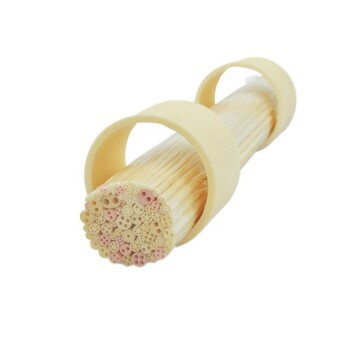
Alumina tubes and alumina wool insulation function as the critical reaction vessel and thermal stabilizer within a high-temperature pyrolysis furnace. The high-purity alumina tube acts as a chemically inert chamber that isolates the biomass feedstock, while the alumina wool insulation wraps the system to ensure a uniform heat field and minimize energy loss.
Successful biochar production requires an environment free of temperature fluctuations and chemical contamination. Alumina components provide the necessary isolation and thermal consistency to transform raw biomass into high-quality, stable carbon.
The Role of the High-Purity Alumina Tube
Creating a Chemically Inert Reaction Chamber
The primary function of the alumina tube is to serve as the physical vessel where pyrolysis occurs. Because it is made of high-purity alumina, it offers exceptional chemical inertness.
This prevents the furnace material from reacting with the biomass feedstock during heating. Maintaining this isolation is essential for preserving specific surface functional groups on the biochar, such as carboxyl and phenolic hydroxyl groups.
Withstanding High Thermal Stress
Biochar production typically occurs between 500°C and 800°C. The alumina tube provides excellent thermal stability within this range.
It maintains its structural integrity without deforming, even during the specific heating rates required for dehydration, deoxygenation, and polycondensation reactions.
Enabling Atmosphere Control
The tube structure allows for a sealed environment, which is critical for anaerobic processing. It facilitates the introduction of nitrogen or other inert gases to displace oxygen.
This oxygen-limited environment prevents the biomass from combusting (burning to ash) and instead drives the carbonization process needed to fix carbon and develop aromaticity.
The Role of Alumina Wool Insulation
Ensuring a Uniform Heat Field
Alumina wool acts as a sophisticated thermal shield surrounding the reaction chamber. Its primary goal is to ensure that heat is distributed evenly throughout the furnace cavity.
Uniform heat is vital for consistent pore development. If temperature gradients exist, different parts of the biomass sample will pyrolyze at different rates, resulting in uneven surface areas and inconsistent adsorption capabilities.
Maximizing Energy Efficiency and Control
By minimizing heat loss to the outside environment, alumina wool allows the furnace controller to maintain precise internal temperatures.
This insulation enables the system to stick strictly to programmed heating rates. Accurate regulation of these parameters is what dictates the final pore structure and stability of the biochar.
Understanding the Trade-offs
Sensitivity to Thermal Shock
While alumina is thermally stable at high temperatures, it has a low resistance to rapid temperature changes (thermal shock).
Aggressive heating or cooling rates can cause the alumina tube to crack. Operators must balance the need for specific heating profiles with the physical limitations of the ceramic material.
Scale Limitations
Tube furnaces relying on these components are generally limited to laboratory or small-scale pilot production.
While they offer superior control for research and high-value biochar production, the geometry of the alumina tube restricts the volume of feedstock that can be processed compared to industrial rotary kilns.
Making the Right Choice for Your Goal
To maximize the utility of your pyrolysis setup, consider your specific production targets:
- If your primary focus is maximizing specific surface area (porosity): Rely on the thermal uniformity provided by high-quality insulation to ensure consistent degassing and pore formation across the entire sample.
- If your primary focus is chemical purity for ion exchange: Depend on the inertness of the high-purity alumina tube to prevent contamination and preserve the surface functional groups required for arsenic or heavy metal removal.
The synergy between the inert containment of the tube and the thermal stability of the insulation is what allows for the precise engineering of biochar properties.
Summary Table:
| Component | Primary Function | Key Benefit for Biochar |
|---|---|---|
| Alumina Tube | Chemically inert reaction vessel | Prevents contamination & preserves surface functional groups |
| Alumina Wool | High-efficiency thermal insulation | Ensures uniform heat field for consistent pore development |
| Atmosphere Control | Sealed anaerobic environment | Prevents combustion to ensure carbonization instead of ash |
| Thermal Stability | Structural integrity at 500-800°C | Enables precise control over dehydration & polycondensation |
Elevate Your Material Research with KINTEK
Precision in biochar production starts with high-performance thermal equipment. KINTEK specializes in advanced laboratory solutions, providing the high-purity alumina tubes, ceramic components, and high-temperature furnaces (tube, muffle, and vacuum) essential for rigorous pyrolysis research.
Whether you are engineering specific surface porosities or developing high-purity carbon for ion exchange, our comprehensive range—including crushing systems, hydraulic presses, and atmosphere-controlled reactors—is designed to meet the most demanding scientific standards.
Ready to optimize your lab's thermal processing? Contact KINTEK experts today to find the perfect equipment for your application.
References
- Van Ngoc Duong, Hynek Roubík. A novel treatment of biogas digestate waste for biochar production and its adsorption of methylene blue and malachite green in a binary system. DOI: 10.1002/bbb.2772
This article is also based on technical information from Kintek Solution Knowledge Base .
Related Products
- High Temperature Alumina (Al2O3) Furnace Tube for Engineering Advanced Fine Ceramics
- 1700℃ Laboratory High Temperature Tube Furnace with Alumina Tube
- 1400℃ Laboratory High Temperature Tube Furnace with Alumina Tube
- High Temperature Aluminum Oxide (Al2O3) Protective Tube for Engineering Advanced Fine Ceramics
- Engineering Advanced Fine Alumina Al2O3 Ceramic Rod Insulated for Industrial Applications
People Also Ask
- What is the primary function of an Alumina (Al2O3) tube in LLZTO sintering? Optimize Your Thermal Processing
- What role does a high-alumina furnace tube play in high-temperature nickel slag reduction? Ensure 1400°C Precision
- How does an alumina tube furnace with a controlled atmosphere simulate conditions in CSP environments? Master Accuracy.
- How do you clean an alumina tube furnace? Extend Tube Life with Proper Maintenance
- How to clean an alumina tube furnace? Extend Tube Life and Ensure Experimental Purity