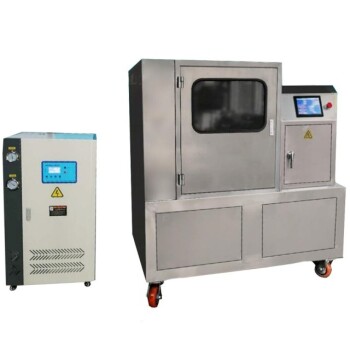
The primary function of industrial pulverizers and crushers in this context is to act as the essential bridge between raw material synthesis and fine powder production. Specifically, they apply intense mechanical stress to fracture the extremely hard and brittle cermet "cakes" produced by self-propagating high-temperature synthesis (SHS) into manageable particles smaller than 3 mm. This step is mandatory because standard grinding equipment lacks the force required to process these toughened alloys without failure.
The master alloys generated by SHS are too hard and brittle for standard equipment to handle directly. Industrial crushers provide the necessary high-impact force to reduce these solid synthetic blocks into a sub-3 mm feedstock, establishing the foundation for all subsequent fine grinding and classification.
Overcoming Material Constraints
The Limitation of Standard Equipment
The cermet blocks resulting from SHS are not typical alloys; they are defined by extreme hardness.
Standard grinding machinery generally lacks the mechanical force required to process this material. Attempting to use non-specialized equipment often results in machinery damage or operational failure.
Leveraging Brittleness
While the material is hard, the SHS process also renders the master alloys highly brittleness.
Industrial pulverizers exploit this characteristic. Rather than cutting the material, they apply massive compressive stress or impact force to shatter the brittle structure.
The Mechanics of Reduction
Breaking Down the Synthetic Cake
The raw output of the SHS process is a solid, cohesive mass often referred to as a synthetic cake.
Crushers are the first line of defense, taking this large, unmanageable solid and mechanically fracturing it into irregular chunks.
Achieving the Critical Particle Size
The operational goal of this stage is precise: reducing the material to particles smaller than 3 mm.
This specific size threshold is critical. It transforms the material from a solid block into a flowable granular state that can be handled by downstream machinery.
The Strategic Role in Processing
Foundation for Fine Grinding
Crushing is strictly a preparatory step; it establishes the foundation for fine grinding.
Fine grinding mills are designed for precision, not heavy reduction. They require pre-crushed feedstock (the <3 mm particles) to operate efficiently and effectively.
Enabling Classification
Once the material is reduced to the target size, it is ready for classification.
This ensures that only particles of the correct dimension move forward, protecting delicate downstream equipment from oversized chunks.
Understanding the Trade-offs
Equipment Wear and Tear
Processing materials with such extreme hardness inevitably leads to rapid abrasion of crushing surfaces.
Operators must plan for regular inspection and replacement of liners or hammers, as the "cake" is often harder than the steel used to crush it.
Energy Intensity
Breaking down SHS alloys requires significantly higher mechanical stress than standard mineral processing.
This implies a higher energy consumption per ton of material processed compared to softer industrial compounds.
Making the Right Choice for Your Process
If you are designing a comminution circuit for SHS materials, consider these priorities:
- If your primary focus is process efficiency: rigid adherence to the <3 mm output size will significantly increase the throughput speed of your subsequent fine grinding stage.
- If your primary focus is equipment longevity: ensure your crushers are specifically rated for high-hardness master alloys to avoid catastrophic mechanical failure.
By effectively reducing an unworkable solid into a granular feedstock, industrial crushers render high-performance cermets usable for manufacturing applications.
Summary Table:
| Feature/Function | Description | Impact on Processing |
|---|---|---|
| Material Reduction | Fractures hard synthetic "cakes" into particles < 3 mm. | Converts solid masses into flowable granular feedstock. |
| Stress Application | Applies intense mechanical impact to exploit brittleness. | Overcomes extreme hardness that standard equipment cannot handle. |
| Process Foundation | Acts as the primary stage before fine grinding. | Protects precision downstream mills from mechanical failure. |
| Classification Prep | Prepares material for size-based sorting. | Ensures uniform input for high-quality final powder production. |
| Wear Management | Requires high-durability crushing surfaces. | Prevents catastrophic equipment damage during high-stress processing. |
Optimize Your Cermet Production with KINTEK
Ensure your laboratory workflow is efficient and your equipment is protected with KINTEK’s robust crushing and milling systems. Processing extremely hard SHS cermet blocks requires high-impact force that standard machinery simply cannot provide. KINTEK specializes in high-performance laboratory equipment designed for these demanding applications.
Our comprehensive portfolio includes:
- Crushing and Milling Systems: Engineered to reduce tough alloys to the precise sub-3 mm feedstock required for fine grinding.
- High-Temperature Furnaces: Including muffle, vacuum, and CVD options for synthesis and heat treatment.
- Hydraulic Presses: Ideal for pelleting and isostatic pressing of advanced materials.
- Consumables: High-quality ceramics, crucibles, and PTFE products to support your research.
Don't let material hardness stall your innovation. Contact KINTEK today to find the perfect solution for your material processing needs and enhance your lab's productivity!
References
- Vladimir Promakhov, Anton Perminov. Inconel 625/TiB2 Metal Matrix Composites by Direct Laser Deposition. DOI: 10.3390/met9020141
This article is also based on technical information from Kintek Solution Knowledge Base .
Related Products
People Also Ask
- What is the function of an industrial vibratory mill? Optimize Fe-Cr-Al Alloy Powder Production
- How does a Vibratory Mill improve niobium recovery efficiency? Optimize Waste Pre-treatment for Maximum Yield
- Why use stainless steel jars and balls for solid-state battery slurries? Maximize Dispersion and Conductivity
- What role does ultra-low temperature cooling equipment play in hydrogel preparation? Master Light-Driven Actuation
- Why is a low-temperature cooling solution necessary for nanoparticle toxicity? Ensure Scientific Accuracy & Stability