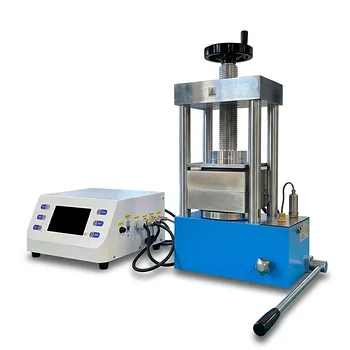
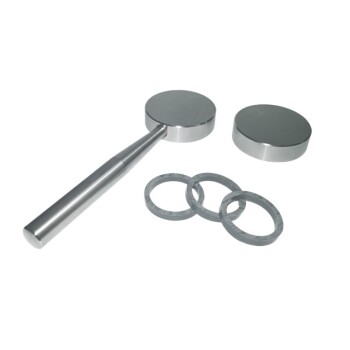
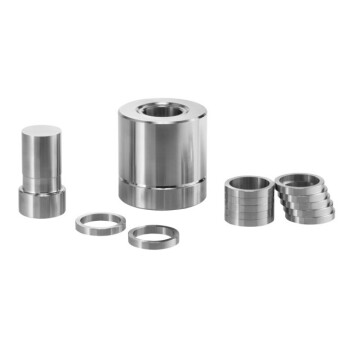
In the preparation of Magnesium Manganese Oxide (MgMnO) granules, laboratory hydraulic presses and forming molds serve as the primary mechanism for transforming loose powders into high-density, geometrically precise solid fuel. This equipment compacts mixed MgO and MnO powders into specific forms, such as 3.5mm spherical granules, which are essential for maintaining optimal fluidity within moving-bed reactors. By applying controlled axial pressure, these tools ensure that the resulting granules possess a uniform reaction surface area necessary for efficient thermochemical reduction.
The core function of the hydraulic press and mold system is to provide the mechanical force and structural constraints required to achieve particle rearrangement and dense packing. This process establishes the physical foundation—mechanical strength, density, and shape—required for the granules to survive subsequent thermal processing and chemical reactions.
Shaping for Operational Efficiency
Achieving Geometric Precision
The use of precision steel molds allows researchers to produce granules with exact dimensions, such as a 3.5mm diameter. This consistency is vital for maintaining a uniform reaction surface area, which ensures that thermochemical processes occur predictably across all particles.
Optimizing Fluidity for Moving-Bed Reactors
A primary requirement for MgMnO granules in solid fuel applications is their ability to flow through a moving-bed reactor. The forming mold shapes the powder into spherical or cylindrical geometries that minimize inter-particle friction, facilitating the constant movement required for continuous processing.
Simulating Industrial Conditions
By using precise pressure control, laboratory presses can create pellets that simulate the bulk density and material contact states of industrial-scale sintering. This allows researchers to accurately predict how the material will behave regarding hot air penetration and solid-phase reaction kinetics in a production environment.
Enhancing Material Reactivity and Integrity
Maximizing Particle Contact and Density
The hydraulic press applies high axial pressure—often ranging from tens to hundreds of megapascals—to overcome friction between powder particles. This forces the MgO and MnO particles to rearrange and bond tightly, excluding trapped air and increasing the contact area for solid-phase reactions.
Ensuring Mechanical Strength of "Green Bodies"
Before sintering, the compressed powder is known as a "green body," which must be strong enough to be handled without breaking. The high-pressure environment ensures the granules have sufficient structural integrity to prevent failure during transport or the initial stages of thermal processing.
Reducing Porosity and Shrinkage
Controlled compression effectively reduces the initial porosity of the MgMnO granules. By minimizing internal voids, the press helps prevent severe volume shrinkage, cracking, or deformation when the material is subjected to high temperatures during the sintering stage.
Understanding the Trade-offs and Limitations
The Challenge of Pressure Distribution
While hydraulic presses are excellent for density, uniaxial (one-direction) pressing can sometimes lead to non-uniform density distributions within a single granule. This variance can cause internal stresses that may lead to structural weaknesses or uneven reaction rates during the thermochemical cycle.
Risks of Over-Compression
Applying excessive pressure can lead to "capping" or lamination, where the granule splits into layers upon being ejected from the mold. It is critical to balance the need for high density with the elastic limits of the MgO and MnO powder mixture to maintain structural soundness.
Mold Wear and Contamination
High-pressure forming creates significant friction between the powder and the steel mold walls. Over time, this can lead to mold wear and potential contamination of the MgMnO granules with trace metallic elements, which may alter the material's catalytic or thermochemical properties.
How to Apply This to Your Project
Making the Right Choice for Your Goal
- If your primary focus is reactor flow dynamics: Prioritize molds that produce highly spherical granules to ensure maximum fluidity and prevent bridging in the reactor.
- If your primary focus is maximizing reaction speed: Use higher compaction pressures (within the material's limits) to increase particle contact area and facilitate faster solid-phase reactions.
- If your primary focus is structural longevity: Focus on precision pressure control and gradual decompression to prevent internal micro-cracks that could lead to granule pulverization during repeated thermal cycles.
- If your primary focus is experimental accuracy: Ensure the press is equipped with a digital gauge to maintain pressure consistency across different batches, ensuring that your test specimens are truly comparable.
The strategic use of hydraulic pressing and precision molding is the fundamental step that bridges the gap between raw chemical powders and functional, high-performance MgMnO solid fuel granules.
Summary Table:
| Feature | Function in MgMnO Preparation | Impact on Research |
|---|---|---|
| High-Pressure Compaction | Rearranges MgO/MnO particles for dense packing | Maximizes reaction surface area and solid-phase kinetics |
| Geometric Precision | Shapes powders into 3.5mm spherical or cylindrical forms | Ensures optimal fluidity and uniform flow in moving-bed reactors |
| Structural Integrity | Creates high-strength "green bodies" | Prevents granule breakage during handling and thermal processing |
| Porosity Control | Minimizes internal voids and air pockets | Reduces volume shrinkage and prevents cracking during sintering |
Elevate Your Material Research with KINTEK Precision
Achieving the perfect MgMnO granule requires more than just pressure—it requires precision. KINTEK specializes in advanced laboratory solutions designed to bridge the gap between raw powder and high-performance solid fuel. Our comprehensive range of laboratory hydraulic presses (pellet, hot, and isostatic) and custom forming molds ensure your samples achieve the exact density and geometric precision required for rigorous thermochemical testing.
Beyond sample preparation, KINTEK supports your entire workflow with:
- High-Temperature Furnaces: Muffle, tube, vacuum, and CVD systems for expert sintering.
- Material Processing: Crushing, milling systems, and sieving equipment for uniform powder consistency.
- Advanced Reactors: High-temperature high-pressure reactors and autoclaves for real-world simulation.
- Specialized Consumables: High-purity ceramics, crucibles, and PTFE products.
Ready to enhance your lab's efficiency and experimental accuracy? Contact KINTEK today to find the ideal equipment for your project!
References
- Philipp Schimmels, James F. Klausner. Enhancing the Chemical Energy Flux in a High-Temperature Tubular Counterflow Solid Fuel Synthesis Reactor Using a Bypass. DOI: 10.1021/acs.iecr.3c01296
This article is also based on technical information from Kintek Solution Knowledge Base .
Related Products
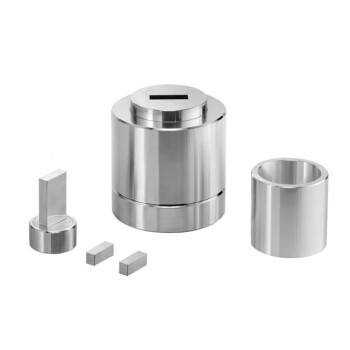
- Ball Press Mold for Lab
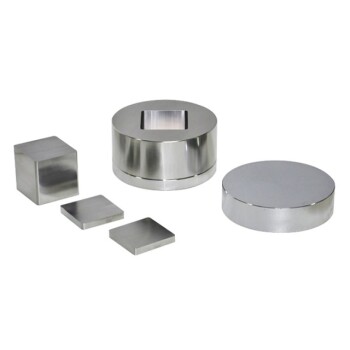
- Assemble Square Lab Press Mold for Laboratory Applications
- Manual Lab Heat Press
- Square Lab Press Mold for Laboratory Applications
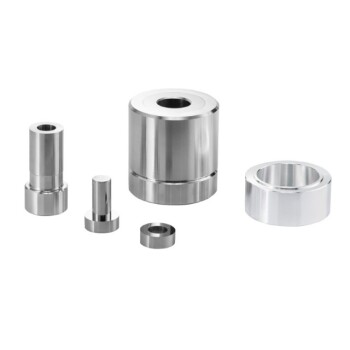
- Ring Press Mold for Lab Applications
People Also Ask
- What are the advantages of using a laboratory hydraulic press for hot pressing? Achieve Peak Nano-Composite Density
- How to use a press mold? Master the Art of Creating Consistent Ceramic Forms
- What is the press mould method? A Guide to Consistent, Detailed Ceramic Forms
- What is the purpose of specialized pressure devices in sulfide solid-state batteries? Ensure Chemo-Mechanical Stability
- Why are pressure molds with non-conductive resin inner walls required for battery testing? Ensure Data Accuracy