Knowledge What is the guideline for autoclave? A Step-by-Step Protocol for Safe Sterilization
Author avatar

Tech Team · Kintek Solution

Updated 6 days ago

What is the guideline for autoclave? A Step-by-Step Protocol for Safe Sterilization


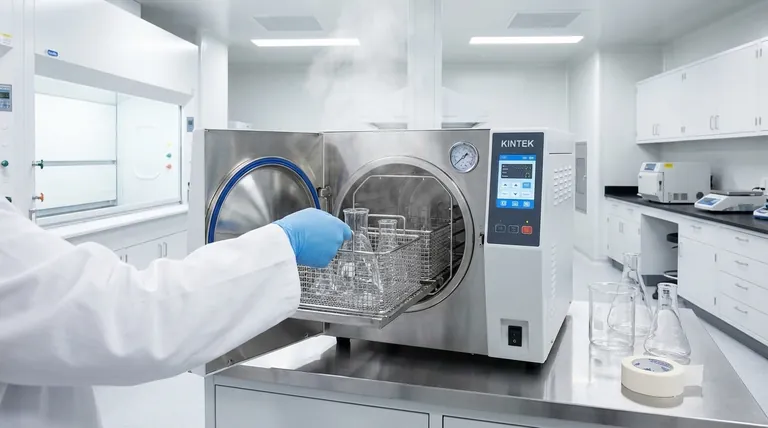
A guideline for an autoclave is a systematic procedure for using pressurized steam to achieve sterility. The core process involves adding water, properly loading materials, sealing the chamber, running a cycle at a specific temperature and pressure (typically 121°C at 15 psi), and allowing a complete cool-down before safely unloading the sterilized items.

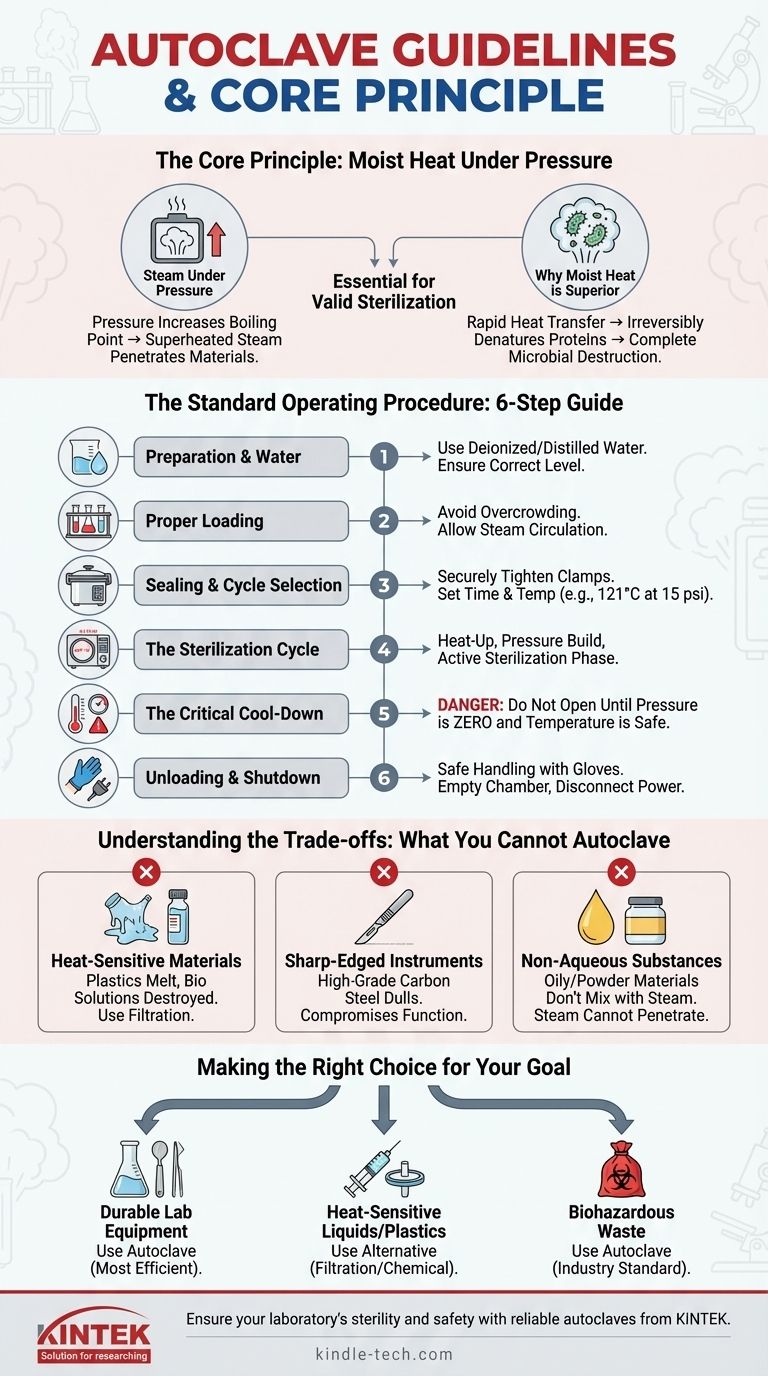
The central principle of autoclaving is not just applying heat, but using moist heat under pressure. Understanding this allows you to determine what can and cannot be safely sterilized, preventing damaged equipment and ensuring complete microbial destruction.
What is the guideline for autoclave? A Step-by-Step Protocol for Safe Sterilization

The Core Principle: How an Autoclave Achieves Sterility

An autoclave's effectiveness comes from its unique combination of physical forces. It is far more effective than simply boiling or using dry heat.

Steam Under Pressure

The sealed chamber of an autoclave allows pressure to increase significantly. This rise in pressure allows water to boil at a much higher temperature than normal, creating superheated steam that can effectively penetrate materials.

Why Moist Heat is Superior

Moist heat is exceptionally efficient at killing microbes. The hot water vapor rapidly transfers heat and irreversibly denatures essential proteins and enzymes within microorganisms, rendering them non-functional and ensuring their destruction.

The Standard Operating Procedure: A Step-by-Step Guide

Following a consistent procedure is critical for both safety and effectiveness. While specific models vary, the fundamental steps remain the same.

Step 1: Preparation and Water Level

Before use, ensure the autoclave has the required amount of deionized or distilled water. Using the correct water level is essential for generating enough steam for the entire cycle.

Step 2: Proper Loading Technique

Place items inside the chamber without overcrowding them. Proper spacing is crucial to allow steam to circulate freely and reach all surfaces of the items being sterilized.

Step 3: Sealing and Cycle Selection

Close the autoclave lid and ensure the safety clamps are securely tightened to create a perfect seal. Set the appropriate time and temperature or select a pre-programmed cycle based on the load (e.g., liquids, glassware, waste).

Step 4: The Sterilization Cycle

Once started, the autoclave will heat up, build pressure, and hold the target temperature for the designated duration. This is the active phase where sterilization occurs.

Step 5: The Critical Cool-Down Phase

After the cycle completes, the chamber must be allowed to cool and depressurize completely. Attempting to open an autoclave while it is still under pressure is extremely dangerous and can cause severe burns or explosive boiling of liquids.

Step 6: Unloading and Shutdown

Once the pressure gauge reads zero and the temperature has dropped to a safe level, you can open the door and carefully remove the items. After use, empty the chamber and disconnect the power if it will not be used again soon.

Understanding the Trade-offs: What You Cannot Autoclave

An autoclave is a powerful tool, but it is not suitable for all materials. Attempting to sterilize incompatible items can result in damaged equipment or failed sterilization.

Heat-Sensitive Materials

Many plastics will melt or deform under the high heat and pressure. Additionally, sensitive biological solutions such as vaccines, serums, or certain protein media will be destroyed and must be sterilized using other methods like filtration.

Sharp-Edged Instruments

The high heat can cause the fine edges of high-grade carbon steel instruments, like certain scalpels or scissors, to become dull, compromising their function.

Non-Aqueous and Oily Substances

Autoclaving relies on moist heat. Oily substances, powders, and other materials that do not mix with water cannot be sterilized effectively because the steam cannot penetrate them.

Making the Right Choice for Your Goal

Select your sterilization method based on the material and your objective.

  • If your primary focus is sterilizing durable lab equipment (glassware, stainless steel tools, media): The autoclave is the most efficient, economical, and reliable method.
  • If your primary focus is sterilizing heat-sensitive liquids or plastics: You must use an alternative method, such as sterile filtration for liquids or chemical sterilization for solids.
  • If your primary focus is decontaminating biohazardous waste: The autoclave is the industry standard for rendering biological waste safe for disposal.

Mastering the autoclave protocol is fundamental to ensuring safety, validity, and success in any sterile environment.

Summary Table:

Key Step Purpose Critical Detail
Preparation & Water Generate sufficient steam Use deionized/distilled water
Loading Ensure steam penetration Avoid overcrowding; allow space for circulation
Cycle Selection Achieve sterility for specific loads Standard cycle: 121°C at 15 psi
Cool-Down Ensure user safety Never open until pressure is zero and temperature is safe
Unloading Safe handling of sterile items Use heat-protective gloves

Ensure your laboratory's sterility and safety with reliable autoclaves from KINTEK.

Proper sterilization is non-negotiable for valid results and user protection. KINTEK specializes in high-quality lab equipment and consumables, providing autoclaves designed for precise temperature control, uniform steam penetration, and long-lasting performance. Our solutions are trusted by laboratories worldwide to meet stringent sterilization protocols efficiently and safely.

Let KINTEK be your partner in laboratory excellence. Contact our experts today to find the perfect autoclave solution for your specific needs, from routine glassware sterilization to biohazard waste decontamination.

Visual Guide
What is the guideline for autoclave? A Step-by-Step Protocol for Safe Sterilization Visual Guide

Related Products

People Also Ask

Related Products

Laboratory Sterilizer Lab Autoclave Vertical Pressure Steam Sterilizer for Liquid Crystal Display Automatic Type

Laboratory Sterilizer Lab Autoclave Vertical Pressure Steam Sterilizer for Liquid Crystal Display Automatic Type

Liquid crystal display automatic vertical sterilizer is a safe, reliable and automatic control sterilization equipment, which is composed of heating system, microcomputer control system and overheating and overvoltage protection system.

Desktop Fast Laboratory Autoclave Sterilizer 35L 50L 90L for Lab Use

Desktop Fast Laboratory Autoclave Sterilizer 35L 50L 90L for Lab Use

The desktop fast steam sterilizer is a compact and reliable device used for rapid sterilization of medical, pharmaceutical, and research items. It efficiently sterilizes surgical instruments, glassware, medicines, and resistant materials, making it suitable for various applications.

Laboratory Sterilizer Lab Autoclave Pulse Vacuum Lifting Sterilizer

Laboratory Sterilizer Lab Autoclave Pulse Vacuum Lifting Sterilizer

The pulse vacuum lifting sterilizer is a state-of-the-art equipment for efficient and precise sterilization. It uses pulsating vacuum technology, customizable cycles, and a user-friendly design for easy operation and safety.

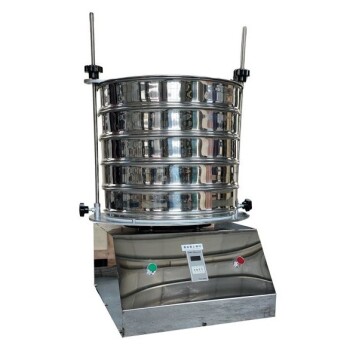
Laboratory Test Sieves and Sieving Machines

Laboratory Test Sieves and Sieving Machines

Precision lab test sieves & sieving machines for accurate particle analysis. Stainless steel, ISO-compliant, 20μm-125mm range. Request specs now!

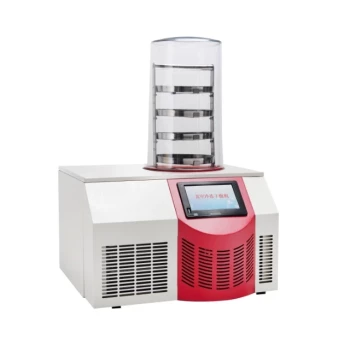
Benchtop Laboratory Vacuum Freeze Dryer

Benchtop Laboratory Vacuum Freeze Dryer

Benchtop laboratory freeze dryer for efficient lyophilization of biological, pharmaceutical, and food samples. Features intuitive touchscreen, high-performance refrigeration, and durable design. Preserve sample integrity—consult now!

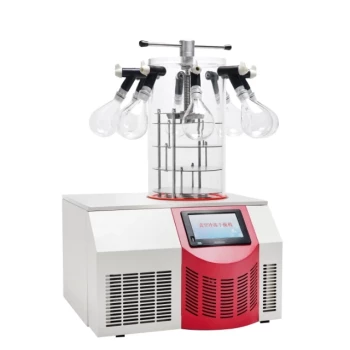
Benchtop Laboratory Freeze Dryer for Lab Use

Benchtop Laboratory Freeze Dryer for Lab Use

Premium benchtop laboratory freeze dryer for lyophilization, preserving samples with ≤ -60°C cooling. Ideal for pharmaceuticals & research.

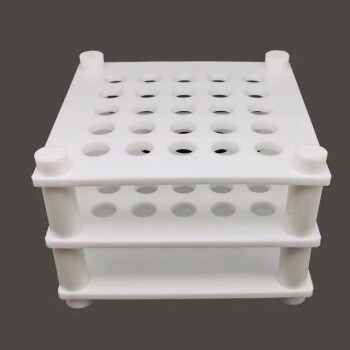
Custom PTFE Teflon Parts Manufacturer for Centrifuge Tube Racks

Custom PTFE Teflon Parts Manufacturer for Centrifuge Tube Racks

The precision-made PTFE test tube racks are completely inert and, due to the high temperature properties of PTFE, these test tube racks can be sterilized (autoclaved) without any problems.

Small Vacuum Heat Treat and Tungsten Wire Sintering Furnace

Small Vacuum Heat Treat and Tungsten Wire Sintering Furnace

The small vacuum tungsten wire sintering furnace is a compact experimental vacuum furnace specially designed for universities and scientific research institutes. The furnace features a CNC welded shell and vacuum piping to ensure leak-free operation. Quick-connect electrical connections facilitate relocation and debugging, and the standard electrical control cabinet is safe and convenient to operate.

Vacuum Dental Porcelain Sintering Furnace

Vacuum Dental Porcelain Sintering Furnace

Get precise and reliable results with KinTek's Vacuum Porcelain Furnace. Suitable for all porcelain powders, it features hyperbolic ceramic furnace function, voice prompt, and automatic temperature calibration.

Laboratory Hybrid Tissue Grinding Mill

Laboratory Hybrid Tissue Grinding Mill

KT-MT20 is a versatile laboratory device used for rapid grinding or mixing of small samples, whether dry, wet, or frozen. It comes with two 50ml ball mill jars and various cell wall breaking adapters for biological applications such as DNA/RNA and protein extraction.

HFCVD Machine System Equipment for Drawing Die Nano-Diamond Coating

HFCVD Machine System Equipment for Drawing Die Nano-Diamond Coating

The nano-diamond composite coating drawing die uses cemented carbide (WC-Co) as the substrate, and uses the chemical vapor phase method ( CVD method for short ) to coat the conventional diamond and nano-diamond composite coating on the surface of the inner hole of the mold.

Custom PTFE Teflon Parts Manufacturer for PTFE Buchner Funnel and Triangular Funnel

Custom PTFE Teflon Parts Manufacturer for PTFE Buchner Funnel and Triangular Funnel

The PTFE funnel is a piece of laboratory equipment used primarily for filtration processes, particularly in the separation of solid and liquid phases in a mixture. This setup allows for efficient and rapid filtration, making it indispensable in various chemical and biological applications.

Anti-Cracking Press Mold for Lab Use

Anti-Cracking Press Mold for Lab Use

The anti-cracking press mold is a specialized equipment designed for molding various shapes and sizes of film using high pressure and electric heating.

Custom PTFE Teflon Parts Manufacturer Corrosion Resistant Cleaning Rack Flower Basket

Custom PTFE Teflon Parts Manufacturer Corrosion Resistant Cleaning Rack Flower Basket

The PTFE cleaning rack, also known as the PTFE flower basket cleaning flower basket, is a specialized laboratory tool designed for the efficient cleaning of PTFE materials. This cleaning rack ensures thorough and safe cleaning of PTFE items, maintaining their integrity and performance in laboratory settings.

Vacuum Hot Press Furnace Machine for Lamination and Heating

Vacuum Hot Press Furnace Machine for Lamination and Heating

Experience clean and precise lamination with Vacuum Lamination Press. Perfect for wafer bonding, thin-film transformations, and LCP lamination. Order now!

Graphite Vacuum Furnace IGBT Experimental Graphitization Furnace

Graphite Vacuum Furnace IGBT Experimental Graphitization Furnace

IGBT experimental graphitization furnace, a tailored solution for universities and research institutions, with high heating efficiency, user-friendliness, and precise temperature control.

915MHz MPCVD Diamond Machine Microwave Plasma Chemical Vapor Deposition System Reactor

915MHz MPCVD Diamond Machine Microwave Plasma Chemical Vapor Deposition System Reactor

915MHz MPCVD Diamond Machine and its multi-crystal effective growth, the maximum area can reach 8 inches, the maximum effective growth area of single crystal can reach 5 inches. This equipment is mainly used for the production of large-size polycrystalline diamond films, the growth of long single crystal diamonds, the low-temperature growth of high-quality graphene, and other materials that require energy provided by microwave plasma for growth.

Variable Speed Peristaltic Pump

Variable Speed Peristaltic Pump

KT-VSP Series Smart Variable Speed Peristaltic Pumps offer precise flow control for labs, medical, and industrial applications. Reliable, contamination-free liquid transfer.

Laboratory Vibratory Sieve Shaker Machine Slap Vibrating Sieve

Laboratory Vibratory Sieve Shaker Machine Slap Vibrating Sieve

KT-T200TAP is a slapping and oscillating sieving instrument for laboratory desktop use, with 300 rpm horizontal circular motion and 300 vertical slapping motions to simulate manual sieving to help sample particles pass through better.

Metallographic Specimen Mounting Machine for Laboratory Materials and Analysis

Metallographic Specimen Mounting Machine for Laboratory Materials and Analysis

Precision metallographic mounting machines for labs—automated, versatile, and efficient. Ideal for sample prep in research and quality control. Contact KINTEK today!


Leave Your Message