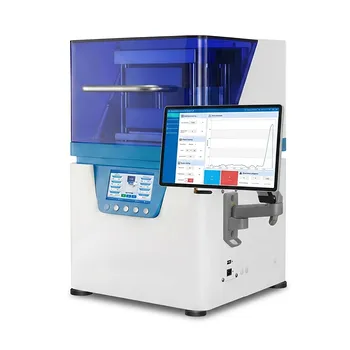
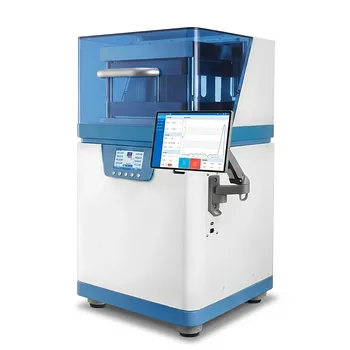
The laboratory hydraulic press is the critical tool for transforming raw biochar powder into a functional industrial adsorbent. By densifying the material into pellets or specific shapes, the press increases packing density, prevents the loss of material as dust in high-speed flows, and optimizes the bed's resistance to gas and liquid penetration.
A laboratory hydraulic press ensures the operational stability of adsorption beds by balancing mechanical strength with high porosity. This process is essential for reducing pressure drops and maintaining consistent performance in continuous-flow environments.
Enhancing Operational Stability and Flow Dynamics
Increasing Packing Density and System Stability
Utilizing a hydraulic press to mold modified biochar powder into pellets significantly increases the packing density of the adsorption bed. This densification is vital for practical applications, as it ensures the material remains seated and stable during operation.
Minimizing Pressure Drop and Flow Resistance
In continuous-flow equipment, loose powder creates high resistance, leading to significant pressure drops. Compressing biochar into regular granules or pellets allows for smoother fluid passage, ensuring the system operates efficiently without requiring excessive pumping power.
Controlling Material Geometry for Uniformity
Precise molding allows for the creation of specific geometric shapes, such as briquettes or pellets. This uniformity ensures that the flow distribution across the adsorption bed is predictable, preventing "channeling" where fluids bypass the adsorbent material.
Improving Mechanical Integrity and Material Longevity
Preventing Dust Emission and Material Loss
Raw biochar is often brittle and prone to turning into fine dust when subjected to high-speed gas flows. A hydraulic press compacts the material into a robust form that resists attrition and erosion, thereby protecting downstream equipment and maintaining bed volume.
Balancing Porosity with Structural Strength
Precise pressure control is necessary to ensure that the resulting biochar blocks maintain high internal porosity for adsorption while possessing the mechanical strength to withstand the impact of water or gas flow. Over-pressuring can crush the pores, while under-pressuring leads to structural failure.
Synergistic Effects of Heat and Binders
When equipped with heating functions, a press can reduce the viscosity of bio-oil or chemical binders. This allows the binder to penetrate the microporous structure of the biochar more effectively, creating stronger van der Waals forces and chemical bonds for superior stability.
Achieving Precision for Analysis and Application
Ensuring Consistency for Instrumental Analysis
A hydraulic press is essential for preparing samples for techniques like XRF spectroscopy or mechanical strength testing. By applying tens of tons of pressure, it creates dense pellets with consistent density, minimizing physical deviations that could skew analytical results.
Optimizing Volumetric Energy and Storage
Densification significantly increases the volumetric energy density and improves the transportation characteristics of biochar. This makes the material easier to handle in industrial settings and reduces the footprint required for storage.
Facilitating Accurate FTIR Characterization
For detailed surface analysis, a press is used to create transparent pellets by mixing biochar with potassium bromide (KBr). The high pressure eliminates air bubbles, resulting in a light-transmitting disk that allows for the clear identification of functional groups like Fe-O or C=O.
Understanding the Trade-offs and Limitations
The Porosity vs. Compaction Dilemma
The primary trade-off in hydraulic pressing is the potential loss of surface area. While higher pressure increases mechanical strength, it can collapse the delicate pore structures that are responsible for the biochar's adsorption capacity.
Equipment and Mold Maintenance
High-pressure molding requires precision-engineered molds that are subject to significant wear. Using inconsistent pressure or poorly maintained molds can lead to internal stress fractures in the pellets, causing them to crumble prematurely during use.
How to Apply Pressing Techniques to Your Biochar Project
Choosing the Right Approach for Your Goal
- If your primary focus is gas-phase adsorption: Use a hydraulic press to create high-density pellets that can withstand high-speed flows without shedding dust.
- If your primary focus is wastewater treatment: Optimize the pressure to maintain maximum porosity while ensuring the pellets do not disintegrate under constant liquid impact.
- If your primary focus is analytical characterization: Use precision pressure control and standardized molds to ensure sample uniformity for repeatable XRF or FTIR data.
- If your primary focus is utilizing binders: Utilize a heated hydraulic press to improve binder penetration and achieve higher mechanical stability at lower pressures.
Properly calibrated hydraulic pressing is the definitive step in moving biochar from a laboratory curiosity to a high-performance industrial adsorbent.
Summary Table:
| Key Benefit | Impact on Adsorption Bed Performance |
|---|---|
| Densification | Increases packing density and ensures stability during operation. |
| Shape Control | Minimizes pressure drops and prevents fluid "channeling." |
| Mechanical Integrity | Prevents attrition and dust loss in high-speed gas/liquid flows. |
| Porosity Balancing | Maintains high internal surface area while ensuring structural strength. |
| Analytical Precision | Produces uniform pellets for consistent XRF and FTIR characterization. |
Elevate your biochar research and industrial material preparation with KINTEK’s precision laboratory solutions. Whether you need a high-performance laboratory hydraulic press (pellet, hot, or isostatic) for densification or specialized high-temperature furnaces (muffle, vacuum, CVD) for carbonization, we deliver the reliability your lab demands. Our comprehensive portfolio also features high-pressure reactors, crushing systems, and essential consumables like crucibles, ensuring a seamless workflow from raw material to final application. Contact KINTEK today to discover how our tailored equipment can optimize your adsorption bed performance and analytical accuracy.
References
- Mingxue Su, Bing Zhu. Competitive interactions of NH3 and toluene with biochar modified by pre- and post-treatments of H3PO4 in dual adsorption systems. DOI: 10.15376/biores.18.2.3870-3884
This article is also based on technical information from Kintek Solution Knowledge Base .
Related Products
- Laboratory Hydraulic Press Split Electric Lab Pellet Press
- Laboratory Hydraulic Press Lab Pellet Press Machine for Glove Box
- Laboratory Hydraulic Press Lab Pellet Press for Button Battery
- Automatic Laboratory Hydraulic Pellet Press Machine for Lab Use
- Fully Automatic Heated Hydraulic Lab Press for Materials Sintering and Sample Preparation
People Also Ask
- What role does a laboratory hydraulic press play in platinum recovery research? Enhancing Sample Precision
- What are the specific applications of a lab hydraulic press in biochar evaluation? Optimize density and data accuracy.
- What are the roles of a laboratory hydraulic press and stainless steel molds in the preparation of graphite samples?
- What is the role of a laboratory hydraulic press in electrode prep? Maximize Energy Density & Sealing Precision
- Why must a laboratory hydraulic press equipped with cylindrical molds be used when preparing BZY green bodies? High Density