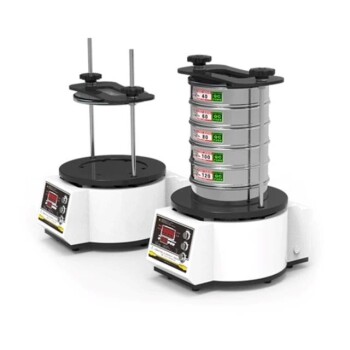
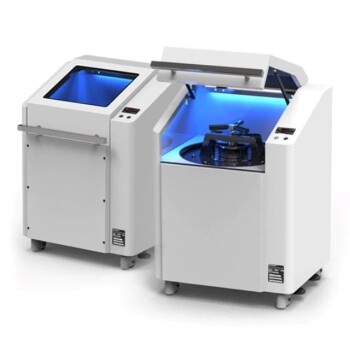
The primary function of crushing and sieving systems is to strictly control particle size, which governs both the chemical reactivity and the physical strength of the final solidification matrix. By mechanically processing Potassium Dihydrogen Phosphate (KH2PO4) and zeolite into specific micron-level ranges, these systems ensure uniform dispersion within the slurry, facilitating a thorough acid-base neutralization reaction and maximizing the matrix's ability to immobilize hazardous ions.
Precise particle size control is the critical variable that links raw material preparation to the final performance of the matrix. It balances the speed of chemical reactions with the physical requirements for structural density and ion adsorption.
Optimizing Reaction Kinetics
To achieve a stable Magnesium Potassium Phosphate matrix, you must control the rate at which the components react. Crushing and sieving are the mechanical means to achieve this chemical stability.
Regulating the Acid-Base Reaction
The core of the solidification process is an acid-base neutralization reaction.
The crushing system processes Potassium Dihydrogen Phosphate (KH2PO4) to a specific target range of 0.15–0.25 mm.
Achieving this specific size range ensures that the phosphate reacts thoroughly with the magnesium source.
Ensuring Uniform Dispersion
If particles are irregular or clumped, the reaction becomes localized and uneven.
Sieving systems ensure that only particles within the target range enter the mix.
This uniformity optimizes the dispersion of solid particles throughout the slurry, preventing "hot spots" of rapid reaction or "dead zones" of unreacted material.
Enhancing Mechanical and Functional Performance
Beyond the chemical reaction, the physical size of the additives defines the structural integrity and functional capability of the solidified form.
Maximizing Zeolite Functionality
Zeolite serves a dual purpose: it is a physical filler and a chemical adsorbent for ions like cesium.
Processing zeolite to a range of 0.07–0.16 mm is critical for these functions.
This size range maximizes the specific surface area available for chemical adsorption and physical interception of target ions.
Strengthening the Matrix
The mechanical strength of the final product relies on how well the particles pack together.
Properly sieved particles fill interstitial voids more efficiently.
This leads to a denser final structure with higher compressive strength and better containment properties.
Understanding the Trade-offs
While achieving precise particle sizes is beneficial, it is important to understand the implications of deviating from these standards.
The Risks of Inconsistent Sizing
Without rigorous sieving, particle size variance increases significantly.
Large, oversized particles can slow down reaction kinetics, leading to incomplete curing and weak points in the structure.
Conversely, excessive fines (dust) can cause the reaction to occur too rapidly, potentially cracking the matrix due to thermal stress or limiting the working time of the slurry.
Balancing Process Efficiency vs. Precision
High-efficiency crushing systems are necessary to maintain throughput, but they must be paired with accurate sieving.
Focusing solely on volume without verifying the specific surface area can lead to unstable kinetic data.
You must ensure that the mechanical processing does not alter the fundamental reaction characteristics of the fuel or matrix components.
Making the Right Choice for Your Goal
When configuring your preparation protocol for solidification matrices, align your particle size targets with your specific performance objectives.
- If your primary focus is Structural Integrity: Prioritize the strict sieving of KH2PO4 to 0.15–0.25 mm to ensure a complete and uniform neutralization reaction.
- If your primary focus is Ion Immobilization (e.g., Cesium): Focus on processing zeolite to the finer 0.07–0.16 mm range to maximize adsorption surface area without compromising mixture fluidity.
Ultimately, the rigorous application of crushing and sieving is the single most effective method for guaranteeing the reproducibility and safety of the final solidified waste form.
Summary Table:
| Component | Target Particle Size | Primary Function in Solidification |
|---|---|---|
| KH2PO4 | 0.15–0.25 mm | Regulates acid-base reaction and ensures thorough neutralization. |
| Zeolite | 0.07–0.16 mm | Maximizes surface area for ion adsorption (e.g., Cesium) and structural filling. |
| Combined System | Uniform Range | Prevents localized hotspots, eliminates unreacted zones, and increases compressive strength. |
Elevate Your Material Preparation with KINTEK Precision
Achieve uncompromising consistency in your solidification matrices with KINTEK’s advanced crushing and milling systems and high-precision sieving equipment. Whether you are optimizing reaction kinetics for KH2PO4 or maximizing the adsorption capacity of zeolites, our laboratory solutions are engineered to deliver the exact particle size distributions your research demands.
Our laboratory portfolio includes:
- Crushing & Milling Systems: High-efficiency tools for precise micron-level reduction.
- Sieving Equipment: Reliable particle size separation for reproducible results.
- Thermal & Pressure Solutions: From muffle and vacuum furnaces to high-temperature high-pressure reactors and autoclaves.
- Sample Preparation: Hydraulic presses (pellet, hot, isostatic) and high-quality crucibles.
Ready to optimize your lab's workflow and ensure the safety of your solidified waste forms? Contact KINTEK today to discuss your equipment needs!
References
- Svetlana A. Kulikova, С. Е. Винокуров. Conditioning of Spent Electrolyte Surrogate LiCl-KCl-CsCl Using Magnesium Potassium Phosphate Compound. DOI: 10.3390/en13081963
This article is also based on technical information from Kintek Solution Knowledge Base .
Related Products
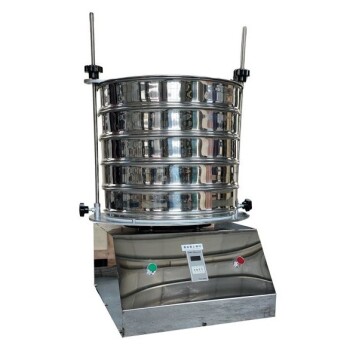
- Laboratory Test Sieves and Sieving Machines
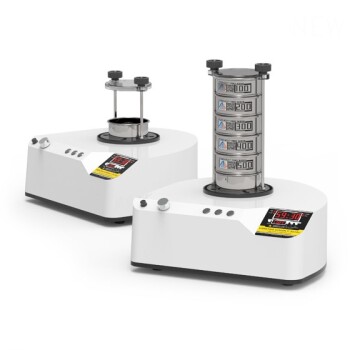
- Three-dimensional electromagnetic sieving instrument
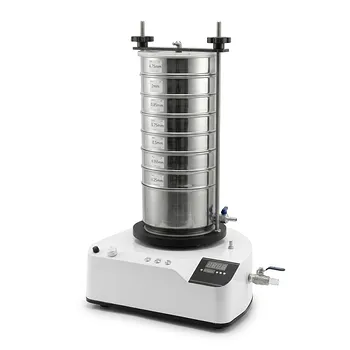
- Laboratory Vibratory Sieve Shaker Machine for Dry and Wet Three-Dimensional Sieving
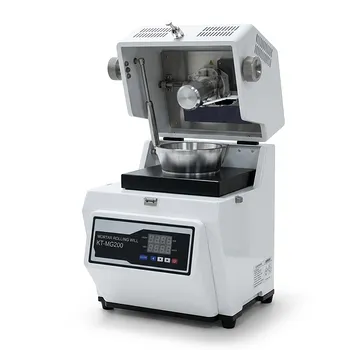
- Laboratory Grinding Mill Mortar Grinder for Sample Preparation
- Laboratory Test Sieves and Vibratory Sieve Shaker Machine
People Also Ask
- What are laboratory test sieves used for? A Guide to Particle Size Analysis
- How do you calculate the sieve test? Master Particle Size Distribution for Quality Control
- How does a lab test sieve contribute to biomass charcoal powder preparation? Achieve Uniform Particle Size
- What are the specifications for test sieves? A Guide to ASTM & ISO Standards for Accurate Particle Analysis
- What materials are required for sieving? Achieve Accurate Particle Size Analysis