Knowledge What is the minimum speed of a ball mill? Optimize Grinding with the Right Operating Range
Author avatar

Tech Team · Kintek Solution

Updated 1 week ago

What is the minimum speed of a ball mill? Optimize Grinding with the Right Operating Range


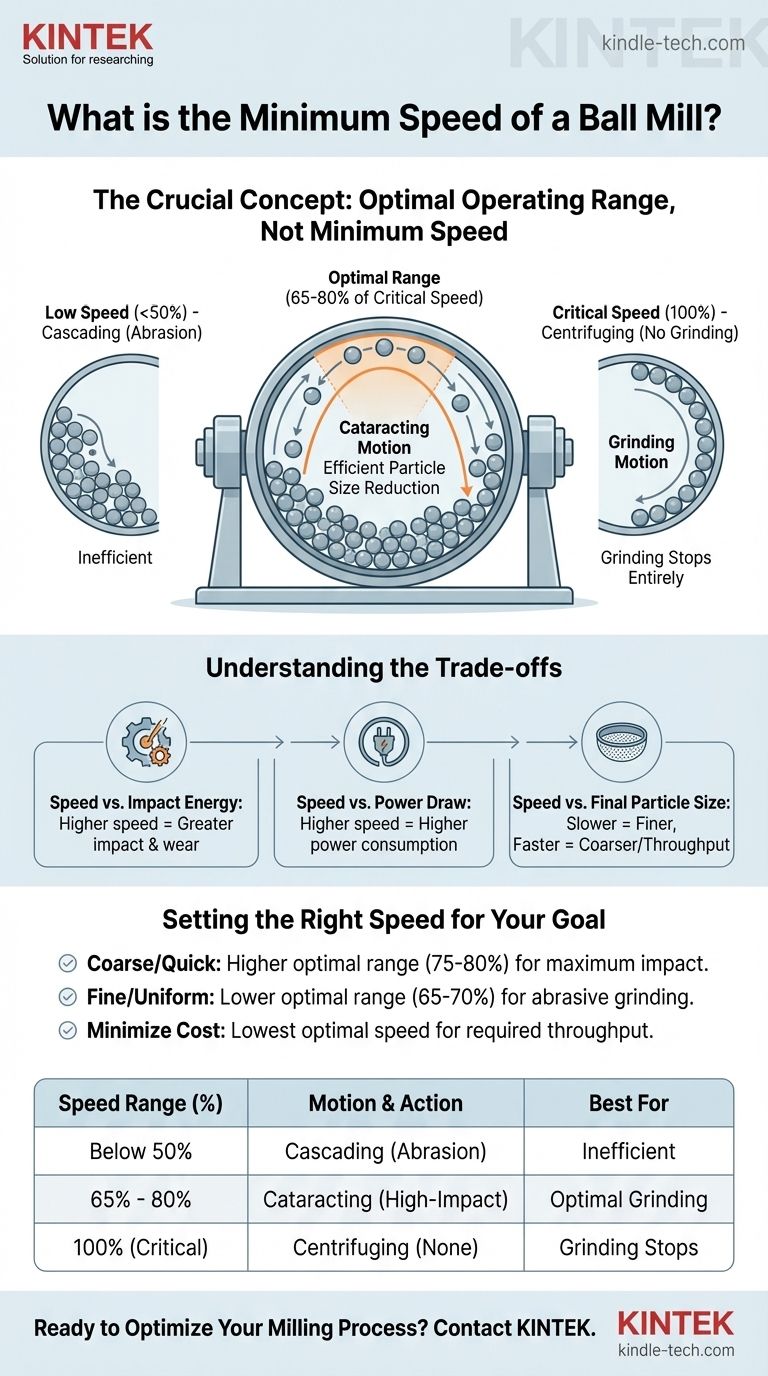
While there isn't a single universal "minimum speed", the effective operation of a ball mill is governed by a concept called critical speed (Nc). A ball mill must operate at a specific percentage of this critical speed to function. Operating too slowly results in inefficient grinding, while operating too fast causes the grinding to stop entirely.

The crucial concept is not a minimum speed, but an optimal operating range. This range is typically between 65% and 80% of the mill's "critical speed"—the theoretical speed at which the grinding media would stick to the mill wall and cease to grind.
What is the minimum speed of a ball mill? Optimize Grinding with the Right Operating Range

Deconstructing Ball Mill Speed: Critical vs. Operating

To understand how a ball mill works, you must distinguish between the theoretical limit (critical speed) and the practical, effective speed (operating speed).

What is Critical Speed (Nc)?

Critical speed is the theoretical rotation speed where the centrifugal force acting on the grinding media perfectly balances the force of gravity.

At this speed, the balls or rods are pinned against the inner wall of the mill, rotating with it as a single mass. No tumbling or impact occurs, and therefore, grinding completely stops. It is a maximum speed limit, not a target to be reached or exceeded.

The Practical "Minimum" - Cascading Motion

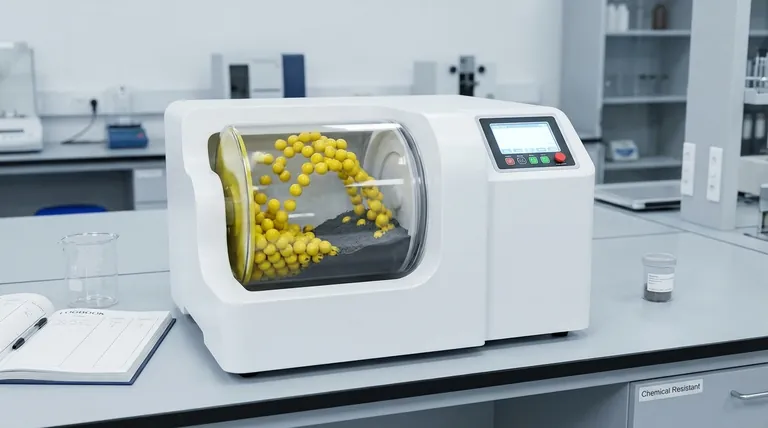
At very low speeds, typically below 50% of critical speed, the grinding media is lifted only slightly by the mill's rotation before it tumbles down the surface of the other media.

This motion is called cascading. It produces grinding action primarily through abrasion (rubbing), which is inefficient for breaking down larger particles. While technically a "minimum" speed for any action, it is rarely the desired state.

The Optimal Speed Range - Cataracting Motion

The most efficient grinding happens in the optimal operating range, generally between 65% and 80% of the critical speed.

In this range, the media is carried further up the side of the mill until it breaks away and follows a parabolic path, crashing down onto the material at the bottom. This is called cataracting. This motion provides the high-impact energy needed for effective and rapid particle size reduction.

Understanding the Trade-offs

Choosing a speed is not arbitrary; it involves balancing competing factors to achieve a specific outcome.

Speed vs. Impact Energy

As you increase speed within the optimal range (from 65% toward 80% of Nc), the media is thrown higher and farther.

This results in greater impact energy, which is ideal for breaking down hard, coarse materials. However, it also significantly increases the rate of wear on both the grinding media and the mill's internal liners.

Speed vs. Power Draw

The power required to turn the mill increases with speed, reaching its peak just below the critical speed.

Operating at the highest possible speed is not always the most energy-efficient choice. It can lead to higher operational costs for only marginal gains in throughput.

Speed vs. Final Particle Size

Slower speeds that favor cascading create more abrasive action, which can be beneficial for producing a very fine final product.

Conversely, higher speeds that create cataracting are better for coarse crushing and maximizing throughput, but may produce a wider particle size distribution.

Setting the Right Speed for Your Goal

Your ideal speed depends entirely on your operational objectives. Use the critical speed of your specific mill as the benchmark and adjust from there.

  • If your primary focus is breaking down coarse material quickly: Operate in the higher end of the optimal range (around 75-80% of critical speed) to maximize impact forces.
  • If your primary focus is producing a very fine, uniform product: Consider operating in the lower end of the optimal range (around 65-70% of critical speed) to favor abrasive grinding over high impact.
  • If your primary focus is minimizing wear and energy costs: Operate at the lowest speed within the optimal range that still achieves your required throughput and particle size reduction.

Ultimately, finding the correct mill speed is a strategic decision that balances throughput, final particle size, and operational cost.

Summary Table:

Speed Range (% of Critical Speed) Motion Type Primary Grinding Action Best For
Below 50% Cascading Abrasion (Rubbing) Inefficient; rarely used
65% - 80% Cataracting High-Impact Energy Efficient particle size reduction (Optimal Range)
100% (Critical Speed - Nc) Centrifuging None Grinding stops entirely

Ready to Optimize Your Milling Process?

Choosing the right ball mill speed is crucial for your lab's productivity and efficiency. KINTEK specializes in high-performance lab equipment, including ball mills, to help you achieve precise particle size reduction and maximize your throughput.

Contact our experts today to discuss your specific grinding needs and discover how KINTEK's solutions can enhance your laboratory's capabilities and reduce operational costs.

Visual Guide
What is the minimum speed of a ball mill? Optimize Grinding with the Right Operating Range Visual Guide

Related Products

People Also Ask

Related Products

Laboratory Single Horizontal Jar Mill

Laboratory Single Horizontal Jar Mill

KT-JM3000 is a mixing and grinding instrument for placing a ball milling tank with a volume of 3000ml or less. It adopts frequency conversion control to realize timing, constant speed, direction change, overload protection and other functions.

High Energy Planetary Ball Mill Milling Machine for Laboratory

High Energy Planetary Ball Mill Milling Machine for Laboratory

The biggest feature is that the high energy planetary ball mill can not only perform fast and effective grinding, but also has good crushing ability

High-Energy Omnidirectional Planetary Ball Mill Milling Machine for Laboratory

High-Energy Omnidirectional Planetary Ball Mill Milling Machine for Laboratory

The KT-P4000E is a new product derived from the vertical high-energy planetary ball mill with a 360° swivel function. Experience faster, uniform, and smaller sample output results with 4 ≤1000ml ball mill jars.

High-Energy Omnidirectional Planetary Ball Mill Machine for Laboratory

High-Energy Omnidirectional Planetary Ball Mill Machine for Laboratory

The KT-P2000E is a new product derived from the vertical high-energy planetary ball mill with a 360°rotation function. The product not only has the characteristics of the vertical high-energy ball mill, but also has a unique 360°rotation function for the planetary body.

High Energy Planetary Ball Mill Milling Machine for Laboratory

High Energy Planetary Ball Mill Milling Machine for Laboratory

Experience fast and effective sample processing with the F-P2000 high-energy planetary ball mill. This versatile equipment offers precise control and excellent grinding capabilities. Perfect for laboratories, it features multiple grinding bowls for simultaneous testing and high output. Achieve optimal results with its ergonomic design, compact structure, and advanced features. Ideal for a wide range of materials, it ensures consistent particle size reduction and low maintenance.

Laboratory Horizontal Planetary Ball Mill Milling Machine

Laboratory Horizontal Planetary Ball Mill Milling Machine

Improve sample uniformity with our Horizontal Planetary Ball Mills. KT-P400H reduces sample deposition and KT-P400E has multi-directional capabilities. Safe, convenient and efficient with overload protection.

Laboratory Planetary Ball Mill Rotating Ball Milling Machine

Laboratory Planetary Ball Mill Rotating Ball Milling Machine

KT-P400E is a desktop multi-directional planetary ball mill with unique grinding and mixing capabilities. It offers continuous and intermittent operation, timing, and overload protection, making it ideal for various applications.

Laboratory Planetary Ball Mill Cabinet Planetary Ball Milling Machine

Laboratory Planetary Ball Mill Cabinet Planetary Ball Milling Machine

The vertical cabinet structure combined with ergonomic design enables users to obtain the best comfortable experience in standing operation. The maximum processing capacity is 2000ml, and the speed is 1200 revolutions per minute.

High Energy Planetary Ball Mill for Laboratory Horizontal Tank Type Milling Machine

High Energy Planetary Ball Mill for Laboratory Horizontal Tank Type Milling Machine

KT-P4000H uses the unique Y-axis planetary motion trajectory, and utilizes the collision, friction and gravity between the sample and the grinding ball to have a certain anti-sinking ability, which can obtain better grinding or mixing effects and further improve the sample output.

High Energy Vibratory Laboratory Ball Mill Double Tank Type

High Energy Vibratory Laboratory Ball Mill Double Tank Type

High-energy vibration ball mill is a small desktop laboratory grinding instrument. It uses 1700r/min high-frequency three-dimensional vibration to make the sample achieve the result of grinding or mixing.

Laboratory Jar Mill with Agate Grinding Jar and Balls

Laboratory Jar Mill with Agate Grinding Jar and Balls

Grind your materials with ease using Agate Grinding Jars with Balls. Sizes from 50ml to 3000ml, perfect for planetary and vibration mills.

High Energy Vibratory Laboratory Ball Mill Grinding Mill Single Tank Type

High Energy Vibratory Laboratory Ball Mill Grinding Mill Single Tank Type

High-energy vibration ball mill is a small desktop laboratory grinding instrument.It can be ball-milled or mixed with different particle sizes and materials by dry and wet methods.

High Energy Vibratory Ball Mill for Lab Use

High Energy Vibratory Ball Mill for Lab Use

The high-energy vibrating ball mill is a high-energy oscillating and impacting multifunctional laboratory ball mill. The table-top type is easy to operate, small in size, comfortable and safe.

Laboratory Grinding Mill Mortar Grinder for Sample Preparation

Laboratory Grinding Mill Mortar Grinder for Sample Preparation

KT-MG200 mortar grinder can be used for mixing and homogenizing powder, suspension, paste and even viscous samples. It can help users realize the ideal operation of sample preparation with more regularization and higher repeatability.

Open Type Two Roll Mixing Mill Machine for Rubber Crusher

Open Type Two Roll Mixing Mill Machine for Rubber Crusher

Rubber crusher open mixing mill/Open two roller rubber mixing mill machine is suitable for mixing and dispersing rubber, plastic raw materials, pigments, masterbatches and other high molecular polymers.

Laboratory Test Sieves and Sieving Machines

Laboratory Test Sieves and Sieving Machines

Precision lab test sieves & sieving machines for accurate particle analysis. Stainless steel, ISO-compliant, 20μm-125mm range. Request specs now!

Anti-Cracking Press Mold for Lab Use

Anti-Cracking Press Mold for Lab Use

The anti-cracking press mold is a specialized equipment designed for molding various shapes and sizes of film using high pressure and electric heating.

Laboratory Sterilizer Lab Autoclave Vertical Pressure Steam Sterilizer for Liquid Crystal Display Automatic Type

Laboratory Sterilizer Lab Autoclave Vertical Pressure Steam Sterilizer for Liquid Crystal Display Automatic Type

Liquid crystal display automatic vertical sterilizer is a safe, reliable and automatic control sterilization equipment, which is composed of heating system, microcomputer control system and overheating and overvoltage protection system.

HFCVD Machine System Equipment for Drawing Die Nano-Diamond Coating

HFCVD Machine System Equipment for Drawing Die Nano-Diamond Coating

The nano-diamond composite coating drawing die uses cemented carbide (WC-Co) as the substrate, and uses the chemical vapor phase method ( CVD method for short ) to coat the conventional diamond and nano-diamond composite coating on the surface of the inner hole of the mold.

Benchtop Laboratory Freeze Dryer for Lab Use

Benchtop Laboratory Freeze Dryer for Lab Use

Premium benchtop laboratory freeze dryer for lyophilization, preserving samples with ≤ -60°C cooling. Ideal for pharmaceuticals & research.


Leave Your Message