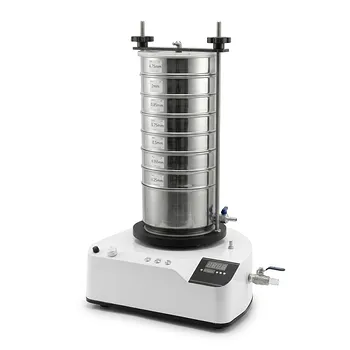
Multi-stage sieving is the critical quality assurance step required to prepare B4C-CeB6 ceramic powders for high-performance applications. By filtering the powder through mesh screens of increasing fineness—typically starting at 40-mesh and finishing with 300-mesh—manufacturers effectively strip away hard agglomerates and large impurities that inevitably form during the drying process.
Multi-stage sieving transforms inconsistent dried powder into a uniform material with high flowability. This step is non-negotiable for maximizing packing density in the mold and preventing catastrophic large-scale defects in the final sintered body.
The Mechanics of Powder Refinement
Eliminating Drying Artifacts
During the drying phase of ceramic powder preparation, particles often bind together to form hard agglomerates. Large-particle impurities may also be introduced or solidified during this stage.
If left unchecked, these irregularities act as flaws within the material. Multi-stage sieving physically separates and removes these unwanted clusters before they reach the mold.
Enhancing Flowability
Raw, unsieved powder often clumps, leading to poor handling characteristics. Passing the material through high-mesh screens significantly improves its flowability (fluidity).
A powder that flows like a liquid ensures that the mold is filled evenly and completely. This flow is essential for complex mold geometries where bridging or voids could occur with sticky or clumpy powder.
Ensuring Particle Uniformity
Consistently sized particles are the foundation of a high-quality ceramic. Sieving ensures that the particle size distribution remains narrow and predictable.
This uniformity eliminates internal density gradients within the powder bed. Without gradients, the material compresses evenly, leading to predictable shrinkage and structural behavior during sintering.
Impact on the Sintered Product
Maximizing Packing Density
The primary goal of mold loading is to achieve the highest possible green density. Sieved powders pack together more efficiently because the particles can rearrange themselves tightly.
High-mesh sieving (e.g., 300-mesh) is particularly effective here. It ensures that fine particles fill the interstices between larger ones, increasing the overall packing density within the graphite mold.
Preventing Structural Defects
The most significant risk in ceramic manufacturing is the formation of large pores or cracks in the final product. These defects are often the direct result of agglomerates that failed to sinter properly.
By removing these agglomerates upstream, sieving prevents the formation of large pore defects. This directly enhances the overall density and mechanical strength of the final sintered body.
Common Process Considerations
Balancing Throughput and Quality
While multi-stage sieving is necessary for quality, it introduces a bottleneck in production speed. Using ultra-fine screens (such as 300-mesh) significantly slows down the processing rate compared to coarser screens.
Manufacturers must accept this time cost as a necessary trade-off for achieving structural integrity in advanced ceramics like B4C-CeB6.
Managing Material Yield
Aggressive sieving can sometimes lead to material loss if usable powder is trapped within the agglomerates being rejected.
However, attempting to crush these agglomerates to save yield is risky. It is often safer to discard the agglomerates entirely to avoid introducing stress concentrations into the final part.
Ensuring Quality in Ceramic Fabrication
To achieve optimal results with B4C-CeB6 powders, you must align your sieving protocol with your specific quality targets.
- If your primary focus is defect elimination: Prioritize the use of high-mesh screens (300-mesh) to strictly filter out even the smallest hard agglomerates that could become pore initiation sites.
- If your primary focus is process consistency: Implement a multi-stage approach (e.g., 40-mesh followed by 300-mesh) to progressively refine the powder without blinding the finer screens immediately.
A rigorous sieving strategy is the single most effective method for guaranteeing the density and reliability of the final ceramic component.
Summary Table:
| Sieving Stage | Mesh Size | Primary Function | Impact on Ceramic Quality |
|---|---|---|---|
| Initial Stage | ~40 Mesh | Removing large impurities & hard agglomerates | Prevents major structural flaws and inclusions |
| Final Stage | ~300 Mesh | Refining particle uniformity & distribution | Maximizes packing density and reduces micro-pores |
| Process-Wide | Multi-stage | Enhancing powder flowability/fluidity | Ensures even mold filling and uniform green density |
Elevate Your Ceramic Research with Precision Engineering
Achieving the perfect sintered body starts with superior powder preparation. KINTEK specializes in high-performance laboratory equipment designed to meet the rigorous demands of advanced materials science.
Whether you are processing B4C-CeB6 or other advanced ceramics, our comprehensive range of sieving equipment, crushing and milling systems, and high-pressure hydraulic presses ensures your materials meet the highest standards of uniformity and density. From high-temperature furnaces (muffle, vacuum, and CVD) for sintering to graphite molds and consumables, KINTEK provides the end-to-end solutions necessary for consistent, defect-free results.
Ready to optimize your powder refinement process? Contact our technical experts today to find the ideal equipment for your laboratory and take the first step toward superior material performance.
Related Products
- Stainless Steel Laboratory Ball Mill for Dry Powder and Liquid with Ceramic Polyurethane Lining
- Three-dimensional electromagnetic sieving instrument
- Laboratory Vibratory Sieve Shaker Machine for Dry and Wet Three-Dimensional Sieving
- Laboratory Test Sieves and Sieving Machines
- High Purity Alumina Granulated Powder for Engineering Advanced Fine Ceramics
People Also Ask
- How do laboratory ball mills facilitate the mechanochemical synthesis of ZIF-8? Solvent-Free Synthesis Explained
- What is the primary function of a laboratory ball mill in the modification of sulfide-based solid electrolytes with LiPO2F2?
- How does a laboratory ball mill ensure the mixing quality of Mn3Zn0.8Sn0.2N and Ti? Achieve Perfect Homogeneity
- What is the function of a laboratory ball mill in the preparation of AMMCs? Optimize Dispersion & Grain Refinement
- In what way does a laboratory ball mill affect material properties when modifying PHBV/pulp fiber composites?