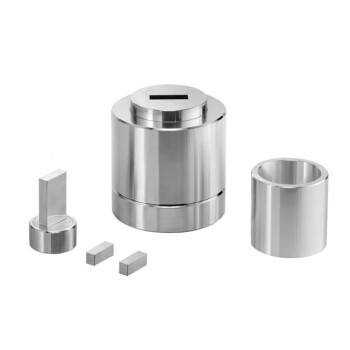
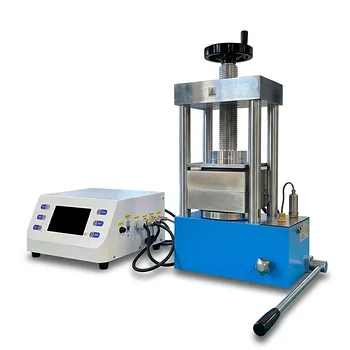
The laboratory hydraulic pellet press is an indispensable tool for transforming loose catalyst powders into structurally robust pellets required for stable sorbitol conversion. By applying precise and uniform pressure, the device eliminates internal air pores and density gradients that naturally occur in mixed powders. This densification process is critical for ensuring the catalyst maintains high compressive strength and optimal fluid dynamic performance, particularly when employed in fixed-bed reactor systems.
Converting loose powder into solid pellets is not merely a shaping exercise; it is a functional requirement for reactor efficiency. The hydraulic press ensures close particle contact and mechanical integrity, allowing the catalyst to withstand reactor conditions without disintegrating or impeding fluid flow.
Ensuring Reactor Stability and Flow
Eliminating Structural Inconsistencies
Loose powders contain significant amounts of trapped air and uneven spacing between particles. A hydraulic press removes these internal air pores and creates a uniform structure.
Without this compression, density gradients within the material can lead to unpredictable flow patterns inside a reactor.
Optimizing Fluid Dynamics
In sorbitol conversion, particularly within fixed-bed reactors, the physical shape of the catalyst dictates how fluids move through the system.
Pellets created with specific geometric shapes ensure consistent voids between particles. This facilitates steady fluid flow and prevents the dangerous pressure drops often caused by loose or crumbling powders.
Achieving High Compressive Strength
Reactors subject catalysts to significant physical stress.
The press compacts active components and supports into a unified body with high mechanical strength. This prevents the catalyst from crushing under its own weight or the force of the flow, which would otherwise contaminate the product and clog the system.
Enhancing Chemical Efficiency
Shortening Reaction Paths
The hydraulic press forces powder particles into extremely close contact.
This physical proximity significantly shortens the solid-state reaction path. By reducing the distance reactants must travel between particles, the efficiency of the conversion process is fundamentally improved.
Improving Doping Efficiency
Many catalysts require specific doping reactions to become active.
The tight contact achieved during pressing improves the efficiency of these doping reactions during subsequent calcination processes. This ensures the final catalyst possesses the correct chemical properties for converting sorbitol effectively.
Achieving Experimental Reproducibility
Standardizing Sample Specifications
Reliable research demands variable control. A hydraulic press allows for the creation of "green pellets" with precise, repeatable densities.
This consistency ensures that any changes in sorbitol conversion rates can be attributed to chemical formulation rather than physical inconsistencies in the catalyst's shape or density.
Facilitating Physical Analysis
The compact structure produced by the press creates a stable medium for characterization.
Researchers can accurately measure physical properties, such as material hardness and thermal conductivity, only when the sample is in a uniform, pelletized state.
Understanding the Trade-offs
Balancing Density and Porosity
While compression is necessary, applying excessive pressure can be detrimental.
Over-compressing the pellet may reduce the pore volume too drastically, making it difficult for sorbitol reactants to penetrate the catalyst and reach active sites.
Mechanical Integrity vs. Surface Area
There is an inverse relationship between mechanical strength and accessible surface area.
You must find the "sweet spot" in pressure application: high enough to prevent crumbling in the reactor, but low enough to maintain the porosity required for maximum catalytic activity.
Making the Right Choice for Your Goal
When configuring your hydraulic press parameters for sorbitol conversion research, consider your primary objective:
- If your primary focus is Reactor Hydrodynamics: Prioritize higher pressure to maximize compressive strength and ensure the pellet retains its specific geometric shape under flow.
- If your primary focus is Chemical Kinetics: Prioritize a balanced pressure setting that ensures particle contact for doping without collapsing the pore structure required for reactant access.
Ultimately, the hydraulic pellet press acts as the bridge between theoretical chemistry and practical application, turning a reactive powder into a viable engineering solution.
Summary Table:
| Key Benefit | Impact on Sorbitol Conversion Research |
|---|---|
| Structural Integrity | Eliminates air pores and density gradients to prevent catalyst disintegration. |
| Fluid Dynamics | Ensures uniform voids in fixed-bed reactors, preventing pressure drops. |
| Reaction Efficiency | Shortens solid-state reaction paths and improves doping during calcination. |
| Reproducibility | Standardizes pellet density for consistent and accurate experimental results. |
| Material Strength | Increases compressive strength to withstand high-stress reactor environments. |
Elevate Your Catalyst Research with KINTEK Precision
Don't let inconsistent catalyst density compromise your sorbitol conversion results. KINTEK specializes in advanced laboratory equipment designed for rigorous research environments. Our precision hydraulic pellet presses (manual, hot, and isostatic) provide the uniform pressure needed to ensure mechanical integrity and optimal porosity for your solid catalysts.
From high-performance crushing and milling systems to our specialized high-temperature high-pressure reactors and autoclaves, KINTEK offers a comprehensive ecosystem for material science. Our portfolio also includes essential ceramics, crucibles, and battery research tools tailored for precision engineering.
Ready to optimize your pellet preparation and reactor efficiency? Contact our technical experts today to find the perfect pressing solution for your laboratory.
References
- Léa Vilcocq, Daniel Duprez. Transformation of Sorbitol to Biofuels by Heterogeneous Catalysis: Chemical and Industrial Considerations. DOI: 10.2516/ogst/2012073
This article is also based on technical information from Kintek Solution Knowledge Base .
Related Products
- Laboratory Hydraulic Pellet Press for XRF KBR FTIR Lab Applications
- Automatic Laboratory Hydraulic Pellet Press Machine for Lab Use
- Automatic Laboratory Hydraulic Press for XRF & KBR Pellet Press
- Laboratory Manual Hydraulic Pellet Press for Lab Use
- Laboratory Manual Hydraulic Pellet Press for Lab Use
People Also Ask
- What is the role of a laboratory hydraulic pellet press and stainless steel molds in the fabrication of RuO2/NbC anodes?
- What is the necessity of using a laboratory hydraulic pellet press in the preparation of biomass fuel pellets? Guide
- How does a laboratory hydraulic pellet press contribute to SiCw/2024 aluminum composite preforms? Optimize Densification
- What is the significance of applying 200 MPa of pressure with a laboratory hydraulic pellet press for composite ceramics?
- What key role does a laboratory pellet press play in FTIR analysis? Master KBr Sample Preparation Excellence