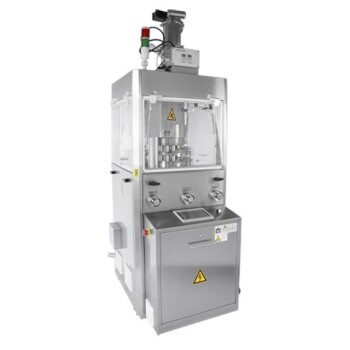
The primary objective of using a pellet press for pre-pressing is to mechanically stabilize loose powder into a cohesive form, known as a "green compact," before it enters the sintering furnace. This process expels significant amounts of trapped air and forces particles to rearrange into a higher packing density. By establishing this density early, you minimize the volume of shrinkage that occurs during the vacuum hot press stage and prevent the final product from deforming.
Pre-pressing is a critical preparation step that reduces the workload of the sintering process by establishing high initial density and removing voids. This ensures the material maintains its shape and structural integrity, preventing warping caused by uneven powder loading.
The Mechanics of Densification
Expelling Trapped Air
Loose powder naturally contains a high volume of voids filled with air. Applying initial pressure via a mold effectively expels this air from between the particles.
Removing this air prior to heating is crucial. It prevents gas pockets from interfering with the vacuum hot pressing process and inhibiting later densification.
Increasing Initial Packing Density
Pre-pressing forces powder grains to flow and rearrange into a tighter configuration. This significantly increases the initial packing density of the material.
Once the particles are mechanically interlocked, further pressure causes plastic and elastic deformation. This bonding creates a solid baseline density that improves the efficiency of the subsequent sintering.
Ensuring Structural Integrity
Reducing Sintering Shrinkage
Because pre-pressing maximizes density early, the material has less volume to lose during the hot press stage. This directly reduces the volume of shrinkage required to achieve the final state.
Lower shrinkage rates during high-temperature processing lead to more predictable final dimensions. It reduces the internal stresses that typically develop when a material contracts significantly.
Preventing Deformation
Pouring loose powder directly into a hot press mold often leads to uneven loading. This inconsistency causes differential shrinkage, resulting in a sintered body that is warped or distorted.
A pre-pressed pellet ensures the material is distributed uniformly. This uniformity helps the sample resist deformation and maintain the correct geometric shape throughout the thermal cycle.
Establishing Green Strength
The pre-pressing process creates a "green compact" with sufficient mechanical strength. This allows the sample to be handled, stored, and loaded into the hot press without falling apart.
Common Pitfalls to Avoid
The Risk of Skipping Pre-Pressing
Attempting to sinter without pre-pressing often relies solely on the hot press to manage densification. This frequently leads to excessive shrinkage inside the furnace, which can exceed the travel limits of the hot press rams.
Ignoring Uneven Distribution
If powder is not pre-pressed, it is difficult to guarantee it is flat and level within the die. This usually results in a final product with variable density gradients, where some areas are fully dense and others remain porous or brittle.
Making the Right Choice for Your Goal
To maximize the quality of your sintered materials, align your pre-pressing strategy with your specific objectives:
- If your primary focus is Dimensional Accuracy: Ensure you apply sufficient pre-load to minimize shrinkage volume, which creates a more predictable final shape.
- If your primary focus is Material Homogeneity: Use pre-pressing to eliminate uneven loading, ensuring the density is consistent across the entire cross-section of the sample.
- If your primary focus is Process Efficiency: Utilize pre-pressing to create robust green bodies that speed up loading times and reduce the travel distance required during the hot press cycle.
By treating pre-pressing as a foundational stability step rather than just a shaping task, you ensure a denser, more uniform, and defect-free final product.
Summary Table:
| Objective | Key Benefit | Impact on Final Product |
|---|---|---|
| Air Expulsion | Removes trapped gas pockets | Prevents internal voids and gas interference |
| Densification | Increases initial packing density | Minimizes shrinkage and prevents warping |
| Structural Stability | Establishes green strength | Allows for safe handling and uniform loading |
| Dimensional Control | Predictable volume reduction | Ensures geometric accuracy and homogeneity |
Elevate Your Materials Research with KINTEK Precision
Maximize the quality of your sintered products by integrating KINTEK’s high-performance hydraulic pellet presses into your workflow. As specialists in laboratory equipment, we provide the tools necessary to create uniform green compacts, ensuring your vacuum hot press sintering results in superior density and dimensional accuracy.
Beyond pelletizing, KINTEK offers a comprehensive range of high-temperature furnaces, crushing and milling systems, and high-pressure reactors tailored for advanced R&D and industrial applications. Let our expertise in laboratory consumables and equipment drive your next breakthrough.
Ready to achieve perfect material homogeneity? Contact our technical experts today to find the ideal solution for your lab.
Related Products
- kbr pellet press 2t
- Laboratory Hydraulic Pellet Press for XRF KBR FTIR Lab Applications
- Automatic Laboratory Hydraulic Pellet Press Machine for Lab Use
- Laboratory Manual Hydraulic Pellet Press for Lab Use
- Automatic Laboratory Hydraulic Press for XRF & KBR Pellet Press
People Also Ask
- How do you prepare samples for IR spectroscopy? A Step-by-Step Guide for Solids, Liquids, and Gases
- What measurement methods are commonly used for powder samples in infrared spectroscopy? Optimize Your FTIR Analysis
- Why KBr is used in IR spectrophotometry? A Key to Transparent Sample Analysis
- How are a KBr pellet press and mortar utilized in FTIR analysis of activated carbon? Expert Sample Prep Guide
- How do you prepare KBr pellets for FTIR analysis? Master the Technique for High-Quality IR Spectra