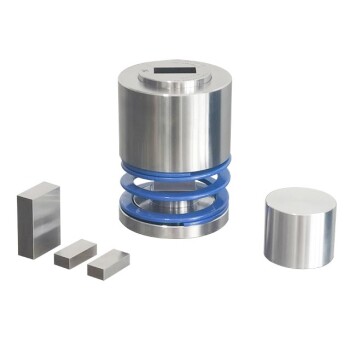
The primary function of a high-pressure reactor in this context is to generate a controlled supercritical or subcritical fluid environment necessary for hydrothermal synthesis. By sealing reactants like magnesium oxide, silicic acid, and boric acid within a vessel at elevated temperatures (e.g., 573 K) and pressures (e.g., 25 MPa), the reactor forces the chemical interaction required to synthesize boron-modified chrysotile.
The reactor acts as a catalyst for structural engineering, creating the specific extreme conditions needed to substitute silicon atoms with boron atoms. This process is essential for growing high-aspect-ratio nanotubular fibers that would not form under standard atmospheric conditions.
The Mechanics of Hydrothermal Synthesis
Creating the Critical Environment
The reactor’s main role is to maintain a sealed, high-pressure ecosystem.
It heats an alkaline aqueous solution to temperatures where the fluid properties change drastically, often reaching supercritical or subcritical states.
This environment increases the solubility and reactivity of the solid precursors, allowing them to dissolve and interact at a rate impossible in open vessels.
Facilitating Atomic Substitution
For boron-modified chrysotile, simple mixing is insufficient; the lattice structure must be chemically altered.
The high-pressure conditions provide the thermodynamic drive necessary for boron atoms to effectively replace silicon atoms within the crystal lattice.
This atomic substitution is the defining characteristic of the modified material, distinct from pure chrysotile.
Impact on Material Structure
Guiding Nanotubular Growth
Beyond chemical composition, the reactor dictates the physical morphology of the final product.
The specific combination of heat and pressure guides the self-assembly of the material into nanotubular structures.
This results in fibers with a high aspect ratio, which is a critical metric for the performance of chrysotile materials.
Ensuring Homogeneity
The closed nature of the reactor ensures a uniform distribution of heat and pressure.
This stability prevents temperature gradients that could lead to inconsistent crystal growth or incomplete substitution.
The result is a batch of nanofibers with consistent structural integrity and chemical composition.
Understanding the Trade-offs
Operational Complexity and Safety
While high-pressure reactors are effective, they introduce significant operational risks compared to atmospheric synthesis.
Working with pressures around 25 MPa requires robust safety protocols, specialized vessel materials, and rigorous maintenance to prevent seal failures or ruptures.
Energy and Equipment Costs
Achieving and maintaining temperatures near 573 K requires substantial energy input.
Furthermore, the equipment itself—designed to withstand hydrothermal corrosion and extreme pressure—represents a higher initial capital investment than standard reflux setups.
Making the Right Choice for Your Goal
To maximize the utility of a high-pressure reactor for your synthesis, consider your specific material requirements.
- If your primary focus is structural aspect ratio: Prioritize the precise control of pressure stability, as fluctuations here can disrupt the directional growth of the nanotubes.
- If your primary focus is chemical doping efficiency: Optimize the temperature settings to ensure the system reaches the thermodynamic threshold required for maximum boron-silicon substitution.
The high-pressure reactor is not just a vessel; it is the active environment that forces the transition from raw precursors to engineered nanomaterials.
Summary Table:
| Feature | Function in Synthesis | Benefit for Material |
|---|---|---|
| Hydrothermal Environment | Creates supercritical/subcritical fluid states | Increases solubility and reactivity of precursors |
| Atomic Substitution | Drives boron atoms to replace silicon atoms | Enables successful chemical modification of the lattice |
| Morphology Control | Guides self-assembly into nanotubes | Produces fibers with high aspect ratios |
| Atmospheric Stability | Maintains uniform heat and pressure | Ensures consistent structural integrity and homogeneity |
Elevate Your Material Research with KINTEK Precision
Are you looking to master complex hydrothermal synthesis or nanotubular growth? KINTEK provides the advanced laboratory equipment you need to achieve precise, repeatable results. Our high-performance high-temperature high-pressure reactors and autoclaves are specifically engineered to withstand extreme conditions, ensuring safety and efficiency in the synthesis of engineered nanomaterials.
Beyond reactors, KINTEK offers a comprehensive portfolio for your lab, including:
- High-Temperature Furnaces: Muffle, tube, vacuum, and CVD systems for advanced heat treatment.
- Sample Preparation: Precision crushing, milling, and hydraulic presses (pellet, hot, isostatic).
- Material Research Tools: Electrolytic cells, battery research consumables, and high-purity ceramics/crucibles.
- Cooling & Processing: ULT freezers, freeze dryers, and high-speed homogenizers.
Ready to optimize your synthesis process? Contact our technical experts today to find the perfect equipment solution for your laboratory’s unique requirements!
References
- Roman Nikolaevich Yastrebinsky, Anastasia Vladislavovna Akimenko. Application of Organosilicon Modifier Based on Tetraethoxysilane for the Production of Heat-Resistant Chrysotile Fibers and Reinforced Cement Composites. DOI: 10.3390/fib11100080
This article is also based on technical information from Kintek Solution Knowledge Base .
Related Products
- Customizable Laboratory High Temperature High Pressure Reactors for Diverse Scientific Applications
- Customizable High Pressure Reactors for Advanced Scientific and Industrial Applications
- Stainless High Pressure Autoclave Reactor Laboratory Pressure Reactor
- Visual High-Pressure Reactor for In-Situ Observation
- Mini SS High Pressure Autoclave Reactor for Laboratory Use
People Also Ask
- How do high-pressure and high-temperature reactors ensure the effective treatment of lignocellulosic wastewater in WAO?
- What equipment is required for high-pressure high-temperature reactions? Master Extreme Chemistry Safely
- How do you control high pressure in a reactor? A Guide to Safe & Stable Operation
- Why is argon better than nitrogen for inert atmosphere? Ensure Absolute Reactivity & Stability
- How does initial oxygen pressure affect the wet oxidation of pharmaceutical sludge? Master Your Oxidation Depth