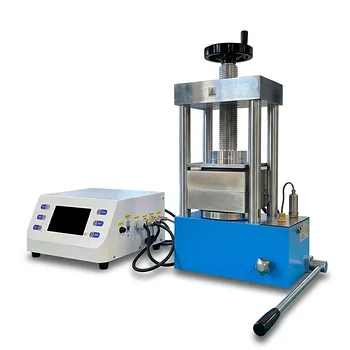
The primary function of a laboratory uniaxial hydraulic press in MgB2 fabrication is to compress loose Magnesium-Boron (Mg-B) powder mixtures into a high-density "green body." By applying significant mechanical pressure through a specific mold, the press reduces internal porosity and maximizes the contact area between particles. This physical compaction is the critical first step that enables effective atomic diffusion and ensures strong connectivity between superconducting grains during subsequent thermal processing.
The hydraulic press serves as the bridge between raw powder and a viable bulk material, providing the structural density and particle-to-particle contact necessary for high-performance superconductivity. Without this initial compaction, the material would lack the connectivity required for efficient current flow.
The Mechanics of Powder Compaction
Creating the Green Body
A hydraulic press applies unidirectional mechanical force to powder mixtures held within a precision steel mold. This process transforms loose, non-cohesive material into a solid "green body" with a defined geometric shape, typically a pellet or cylinder.
Overcoming Inter-particle Friction
The high axial pressure—often ranging from 0.5 to 1.0 GPa—is required to overcome the friction between individual powder particles. This force facilitates particle rearrangement and dense packing, ensuring the sample has the mechanical strength required for handling.
Establishing the Geometric Foundation
Consistency in diameter and thickness is vital for experimental repeatability. The press ensures that each sample begins the sintering or reaction process with the same geometric dimensions, which is essential for accurate post-fabrication analysis.
Impact on Superconducting Performance
Enhancing Atomic Diffusion
Magnesium Diboride is typically formed via solid-state reactions. By forcing particles into intimate contact, the hydraulic press significantly promotes atomic diffusion, allowing the magnesium and boron to react more thoroughly at lower temperatures.
Improving Grain Connectivity
The quality of a superconductor depends on how well current can flow between its grains. High-pressure treatment reduces the gaps between particles, directly improving the electrical connectivity of the resulting superconducting phases.
Reducing Framework Porosity
Residual air pockets or voids within the MgB2 framework act as barriers to current and structural weak points. The press eliminates these porosity gradients, leading to a more homogenous material that can support higher critical current densities.
The Press as a Prerequisite for Advanced Processing
Foundation for Isostatic Pressing
In many workflows, the uniaxial press is a pre-forming step. The resulting green body provides the foundational shape that allows subsequent Cold Isostatic Pressing (CIP) or Hot Isostatic Pressing (HIP) to apply uniform pressure more effectively.
Preventing Structural Failure
By ensuring tight contact and high initial density, the press prevents cracks and deformations from occurring during the intense temperature variations of sintering. A well-compacted pellet is far less likely to undergo structural failure or warping during thermal expansion.
Understanding the Trade-offs
Pressure Limits and Material Stress
While higher pressure generally increases density, exceeding the mechanical limits of the mold or the powder can lead to capping or laminating. These are internal fractures that occur when the elastic energy stored in the compressed powder is released too quickly upon unloading.
Density Gradients
Because the pressure is uniaxial (applied from one direction), the density may not be perfectly uniform throughout the sample. The areas closest to the moving plunger often reach a higher density than the center of the pellet, a limitation that often necessitates the use of lubricants or subsequent isostatic pressing.
How to Apply This to Your Project
Making the Right Choice for Your Goal
To achieve the best results in your MgB2 fabrication, tailor your pressing strategy to your specific research or production objectives.
- If your primary focus is maximum superconducting connectivity: Use higher pressures (near 1.0 GPa) to minimize inter-granular distance and maximize the contact area for solid-state reactions.
- If your primary focus is structural uniformity in large samples: Use the uniaxial press primarily for pre-forming, followed by Cold Isostatic Pressing (CIP) to eliminate internal density gradients.
- If your primary focus is high-volume screening of dopants: Utilize precision steel molds to ensure geometric consistency across dozens of samples, allowing for more accurate comparative analysis.
By mastering the initial compaction phase, you establish the physical and chemical foundation necessary for high-performance superconducting materials.
Summary Table:
| Key Function | Role in MgB2 Fabrication | Impact on Superconductivity |
|---|---|---|
| Powder Compaction | Transforms loose powder into a high-density "green body." | Ensures structural integrity for sintering. |
| Porosity Reduction | Minimizes internal air pockets and voids. | Boosts critical current density and homogeneity. |
| Atomic Diffusion | Maximizes particle-to-particle contact area. | Facilitates faster, more thorough solid-state reactions. |
| Shape Formation | Provides uniform geometric dimensions (pellets/cylinders). | Ensures experimental repeatability and accuracy. |
| Pre-forming | Prepares samples for subsequent CIP or HIP processing. | Prevents cracking and warping during thermal cycles. |
Elevate Your Material Research with KINTEK
Precision is the foundation of high-performance superconductivity. KINTEK specializes in high-quality laboratory equipment designed to meet the rigorous demands of material science. Our comprehensive range of uniaxial hydraulic presses (pellet, hot, and isostatic) ensures optimal compaction and density for your MgB2 fabrication and beyond.
Beyond pressing, we offer a complete ecosystem for your lab, including:
- High-Temperature Furnaces: Muffle, tube, and vacuum systems for precise sintering.
- Material Processing: Crushing, milling, and sieving equipment for perfect powder preparation.
- Advanced Reactors: High-temperature high-pressure autoclaves and electrolytic cells.
- Essential Consumables: High-purity ceramics, crucibles, and PTFE products.
Ready to achieve superior grain connectivity and experimental repeatability? Contact our experts today to find the ideal equipment solution tailored to your research goals!
References
- Burcu Savaşkan. Strong Influence of Pressure on the Magnetic Properties of MgB2 Bulk Superconductors. DOI: 10.16984/saufenbilder.1194146
This article is also based on technical information from Kintek Solution Knowledge Base .
Related Products
- Manual Lab Heat Press
- Hydraulic Diaphragm Lab Filter Press for Laboratory Filtration
- kbr pellet press 2t
- Automatic Hydraulic Hot Press with 500x500mm Heating Plates and Multi Stage PLC Control for Material Sintering
- Automatic Laboratory Hydraulic Press for XRF & KBR Pellet Press
People Also Ask
- Why use laboratory manual hydraulic presses for semiconductor pellets? Optimize Annealing & Crystalline Quality
- How is a laboratory manual hydraulic press used in solid-state battery testing? Optimize Electrode Performance
- What is manual hydraulic press? A Guide to Simple, High-Force Compression
- What role does a laboratory manual hydraulic press play in the preparation of salt pellets? Ensure Research Precision
- What is a manual press? Amplify Your Force for Precision Assembly and Stamping