Knowledge What is the primary function of a vacuum hot pressing furnace? Unlock High-Density Boron Carbide Composites
Author avatar

Tech Team · Kintek Solution

Updated 1 day ago

What is the primary function of a vacuum hot pressing furnace? Unlock High-Density Boron Carbide Composites


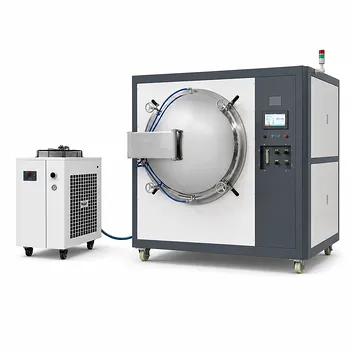
The primary function of a vacuum hot pressing furnace is to generate the mechanical and thermal driving forces necessary to densify boron carbide (B4C) into a solid, high-performance composite. By simultaneously applying extreme temperatures (typically 1750°C to 1850°C) and uniaxial mechanical pressure (around 40 MPa), the furnace overcomes the material's natural resistance to sintering.

Boron carbide is characterized by strong covalent bonding and low self-diffusion, making it notoriously difficult to densify using heat alone. Vacuum hot pressing bypasses these limitations by mechanically forcing particle rearrangement and promoting chemical reactions, achieving relative densities as high as 98.7% at temperatures significantly lower than those required for pressureless sintering.

Overcoming the "Sintering Barrier"

The Challenge of Covalent Bonding

Boron carbide is an advanced ceramic with exceptional hardness, but this property comes with a manufacturing cost. Its strong covalent bonds and low diffusion coefficient mean that particles resist bonding together, even at extremely high temperatures.

The Role of Mechanical Pressure

The vacuum hot pressing furnace introduces a critical variable: external pressure. By applying a uniaxial load of approximately 40 MPa, the equipment physically forces the powder particles into a tighter arrangement.

This mechanical force lowers the energy barrier required for densification, allowing the material to reach near-theoretical density without requiring temperatures that might degrade the material's microstructure.

Enhancing Microstructural Integrity

Facilitating Liquid Phase Filling

For B4C composites, specifically those involving silicon additives, the furnace plays a crucial chemical role. The environment facilitates the reaction between the silicon additives and the boron carbide matrix.

This reaction promotes "liquid phase filling," where a transient liquid phase flows into the voids between solid particles. This mechanism effectively eliminates pores and seals the microstructure, resulting in a highly dense final product.

Preservation via Vacuum Environment

While the pressure drives density, the vacuum environment is essential for chemical purity. It removes adsorbed gases and volatiles from the powder mass that could form pores or defects.

Furthermore, the vacuum prevents the oxidation of the composite components during the high-temperature ramp, ensuring the material retains its intended mechanical and physical properties.

Understanding the Trade-offs

Geometry Limitations

The pressure applied in these furnaces is uniaxial (typically vertical). This means the force is effective for simple geometries like flat plates, discs, or cylinders, but it cannot effectively densify complex, irregular shapes with undercuts.

Process Throughput

Vacuum hot pressing is inherently a batch process. The cycle times—including vacuum pumping, heating, pressing, and cooling—are significant. While it produces superior material quality, it generally has a lower production throughput compared to continuous sintering methods.

Cost Implications

The requirement for high-purity graphite molds to contain the powder and transmit the pressure adds to the operational cost. These molds are consumables that wear down over time due to the extreme thermal and mechanical stresses.

Making the Right Choice for Your Project

If you are evaluating whether vacuum hot pressing is the correct method for your B4C application, consider the following key factors:

  • If your primary focus is maximum density: This is the superior choice, as the mechanical pressure can achieve up to 98.7% relative density where pressureless methods often fail.
  • If your primary focus is complex part geometry: You will likely need to press a simple block or disc first and then machine the final shape using diamond tooling, as the furnace cannot press complex net shapes directly.
  • If your primary focus is microstructural control: The ability to lower sintering temperatures helps control grain growth, preserving the mechanical properties of the boron carbide.

Vacuum hot pressing is not merely a heating method; it is a mechanical consolidation tool essential for unlocking the full potential of difficult-to-sinter covalent ceramics.

Summary Table:

Feature Vacuum Hot Pressing Performance
Temperature Range 1750°C - 1850°C
Applied Pressure Approx. 40 MPa (Uniaxial)
Relative Density Up to 98.7%
Core Mechanism Mechanical particle rearrangement & liquid phase filling
Atmosphere High vacuum to prevent oxidation and remove volatiles
Ideal Geometries Simple shapes (discs, plates, cylinders)

Elevate Your Advanced Ceramic Manufacturing with KINTEK

Achieving near-theoretical density in covalent ceramics like Boron Carbide requires more than just heat—it requires precision-engineered mechanical and thermal control. KINTEK specializes in high-performance laboratory equipment, offering state-of-the-art vacuum hot pressing furnaces and hydraulic presses designed to overcome the most challenging sintering barriers.

Whether you are developing ballistic armor, wear-resistant components, or nuclear shielding, our comprehensive portfolio—including high-temperature furnaces, crushing and milling systems, and ceramic consumables—provides the end-to-end solutions your research demands.

Ready to optimize your material properties? Contact our technical experts today to find the perfect vacuum hot pressing solution for your lab’s specific needs.

Related Products

People Also Ask

Related Products

Vacuum Hot Press Furnace Machine Heated Vacuum Press

Vacuum Hot Press Furnace Machine Heated Vacuum Press

Discover the advantages of Vacuum Hot Press Furnace! Manufacture dense refractory metals & compounds, ceramics, and composites under high temp and pressure.

Vacuum Hot Press Furnace Heated Vacuum Press Machine Tube Furnace

Vacuum Hot Press Furnace Heated Vacuum Press Machine Tube Furnace

Reduce forming pressure & shorten sintering time with Vacuum Tube Hot Press Furnace for high-density, fine-grain materials. Ideal for refractory metals.

600T Vacuum Induction Hot Press Furnace for Heat Treat and Sintering

600T Vacuum Induction Hot Press Furnace for Heat Treat and Sintering

Discover the 600T Vacuum Induction Hot Press Furnace, designed for high-temperature sintering experiments in vacuum or protected atmospheres. Its precise temperature and pressure control, adjustable working pressure, and advanced safety features make it ideal for nonmetal materials, carbon composites, ceramics, and metal powders.

High Pressure Laboratory Vacuum Tube Furnace Quartz Tubular Furnace

High Pressure Laboratory Vacuum Tube Furnace Quartz Tubular Furnace

KT-PTF High Pressure Tube Furnace: Compact split tube furnace with strong positive pressure resistance. Working temp up to 1100°C and pressure up to 15Mpa. Also works under controller atmosphere or high vacuum.

Laboratory Vacuum Tilt Rotary Tube Furnace Rotating Tube Furnace

Laboratory Vacuum Tilt Rotary Tube Furnace Rotating Tube Furnace

Discover the versatility of Laboratory Rotary Furnace: Ideal for calcination, drying, sintering, and high-temperature reactions. Adjustable rotating and tilting functions for optimal heating. Suitable for vacuum and controlled atmosphere environments. Learn more now!

Vacuum Heat Treat Sintering Brazing Furnace

Vacuum Heat Treat Sintering Brazing Furnace

A vacuum brazing furnace is a type of industrial furnace used for brazing, a metalworking process that joins two pieces of metal using a filler metal that melts at a lower temperature than the base metals. Vacuum brazing furnaces are typically used for high-quality applications where a strong, clean joint is required.

Vacuum Heat Treat Furnace with Ceramic Fiber Liner

Vacuum Heat Treat Furnace with Ceramic Fiber Liner

Vacuum furnace with polycrystalline ceramic fiber insulation liner for excellent heat insulation and uniform temperature field. Choose from 1200℃ or 1700℃ max. working temperature with high vacuum performance and precise temperature control.

Vacuum Heat Treat and Sintering Furnace with 9MPa Air Pressure

Vacuum Heat Treat and Sintering Furnace with 9MPa Air Pressure

The air pressure sintering furnace is a high-tech equipment commonly used for the sintering of advanced ceramic materials. It combines vacuum sintering and pressure sintering techniques to achieve high-density and high-strength ceramics.

Horizontal High Temperature Graphite Vacuum Graphitization Furnace

Horizontal High Temperature Graphite Vacuum Graphitization Furnace

Horizontal Graphitization Furnace: This type of furnace is designed with the heating elements placed horizontally, allowing for uniform heating of the sample. It's well-suited for graphitizing large or bulky samples that require precise temperature control and uniformity.

Ultra-High Temperature Graphite Vacuum Graphitization Furnace

Ultra-High Temperature Graphite Vacuum Graphitization Furnace

The ultra-high temperature graphitization furnace utilizes medium frequency induction heating in a vacuum or inert gas environment. The induction coil generates an alternating magnetic field, inducing eddy currents in the graphite crucible, which heats up and radiates heat to the workpiece, bringing it to the desired temperature. This furnace is primarily used for graphitization and sintering of carbon materials, carbon fiber materials, and other composite materials.

Molybdenum Vacuum Heat Treat Furnace

Molybdenum Vacuum Heat Treat Furnace

Discover the benefits of a high-configuration molybdenum vacuum furnace with heat shield insulation. Ideal for high-purity, vacuum environments like sapphire crystal growth and heat treatment.

2200 ℃ Tungsten Vacuum Heat Treat and Sintering Furnace

2200 ℃ Tungsten Vacuum Heat Treat and Sintering Furnace

Experience the ultimate refractory metal furnace with our Tungsten vacuum furnace. Capable of reaching 2200℃, perfect for sintering advanced ceramics and refractory metals. Order now for high-quality results.

Small Vacuum Heat Treat and Tungsten Wire Sintering Furnace

Small Vacuum Heat Treat and Tungsten Wire Sintering Furnace

The small vacuum tungsten wire sintering furnace is a compact experimental vacuum furnace specially designed for universities and scientific research institutes. The furnace features a CNC welded shell and vacuum piping to ensure leak-free operation. Quick-connect electrical connections facilitate relocation and debugging, and the standard electrical control cabinet is safe and convenient to operate.

Vacuum Sealed Continuous Working Rotary Tube Furnace Rotating Tube Furnace

Vacuum Sealed Continuous Working Rotary Tube Furnace Rotating Tube Furnace

Experience efficient material processing with our vacuum-sealed rotary tube furnace. Perfect for experiments or industrial production, equipped with optional features for controlled feeding and optimized results. Order now.

1200℃ Controlled Atmosphere Furnace Nitrogen Inert Atmosphere Furnace

1200℃ Controlled Atmosphere Furnace Nitrogen Inert Atmosphere Furnace

Discover our KT-12A Pro Controlled atmosphere furnace - high precision, heavy duty vacuum chamber, versatile smart touch screen controller, and excellent temperature uniformity up to 1200C. Ideal for both laboratory and industrial application.

Graphite Vacuum Furnace Bottom Discharge Graphitization Furnace for Carbon Materials

Graphite Vacuum Furnace Bottom Discharge Graphitization Furnace for Carbon Materials

Bottom-out graphitization furnace for carbon materials, ultra-high temperature furnace up to 3100°C, suitable for graphitization and sintering of carbon rods and carbon blocks. Vertical design, bottom discharging, convenient feeding and discharging, high temperature uniformity, low energy consumption, good stability, hydraulic lifting system, convenient loading and unloading.

1200℃ Split Tube Furnace with Quartz Tube Laboratory Tubular Furnace

1200℃ Split Tube Furnace with Quartz Tube Laboratory Tubular Furnace

KT-TF12 split tube furnace: high-purity insulation, embedded heating wire coils, and max. 1200C. Widely used for new materials and chemical vapour deposition.

Graphite Vacuum Furnace Negative Material Graphitization Furnace

Graphite Vacuum Furnace Negative Material Graphitization Furnace

Graphitization furnace for battery production has uniform temperature and low energy consumption. Graphitization furnace for negative electrode materials: an efficient graphitization solution for battery production and advanced functions to enhance battery performance.

Laboratory Rapid Thermal Processing (RTP) Quartz Tube Furnace

Laboratory Rapid Thermal Processing (RTP) Quartz Tube Furnace

Get lightning-fast heating with our RTP Rapid Heating Tube Furnace. Designed for precise, high-speed heating and cooling with convenient sliding rail and TFT touch screen controller. Order now for ideal thermal processing!

Graphite Vacuum Furnace High Thermal Conductivity Film Graphitization Furnace

Graphite Vacuum Furnace High Thermal Conductivity Film Graphitization Furnace

The high thermal conductivity film graphitization furnace has uniform temperature, low energy consumption and can operate continuously.


Leave Your Message