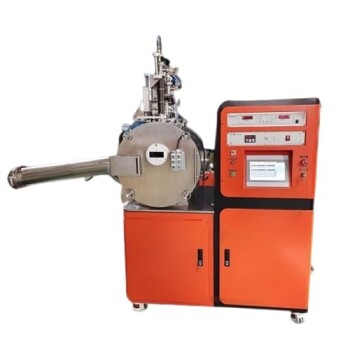
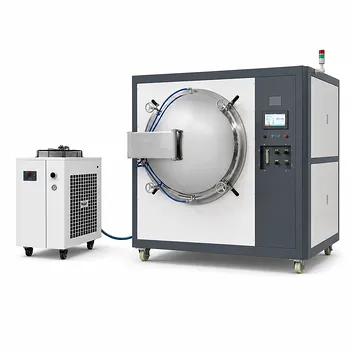
The primary function of a Vacuum Induction Furnace (VIF) in this context is to guarantee the precise chemical composition of the alloy by preventing oxidation. Specifically for 15Cr12MoVWN steel, the furnace creates a high-vacuum environment that isolates the molten metal from atmospheric oxygen and nitrogen. This protection is critical for retaining active alloying elements—such as Chromium (Cr), Vanadium (V), and Niobium (Nb)—which would otherwise be lost to oxidation or contamination during the melting process.
By eliminating atmospheric interference, the furnace allows for the strict retention of critical active elements and the removal of volatile impurities. This purity is the non-negotiable foundation for the steel’s superior radiation resistance and mechanical integrity required in nuclear applications.
Preserving Chemical Precision
The synthesis of 15Cr12MoVWN ferritic/martensitic steel is a delicate balancing act. The Vacuum Induction Furnace serves as the first line of defense in maintaining the strict elemental ratios defined in the alloy's design.
Protecting Active Alloying Elements
The specific alloying elements in this steel—Chromium, Vanadium, and Niobium—are highly reactive. In an open-air environment, they would rapidly react with oxygen to form oxides.
The VIF prevents this loss, ensuring that these expensive and critical elements remain dissolved in the steel matrix rather than turning into slag. This retention is vital because these elements are responsible for the material's high-temperature strength and creep resistance.
Eliminating Gaseous Impurities
Beyond preserving desired elements, the vacuum environment actively degasses the molten pool. It promotes the removal of harmful volatile impurities, specifically oxygen and nitrogen, which can severely degrade the steel's properties.
High nitrogen content, for example, can lead to the formation of brittle nitrides. By keeping the pressure extremely low (often below 15 Pa), the VIF minimizes the formation of macroscopic inclusions that could act as crack initiation sites.
Ensuring Nuclear-Grade Performance
The ultimate goal of using a VIF for 15Cr12MoVWN steel is to meet the stringent requirements of nuclear environments. The initial melting process dictates the material's lifespan and safety profile.
Achieving Superior Radiation Resistance
The primary reference highlights that the purity achieved via VIF is essential for radiation resistance. Impurities and oxide inclusions can swell or become brittle under neutron irradiation.
By producing a clean, homogenous ingot, the VIF ensures the steel can withstand the harsh conditions inside a nuclear reactor without suffering from premature degradation or void swelling.
Facilitating Thermomechanical Processing
A chemically precise, high-purity ingot is a prerequisite for successful downstream processing. If the initial composition varies due to oxidation, subsequent heat treatments cannot correct the microstructure.
The uniformity provided by vacuum induction melting ensures that subsequent steps—such as forging or rolling—yield consistent mechanical properties across the entire batch.
Understanding the Trade-offs
While Vacuum Induction Melting is superior for quality, it introduces specific operational constraints that must be managed.
Batch Size and Scalability
VIF is inherently a batch process. Unlike continuous casting methods used for commodity steels, VIF limits the volume of metal that can be produced at one time. This increases the cost per ton and reduces overall throughput.
Reliance on Input Material Quality
While VIF is excellent at preventing oxidation and removing gases, it has limited ability to remove non-volatile impurities like phosphorus or sulfur compared to other refining methods (such as Electro-Slag Remelting).
Therefore, the raw materials charged into the VIF must already be of relatively high purity. The process protects quality rather than creating it from low-grade scrap.
Making the Right Choice for Your Project
The decision to utilize Vacuum Induction Melting is driven by the specific performance targets of the final component.
- If your primary focus is Nuclear Safety: You must use VIF to minimize inclusions and ensure the radiation resistance of the 15Cr12MoVWN alloy.
- If your primary focus is Compositional Control: You should rely on VIF to prevent the loss of reactive elements like Vanadium and Niobium, ensuring the chemistry matches the design specifications exactly.
- If your primary focus is Cost Reduction: You must be aware that VIF is a premium process; attempting to bypass it for this specific alloy will result in material that fails to meet nuclear standards.
In the production of 15Cr12MoVWN, the Vacuum Induction Furnace is not an option but a necessity, transforming raw ingredients into a mathematically precise alloy capable of surviving the most extreme environments.
Summary Table:
| Feature | Impact on 15Cr12MoVWN Steel |
|---|---|
| High-Vacuum Environment | Prevents oxidation of Cr, V, and Nb; ensures radiation resistance. |
| Active Degassing | Removes oxygen and nitrogen to prevent brittle nitride formation. |
| Elemental Retention | Maintains strict chemical ratios for high-temperature strength. |
| Impurity Control | Minimizes macroscopic inclusions to prevent crack initiation. |
Elevate Your Material Integrity with KINTEK
Precision is paramount when dealing with nuclear-grade alloys and advanced material science. KINTEK specializes in high-performance laboratory equipment, offering a comprehensive range of Vacuum Induction Melting (VIM) systems, induction melting furnaces, and high-temperature reactors designed to meet the most stringent purity standards.
Whether you are synthesizing 15Cr12MoVWN steel or conducting cutting-edge battery research, our solutions—including crushing systems, hydraulic presses, and specialized ceramics—provide the reliability your lab demands.
Ready to optimize your melting process and ensure chemical precision? Contact our technical experts today to find the perfect equipment for your specific application.
References
- Tingwei Ma, Ping Wang. Effect of Heat Treatments on Microstructural Evolution and Tensile Properties of 15Cr12MoVWN Ferritic/Martensitic Steel. DOI: 10.3390/met10091271
This article is also based on technical information from Kintek Solution Knowledge Base .
Related Products
- 600T Vacuum Induction Hot Press Furnace for Heat Treat and Sintering
- Lab-Scale Vacuum Induction Melting Furnace
- Non Consumable Vacuum Arc Induction Melting Furnace
- Vacuum Heat Treat Furnace and Levitation Induction Melting Furnace
- Vacuum Arc Induction Melting Furnace
People Also Ask
- What role does an induction vacuum hot pressing furnace play in sintering? Achieve 98% Density in Carbide Blocks
- What advantages does a vacuum hot press furnace provide for LSLBO ceramic electrolytes? Achieve 94% Relative Density
- What role does a Vacuum Hot Press (VHP) furnace play in the densification of austenitic stainless steel 316 composites?
- What role does mechanical pressure play during the vacuum diffusion bonding of tungsten and copper? Keys to Solid Bonding
- What are the advantages of a vacuum hot press furnace for W-50%Cu? Achieve 99.6% Density at Lower Temperatures