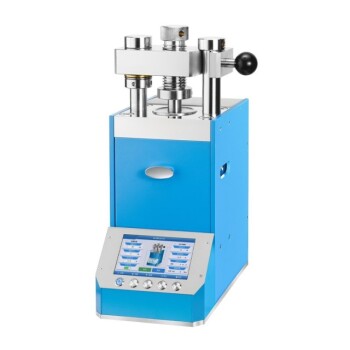
The primary function of an industrial Hot Isostatic Press (HIP) is to provide the driving force necessary for plastic deformation and subsequent diffusion bonding in gas-atomized powder alloys. By simultaneously applying high temperatures and high pressures—typically around 100 MPa—the system consolidates loose powder into fully densified, near-net-shape components.
HIP technology addresses the critical limitations of standard powder metallurgy by eliminating internal porosity. Through the application of simultaneous heat and isotropic pressure, it transforms powder into a solid, homogeneous material with superior mechanical and tribological properties.
The Mechanics of Densification
Simultaneous Heat and Pressure
The HIP process is distinct because it does not rely on temperature or pressure alone.
It combines thermal energy with significant mechanical force to activate material consolidation.
This dual application creates an environment where the yield strength of the material is lowered while the applied pressure collapses internal voids.
Plastic Deformation and Creep
At the microscopic level, the high-pressure environment forces individual powder particles against one another.
This contact induces plastic deformation at the contact points between particles.
Supplementary mechanisms, such as creep, further assist in closing the gaps between the powder granules as the material yields under stress.
Diffusion Bonding
Once the particles are mechanically compressed, the high temperature facilitates diffusion bonding.
Atoms migrate across the particle boundaries, effectively welding the powder grains together.
This results in a unified solid structure rather than a cluster of compressed particles.
Material Outcomes and Benefits
Achieving Full Densification
The core goal of this process is to produce components that are fully dense.
Unlike traditional sintering, which may leave residual porosity, HIP ensures a compact solid product.
This elimination of voids is essential for structural integrity in critical applications.
Near-Net-Shape Production
HIP allows for the creation of "near-net-shape" components directly from powder.
This minimizes the need for extensive machining or material removal after the consolidation process.
It enables the production of complex geometries that would be difficult to cast or forge using traditional methods.
Enhanced Material Properties
The resulting components exhibit significantly improved mechanical strength.
Because the microstructure is homogenized and annealed, the material also demonstrates better corrosion resistance.
Furthermore, the process boosts tribological performance (wear resistance), making these alloys suitable for harsh operating environments.
Understanding the Process Requirements
Equipment Intensity
The benefits of HIP come at the cost of requiring robust, specialized equipment.
To achieve densification, the machinery must safely contain pressures of 100 MPa (and potentially up to 300 MPa in specialized applications).
This necessitates heavy industrial containment vessels capable of withstanding extreme energy states.
Process Complexity
Achieving the correct microstructure requires precise control over thermal and pressure cycles.
Variables such as dynamic recrystallization and the formation of twin boundaries must be managed carefully.
Inaccurate parameters can lead to incomplete bonding or suboptimal microstructural reorganization.
Making the Right Choice for Your Goal
When evaluating Hot Isostatic Pressing for your manufacturing process, consider your specific performance targets:
- If your primary focus is mechanical integrity: Utilize HIP to eliminate porosity and maximize fatigue strength and corrosion resistance in critical components.
- If your primary focus is geometric complexity: Leverage the near-net-shape capabilities to reduce material waste and machining time for intricate alloy parts.
By mastering the balance of temperature and pressure, HIP transforms raw powder into high-performance materials that exceed the capabilities of traditional metallurgy.
Summary Table:
| Feature | Mechanism | Benefit |
|---|---|---|
| Pressure Mode | Isostatic (Uniform 100-300 MPa) | Eliminates internal porosity and voids |
| Thermal Action | Simultaneous High Temperature | Facilitates diffusion bonding and plastic deformation |
| Material State | Solid-state consolidation | Produces homogeneous, near-net-shape components |
| Performance | Microstructural refinement | Enhanced mechanical strength and wear resistance |
Elevate Your Material Integrity with KINTEK’s HIP Solutions
Unlock the full potential of your gas-atomized powder alloys with KINTEK’s advanced industrial Hot Isostatic Pressing (HIP) technology. Whether you are aiming for near-net-shape precision or seeking to eliminate critical internal defects, our expertise in high-pressure systems ensures your components achieve maximum density and superior mechanical performance.
Beyond HIP, KINTEK specializes in a comprehensive range of laboratory and industrial solutions, including:
- High-Temperature Furnaces: Muffle, tube, vacuum, and atmosphere furnaces.
- Pressing Systems: Isostatic, pellet, and hot hydraulic presses.
- Advanced Reactors: High-temperature high-pressure reactors and autoclaves.
- Research Tools: Electrolytic cells, battery research consumables, and crushing/milling systems.
Ready to transform your manufacturing process? Contact our technical experts today to discover how KINTEK can provide the precision equipment and consumables needed for your most demanding applications.
References
- D. Bowden, Michael Preuß. Phase Evolution Within Multiphase Stainless Steels During Simulated Hot Isostatic Pressing Cycles. DOI: 10.2139/ssrn.3997820
This article is also based on technical information from Kintek Solution Knowledge Base .
Related Products
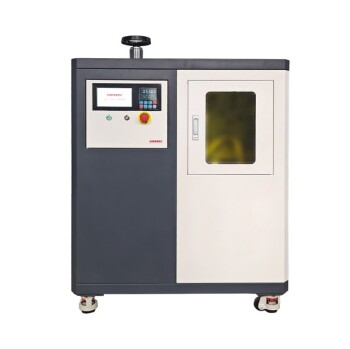
- Warm Isostatic Press for Solid State Battery Research
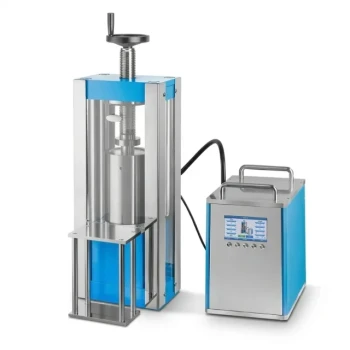
- Electric Split Lab Cold Isostatic Press CIP Machine for Cold Isostatic Pressing
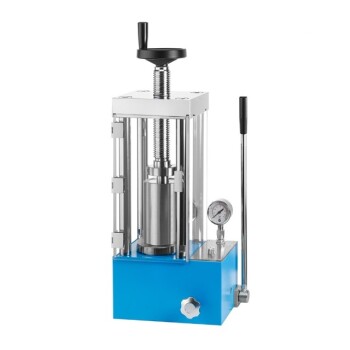
- Manual Cold Isostatic Pressing Machine CIP Pellet Press
- Automatic High Temperature Heated Hydraulic Press Machine with Heated Plates for Lab
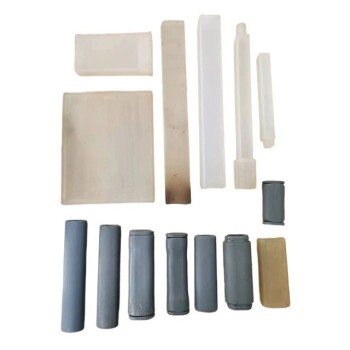
- Isostatic Molding Pressing Molds for Lab
People Also Ask
- What is the temperature of a warm isostatic press? Achieve Optimal Densification for Your Materials
- What is the function of a Warm Isostatic Press (WIP) in all-solid-state pouch cells? Optimize Battery Density
- Why are Warm Isostatic Presses (WIP) necessary for solid-state batteries? Achieve Atomic-Level Contact
- What advantages does a warm isostatic press offer over a traditional uniaxial press for Li6PS5Cl electrolyte sheets?
- How do warm isostatic presses improve dry electrode performance? Enhance ASSB Conductivity with Heat & Pressure