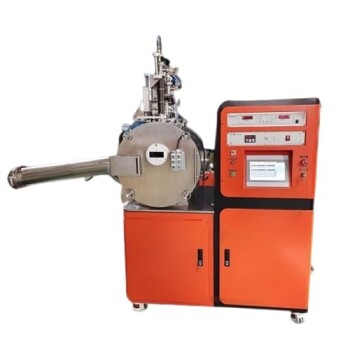
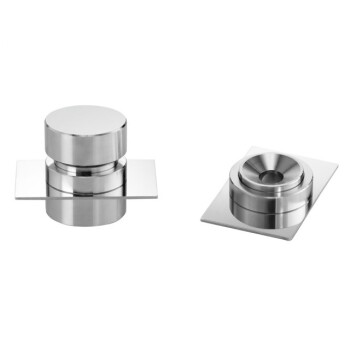
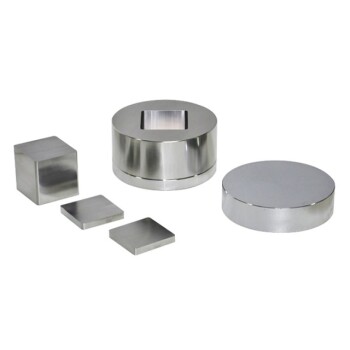
In the preparation of CoCrPtB alloy ingots via vacuum induction melting (VIM), the primary function of the graphite mold is to serve as a thermally stable containment vessel that defines the geometry of the solidifying metal. Operating at temperatures up to 1600°C, the mold ensures the molten alloy cools into a dimensionally precise ingot required for subsequent industrial processing.
Core Takeaway Graphite’s superior thermal resistance allows it to withstand the extreme heat of the molten alloy without deformation, serving as a precision vessel that transitions the material from a liquid state into a solid, structurally sound foundation for future manufacturing.
The Role of Graphite in High-Temperature Environments
Thermal Stability at Extremes
In the vacuum induction melting process, materials are subjected to temperatures reaching 1600°C.
The graphite mold must maintain its structural integrity under these conditions. Its primary role is to resist thermal shock and degradation, ensuring it does not fail or warp while containing the molten CoCrPtB alloy.
Precision Containment
The mold acts as the defining boundary for the liquid metal.
Unlike other refractory materials that might react or soften, graphite provides a rigid barrier. This containment is critical to prevent leaks or shape irregularities during the critical phase change from liquid to solid.
Ensuring Dimensional Accuracy
Predetermined Solidification
The ultimate goal of the VIM process is to create an ingot that fits specific industrial standards.
Graphite molds are machined to precise, predetermined dimensions. As the alloy cools, the mold forces the material to adopt this exact geometry, ensuring the resulting ingot is uniform and ready for downstream steps.
Foundation for Processing
The quality of the initial ingot dictates the success of subsequent manufacturing stages.
By delivering a dimensionally accurate block, the graphite mold eliminates the need for excessive corrective machining. It provides the necessary "foundational ingot" required for whatever processing comes next, such as rolling or sputtering target fabrication.
Process Distinctions and Considerations
VIM vs. Hot Pressing
It is critical to distinguish the mold's role in Vacuum Induction Melting (VIM) from Vacuum Hot Pressing.
In hot pressing, a mold transmits mechanical pressure (often 20–50 MPa) to densify powders. In VIM, the mold’s function is passive containment rather than active pressure transmission. The graphite is selected here for its ability to hold a shape under heat, not to crush powder.
Vacuum Compatibility
While the vacuum environment protects active elements like Chromium and Boron from oxidation, the mold must be compatible with this lack of atmosphere.
Graphite is ideal here because it remains stable in a vacuum where other refractories might outgas or degrade. The mold supports the equipment's goal of maintaining high purity by not introducing contaminants into the melt.
Making the Right Choice for Your Goal
To ensure the success of your alloy preparation, consider the specific requirements of your processing method:
- If your primary focus is Vacuum Induction Melting (VIM): Prioritize graphite molds with high thermal shock resistance and precise internal machining to ensure accurate ingot geometry at 1600°C.
- If your primary focus is Vacuum Hot Pressing: Select graphite grades specifically engineered for high mechanical strength to withstand axial pressures of 20–50 MPa without fracturing.
Select the mold grade that aligns with the specific thermal and mechanical demands of your melting technique to ensure ingot integrity.
Summary Table:
| Feature | Function in Vacuum Induction Melting (VIM) | Benefit for CoCrPtB Ingots |
|---|---|---|
| Thermal Stability | Resists temperatures up to 1600°C | Prevents mold warping or failure |
| Passive Containment | Defines the geometry of solidifying metal | Ensures dimensionally precise ingots |
| Vacuum Compatibility | Low outgassing and high purity | Maintains alloy chemistry and prevents oxidation |
| Machinability | Precise internal dimensions | Minimizes the need for corrective machining |
Elevate Your Material Research with KINTEK Precision Solutions
Unlock the full potential of your alloy production with KINTEK’s high-performance laboratory equipment. Whether you are performing Vacuum Induction Melting (VIM) or advanced Vacuum Hot Pressing, our specialized graphite molds, high-temperature furnaces, and hydraulic presses are engineered to withstand extreme conditions while ensuring absolute dimensional accuracy.
From high-temperature reactors and autoclaves to essential ceramics and crucibles, KINTEK provides the comprehensive toolkit needed by researchers and industrial manufacturers to achieve structural integrity and high purity in every batch.
Ready to optimize your solidification process? Contact our technical experts today to find the perfect equipment and consumables for your lab's specific needs.
Related Products
- 2200 ℃ Graphite Vacuum Heat Treat Furnace
- Ultra-High Temperature Graphite Vacuum Graphitization Furnace
- Graphite Vacuum Furnace IGBT Experimental Graphitization Furnace
- Large Vertical Graphite Vacuum Graphitization Furnace
- Graphite Vacuum Continuous Graphitization Furnace
People Also Ask
- Why do you heat treat in a vacuum? Achieve Perfect Surface Finish and Material Integrity
- How does heat transmit in a vacuum? Mastering Thermal Radiation for Purity & Precision
- What is the process of vacuum heat treating? Achieve Superior Hardening with a Clean, Bright Finish
- How does a vacuum heat treat furnace work? Achieve Pristine, Oxide-Free Metal Parts
- What is graphite heating? A Guide to Durable, High-Temp Industrial Furnace Solutions