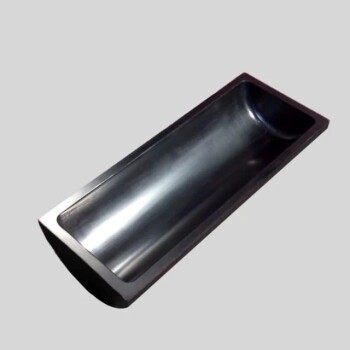
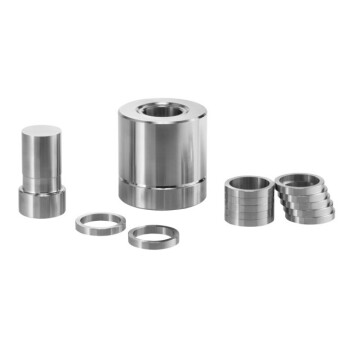
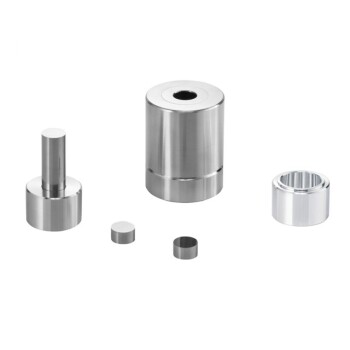
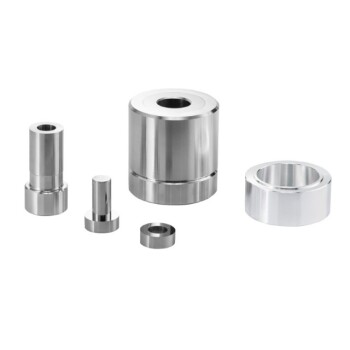
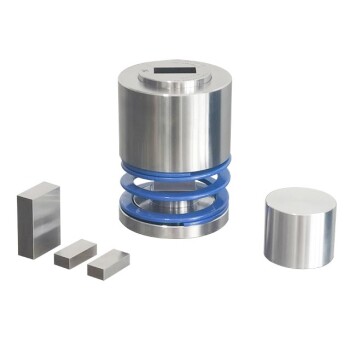
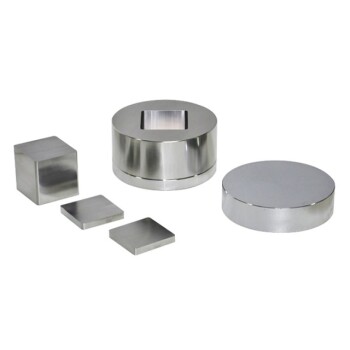
The primary function of high-purity graphite molds is to serve as a structurally stable shaping container that simultaneously manages mechanical compression and thermal distribution. During the hot pressing and sintering of LLZTO solid electrolytes, these molds transmit high pressure to the powder to ensure densification while utilizing their electrical and thermal conductivity to maintain a uniform heat field, preventing structural defects.
By functioning as both a pressure vessel and a thermal conductor, high-purity graphite molds are essential for converting loose powder into high-density, crack-free ceramic pellets capable of effective ionic conduction.
Mechanical Functions and Pressure Transmission
Defining Geometric Shape
The most fundamental role of the graphite mold is to act as the shaping container. It defines the macroscopic geometry of the final LLZTO pellet.
The mold holds the loose powder in place, preventing it from scattering during the initial stages of the process.
Withstanding High-Pressure Environments
LLZTO sintering requires significant mechanical force to eliminate voids and achieve high density.
High-purity graphite possesses exceptional high-temperature mechanical strength. This allows the mold to maintain its structural integrity without deforming, even when subjected to intense uniaxial pressure.
Effective Pressure Transmission
The mold does not merely survive the pressure; it acts as the medium to transfer it.
It ensures that the applied force is transmitted effectively and evenly to the LLZTO powder. This compression is vital for closing pores between particles and facilitating the densification process.
Thermal Management and Conductivity
Promoting Uniform Heat Distribution
Ceramics like LLZTO are sensitive to thermal gradients, which can cause internal stress.
High-purity graphite has excellent thermal conductivity. This property ensures that heat is distributed uniformly throughout the mold and the powder, creating a homogeneous temperature field.
Electrical Conductivity Roles
In addition to thermal properties, high-purity graphite is electrically conductive.
This allows the mold to assist in the heating process, particularly in techniques where current flows through the mold or sample. This conductivity helps facilitate rapid and even heating, which is crucial for controlling grain growth.
Prevention of Cracking
The combination of thermal and electrical conductivity minimizes hot spots and cold zones.
By maintaining a uniform heat field, the mold prevents the formation of thermal stresses that lead to cracks or warping in the final ceramic pellet.
Understanding the Trade-offs
Chemical Reactivity Risks
While graphite is generally stable, it is carbon-based and can react with oxide materials like LLZTO at very high temperatures.
If the processing environment is not strictly controlled (e.g., using a vacuum or inert atmosphere), carbon contamination or reduction of the oxide surface can occur, potentially affecting the electrolyte's purity.
Mechanical Wear and Lifespan
Graphite molds are consumables. The combination of high pressure, high temperature, and physical friction eventually degrades the mold.
Over time, the mechanical strength may diminish, or the surface finish may degrade, requiring mold replacement to maintain the geometric accuracy and surface quality of the LLZTO pellets.
Making the Right Choice for Your Goal
To maximize the effectiveness of your sintering process, consider the following based on your specific objectives:
- If your primary focus is achieving maximum relative density: Prioritize the mechanical strength of the graphite grade to ensure it can withstand the higher pressures required to close all internal pores.
- If your primary focus is preventing structural defects (cracking): Focus on the thermal conductivity specifications of the graphite to ensure the most uniform heat field distribution possible during rapid heating and cooling cycles.
The graphite mold is not a passive accessory, but a critical active component that translates thermal and mechanical energy into material structural integrity.
Summary Table:
| Function | Description | Benefit to LLZTO |
|---|---|---|
| Structural Shaping | Acts as a high-strength container for powder | Defines precise pellet geometry |
| Pressure Transmission | Uniaxially transfers mechanical force | Eliminates voids for high density |
| Thermal Conductivity | Distributes heat uniformly throughout the mold | Prevents thermal stress and cracking |
| Electrical Conductivity | Enables rapid, efficient heating | Controls grain growth and sintering speed |
Elevate Your Battery Research with KINTEK Precision Solutions
High-density, crack-free LLZTO pellets require the perfect synergy of thermal management and mechanical force. KINTEK specializes in advanced laboratory equipment designed for the most demanding material science applications. Our high-performance hydraulic presses (pellet, hot, and isostatic) and high-temperature furnaces are engineered to work seamlessly with premium consumables like high-purity graphite molds and ceramic crucibles.
From battery research tools and consumables to specialized high-pressure reactors and cooling solutions, KINTEK provides the comprehensive portfolio needed to ensure your solid-state electrolyte development is efficient and reproducible.
Ready to optimize your sintering process? Contact KINTEK today to find the ideal equipment for your laboratory.
Related Products
- High Purity Pure Graphite Crucible for Evaporation
- High Purity Pure Graphite Crucible for Electron Beam Evaporation
- High Purity Alumina Granulated Powder for Engineering Advanced Fine Ceramics
- Horizontal High Temperature Graphite Vacuum Graphitization Furnace
- Ultra-High Temperature Graphite Vacuum Graphitization Furnace
People Also Ask
- Why are high-purity graphite crucibles preferred for sulfide solid electrolytes? Achieve Superior Material Purity
- Why is a high-purity graphite crucible required for Chromel-TaC composites? Ensure Peak Purity at 1400°C
- What role do high-purity graphite crucibles play in molten salt corrosion research? Ensure Reactor-Grade Precision
- Why are high-purity graphite crucibles used for magnesium distillation? Ensure 3N8 Purity & Thermal Stability
- Why is a high-purity graphite crucible ideal for nitrogen-doped graphene at 1500 °C? Maximize Purity and Stability