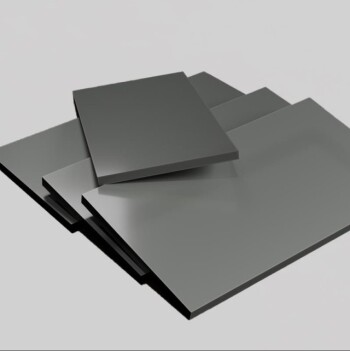
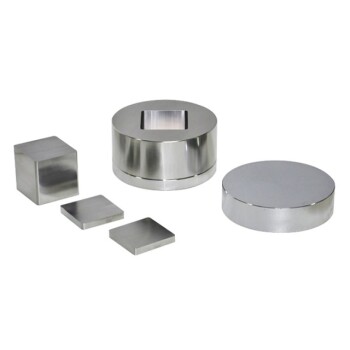
High-purity graphite molds function as both precision containment vessels and active pressure transmission media during the vacuum hot pressing process. They are responsible for holding the layered raw materials in strict alignment while uniformly transferring uniaxial pressure from the hydraulic system to the composite stack. This dual role ensures the necessary plastic deformation and atomic diffusion required to bond graphite films with aluminum matrices.
The graphite mold is not a passive container; it is a critical process component that converts mechanical force into uniform internal pressure. Its performance directly dictates the density, structural integrity, and interlaminar bonding quality of the final composite material.
The Mechanics of Pressure Transmission
Transforming Hydraulic Force
In vacuum hot pressing, the mold acts as the bridge between the machine's hydraulic ram and the delicate composite layers. The mold must possess sufficient mechanical strength to transmit significant forces—often reaching tens of megapascals—without cracking or deforming.
Achieving Uniformity
The primary challenge in layered composites is avoiding local non-bonding or uneven thickness. High-purity graphite molds distribute the applied load evenly across the entire surface area of the sample. This uniformity is essential for eliminating voids and ensuring consistent densification throughout the material.
Facilitating Plastic Deformation
By maintaining high pressure at elevated temperatures, the mold forces the aluminum matrix to undergo plastic deformation. This action fills the microscopic pores between layers and creates a tight, gap-free interface between the metal and the graphite film.
Thermal and Structural Stability
Resistance to Extreme Environments
The fabrication process subjects the assembly to high temperatures (often exceeding 600°C for aluminum composites) and vacuum conditions simultaneously. The mold utilizes its excellent thermal stability to maintain its dimensions and structural rigidity, ensuring the final composite matches the intended geometry.
Thermal Conductivity
Graphite's high thermal conductivity allows heat to pass through the mold and reach the sample efficiently. This ensures that the composite layers are heated uniformly, preventing thermal gradients that could lead to warping or inconsistent material properties.
Precision Alignment
For graphite film/aluminum composites, maintaining the alignment of the multi-layer stack is critical. The mold serves as a positioning tool, preventing lateral movement of the layers during the pressing phase to guarantee a structurally sound final billet.
Understanding the Trade-offs
The Consumable Nature of the Mold
While high-purity graphite is robust, it is generally considered a critical consumable in this process. Repeated exposure to high heat and pressure eventually degrades the mold, necessitating replacement to maintain dimensional accuracy and surface finish.
Chemical Inertness and Demolding
A key advantage that can become a liability if ignored is the interaction between the mold and the metal. High-purity graphite is generally chemically inert to aluminum, which prevents the composite from sticking to the mold walls. However, if the graphite quality is poor, reaction or adhesion can occur, making demolding difficult and potentially damaging the composite surface.
Making the Right Choice for Your Goal
To optimize your vacuum hot pressing process, select your graphite mold specifications based on your specific project requirements:
- If your primary focus is Bonding Integrity: Prioritize molds with exceptional mechanical strength to ensure maximum pressure transmission without deformation.
- If your primary focus is Dimensional Precision: Select high-density graphite grades that offer superior thermal stability to minimize expansion or warping at sintering temperatures.
- If your primary focus is Process Efficiency: Ensure the graphite grade possesses inherent lubricity to facilitate easy demolding and reduce cycle times.
By treating the mold as a precision instrument rather than simple tooling, you ensure the successful fabrication of high-performance layered composites.
Summary Table:
| Function | Key Mechanism | Benefit for Composite |
|---|---|---|
| Pressure Transmission | Converts hydraulic force to uniaxial pressure | Eliminates voids and ensures high densification |
| Containment & Alignment | Maintains strict stack positioning | Prevents lateral movement and ensures structural integrity |
| Thermal Conductivity | Efficient heat transfer through mold walls | Prevents thermal gradients and warping |
| Plastic Deformation | Maintains high pressure at elevated temps | Facilitates atomic diffusion and gap-free bonding |
| Chemical Inertness | Low reactivity with aluminum matrix | Enables easy demolding and superior surface finish |
Elevate Your Composite Material Research with KINTEK
Precision in vacuum hot pressing starts with high-performance tooling. At KINTEK, we specialize in providing high-purity graphite molds and advanced laboratory equipment—including vacuum hot presses, hydraulic systems, and crushing and milling systems—designed to meet the rigorous demands of material science.
Whether you are developing graphite/aluminum layered composites or exploring advanced battery research, our comprehensive range of high-temperature furnaces, isostatic presses, and specialized consumables (like ceramic crucibles and PTFE products) ensures your lab achieves maximum efficiency and superior results.
Ready to optimize your fabrication process? Contact our experts today to find the perfect solution for your specific laboratory needs.
Related Products
- High Purity Pure Graphite Crucible for Evaporation
- Anti-Cracking Press Mold for Lab Use
- Horizontal High Temperature Graphite Vacuum Graphitization Furnace
- Ball Press Mold for Lab
- Ultra-High Temperature Graphite Vacuum Graphitization Furnace
People Also Ask
- Why are high-purity graphite crucibles preferred for sulfide solid electrolytes? Achieve Superior Material Purity
- Why is a high-purity graphite crucible required for Chromel-TaC composites? Ensure Peak Purity at 1400°C
- What role do high-purity graphite crucibles play in molten salt corrosion research? Ensure Reactor-Grade Precision
- Why are high-purity graphite crucibles used for magnesium distillation? Ensure 3N8 Purity & Thermal Stability
- Why is a high-purity graphite crucible ideal for nitrogen-doped graphene at 1500 °C? Maximize Purity and Stability