The primary purpose of configuring a vacuum system with a mechanical and turbomolecular pump is to create a pristine, high-vacuum environment essential for high-quality sputtering. By leveraging this dual-pump setup, you can evacuate the deposition chamber to a base pressure in the range of $10^{-4}$ Pa. This deep vacuum is strictly necessary to remove residual air molecules and impurities, thereby preventing the unintended oxidation of the Aluminum-Zirconium (Al-Zr) alloy during film growth.
The core objective is not simply lowering pressure, but establishing a pure sputtering atmosphere. Without reaching the $10^{-4}$ Pa threshold, residual oxygen will react with the Al-Zr alloy, compromising the chemical integrity and performance of the thin film.
The Mechanics of Decontamination
The Role of the Dual-Pump System
A single pump is often insufficient to reach the high-vacuum levels required for sensitive metallic alloys. The system utilizes a mechanical pump to perform the initial "rough" evacuation, removing the bulk of the atmosphere.
Once the pressure is sufficiently low, the turbomolecular pump takes over. This pump is specifically designed to handle low-pressure molecular flow, driving the system down to the critical $10^{-4}$ Pa base vacuum.
Eliminating Residual Impurities
The sputtering chamber is naturally filled with microscopic contaminants and air molecules. If left in the chamber, these residuals act as barriers and contaminants.
The pumping configuration actively strips these impurities from the environment. This ensures that the only material interacting with the substrate is the intended source material, rather than environmental debris.
Protecting the Al-Zr Alloy
Preventing Unintended Oxidation
Aluminum and Zirconium are reactive materials. If oxygen is present during the deposition process, these metals will chemically bond with it rather than forming the desired metallic alloy.
By achieving a high base vacuum, you effectively remove the oxygen source. This allows the Al-Zr thin film to grow in its pure metallic form, maintaining the specific electrical and physical properties required for the application.
Ensuring a Pure Sputtering Atmosphere
Consistency is the hallmark of effective thin film deposition. The presence of "background gas" creates variables that are difficult to control.
Evacuating to $10^{-4}$ Pa stabilizes the sputtering atmosphere. This ensures that the deposition process is repeatable and that the resulting film composition is uniform throughout the layer.
Common Pitfalls and Risks
The Consequence of Insufficient Vacuum
If the system fails to reach the target base pressure, the resulting film will likely suffer from interstitial contamination.
Even trace amounts of remaining atmosphere can lead to the formation of oxides within the film structure. This often results in a film with higher electrical resistance or poor structural adhesion compared to a pure Al-Zr layer.
Balancing Time and Purity
Reaching $10^{-4}$ Pa requires time, as the turbomolecular pump must work against outgassing from the chamber walls.
Rushing this process by starting deposition before the base vacuum is stable is a common error. It negates the purpose of the equipment and introduces immediate contamination risks.
Ensuring Process Integrity
To maximize the effectiveness of your vacuum system configuration, consider these distinct operational focuses:
- If your primary focus is Material Purity: Ensure the system stabilizes at or below $10^{-4}$ Pa before engaging the sputter source to guarantee zero oxidation.
- If your primary focus is Process Repeatability: Implement strict pump-down protocols to ensure the residual impurity levels are identical for every batch run.
Ultimately, the mechanical and turbomolecular pump combination is the gatekeeper of quality, transforming a standard chamber into a controlled environment suitable for advanced nanotechnology manufacturing.
Summary Table:
| Component/Stage | Function in Vacuum System | Resulting Pressure / Outcome |
|---|---|---|
| Mechanical Pump | Initial 'rough' evacuation of bulk atmosphere | Prepares system for high-vacuum pump |
| Turbomolecular Pump | High-speed molecular flow removal | Reaches critical $10^{-4}$ Pa base vacuum |
| High Vacuum Environment | Elimination of residual oxygen and moisture | Prevents Al-Zr oxidation & contamination |
| Pure Sputtering Atmosphere | Consistent deposition environment | High-quality, uniform metallic thin films |
Elevate Your Thin Film Research with KINTEK Precision
Don't let residual impurities compromise your Al-Zr thin film integrity. KINTEK specializes in high-performance laboratory equipment designed for the most demanding nanotechnology applications. From advanced high-temperature vacuum furnaces and CVD/PECVD systems to our robust crushing and milling equipment, we provide the tools necessary to achieve a pristine $10^{-4}$ Pa environment.
Whether you are performing complex sputter deposition or battery research, our comprehensive portfolio—including hydraulic presses, PTFE consumables, and cooling solutions—ensures your lab maintains peak process repeatability.
Ready to optimize your deposition quality? Contact our experts today to find the perfect vacuum and materials processing solution for your specific needs.
References
- Caroline Villardi de Oliveira, Frédéric Sanchette. Structural and microstructural analysis of bifunctional TiO2/Al-Zr thin film deposited by hybrid process. DOI: 10.1016/j.tsf.2020.138255
This article is also based on technical information from Kintek Solution Knowledge Base .
Related Products
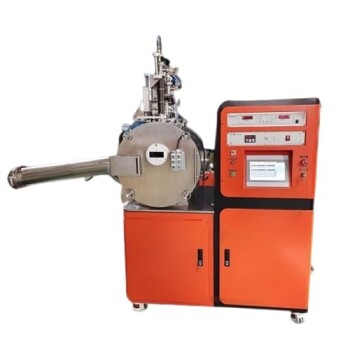
- Vacuum Induction Melting Spinning System Arc Melting Furnace
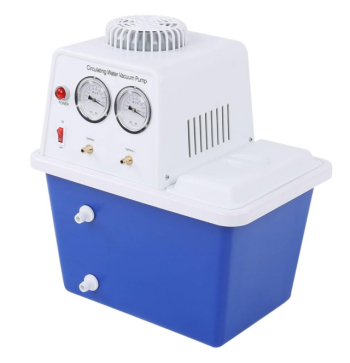
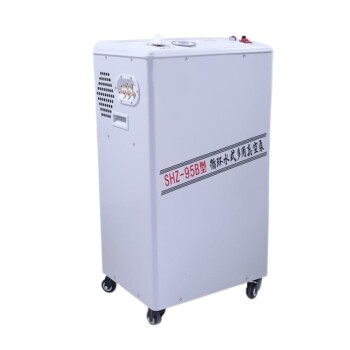
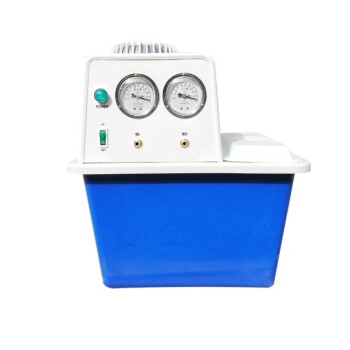
- Circulating Water Vacuum Pump for Laboratory and Industrial Use
- CF KF Flange Vacuum Electrode Feedthrough Lead Sealing Assembly for Vacuum Systems
- 304 316 Stainless Steel Vacuum Ball Valve Stop Valve for High Vacuum Systems
- Vacuum Cold Mounting Machine for Sample Preparation
People Also Ask
- What are the advantages of a vacuum induction melting furnace? Achieve High-Purity Alloys with Precision VIM
- Why use VIM for rare earth steel? Essential Precision for Melting Reactive Lanthanum and Cerium
- What is the primary function of a vacuum induction melting furnace in Ni-Mo-Cr-Fe master alloy prep? Ensure High Purity
- What is the function of a vacuum induction melting furnace? Essential Guide for High-Purity FeCrAl Alloy Production
- What types of metals are typically processed in a vacuum induction melting furnace? High-Purity Alloys for Critical Applications