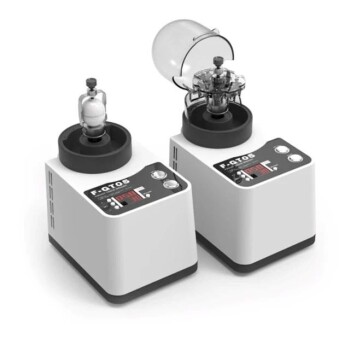
The primary purpose of using a planetary ball mill during the LAGP raw material mixing stage is to achieve effective dispersion and homogenization of precursor powders through high-speed centrifugal and frictional forces.
By utilizing an ethanol medium, this process ensures that components like lithium carbonate, aluminum oxide, and germanium oxide achieve atomic or micron-level uniform contact. This microscopic uniformity is critical for maintaining the accurate stoichiometric ratio required for the subsequent solid-phase reaction.
The planetary ball mill does more than simply mix ingredients; it creates the necessary atomic-level interface between reactants. Without this high-energy dispersion, the diffusion barriers between solids would remain too high, preventing the formation of a pure, accurate NASICON structure during synthesis.
The Mechanics of High-Energy Homogenization
Generating Centrifugal and Frictional Forces
The planetary ball mill operates by rotating jars at high speeds, creating intense centrifugal force.
This force generates high-energy impact and friction between the grinding media and the raw materials.
These forces are significantly more effective than standard stirring, allowing the system to break down agglomerates that naturally occur in fine chemical powders.
The Role of the Liquid Medium
The process is typically conducted in a liquid medium, specifically ethanol.
This "wet milling" technique prevents dust formation and facilitates a more fluid dispersion of the particles.
It ensures that the precursor powders are suspended evenly, preventing segregation based on particle density.
Achieving Micron-Level Refinement
The physical impact of the milling media refines the particle size of the raw materials to the micron or even nano-scale.
This reduction in particle size dramatically increases the specific surface area available for reaction.
Why Uniformity Drives LAGP Synthesis
Ensuring Accurate Stoichiometry
The most critical function of this stage is maintaining the correct chemical balance across the entire mixture.
If the precursors are not mixed at an atomic or micron level, local variations in composition will occur.
These variations lead to impurities or secondary phases in the final product, rather than the desired NASICON structure.
Overcoming Diffusion Barriers
Solid-state reactions rely on the diffusion of atoms between solid particles, which is a naturally slow process.
By maximizing the contact area between reactants, the ball mill lowers the diffusion barriers.
This facilitates a complete reaction during the heating phase, often allowing for lower synthesis temperatures and higher phase purity.
Understanding the Trade-offs
Risk of Contamination
While high-energy milling is effective, the friction involved can cause wear on the grinding jar and balls (often Zirconia).
This wear can introduce trace amounts of foreign material into your precursor mix, potentially affecting the ionic conductivity of the final electrolyte.
Process Optimization Required
There is a delicate balance regarding milling duration (typically 24 to 48 hours).
Insufficient milling leads to incomplete reactions, while excessive milling can lead to structural damage or excessive solvent evaporation.
Making the Right Choice for Your Goal
To ensure the successful synthesis of LAGP solid-state electrolytes, align your milling parameters with your specific objectives:
- If your primary focus is Phase Purity: Prioritize the use of an ethanol medium to ensure perfect stoichiometric distribution and prevent local composition errors.
- If your primary focus is Reaction Efficiency: Focus on the particle refinement aspect to maximize surface area, which will facilitate easier diffusion during the sintering phase.
The quality of your final solid-state electrolyte is strictly limited by the homogeneity achieved during this initial milling stage.
Summary Table:
| Feature | Function in LAGP Synthesis | Key Benefit |
|---|---|---|
| High-Energy Impact | Breaks down agglomerates via centrifugal force | Achieves micron-level refinement |
| Ethanol Medium | Prevents segregation and dust formation | Ensures uniform precursor suspension |
| Stoichiometric Control | Maintains precise chemical balance | Prevents impurities/secondary phases |
| Diffusion Optimization | Increases specific surface area | Lowers reaction barriers during sintering |
Elevate Your Material Research with KINTEK Precision
Achieving the perfect NASICON structure starts with the right equipment. KINTEK specializes in advanced laboratory solutions designed for high-performance battery research and materials science.
Our professional-grade planetary ball mills and crushing & milling systems provide the high-energy homogenization necessary for superior LAGP synthesis. Whether you need reliable zirconia grinding media, high-temperature furnaces for sintering, or hydraulic presses for pellet preparation, KINTEK offers a comprehensive range of equipment to ensure your solid-state electrolytes meet the highest standards of ionic conductivity and phase purity.
Ready to optimize your milling process and achieve atomic-level uniformity? Contact KINTEK today to find the perfect solution for your lab!
Related Products
- High Energy Planetary Ball Mill for Laboratory Horizontal Tank Type Milling Machine
- High-Energy Omnidirectional Planetary Ball Mill Milling Machine for Laboratory
- Laboratory Planetary Ball Mill Rotating Ball Milling Machine
- High Energy Planetary Ball Mill Milling Machine for Laboratory
- High Energy Planetary Ball Mill Machine for Laboratory Horizontal Tank Type
People Also Ask
- What is the role of a planetary ball mill in sulfide-based solid-state batteries? Engineer High-Performance Cathodes
- What are the parameters of a planetary ball mill? Master Speed, Time, and Media for Perfect Grinding
- What is the function of a planetary ball mill for nanostructured eutectic steel? Essential Prep for High-Strength Alloys
- What role does a planetary ball mill play in the preparation of NASICON-type solid electrolytes like LATP and LAGP?
- What is the function of a planetary ball mill in solid-state electrolyte prep? Milling vs. SDS Methods Explained