The primary role of a planetary ball mill in this context is to mechanically activate and homogenize the raw precursors. By utilizing high-energy collisions, the mill forces the raw powders—specifically lithium hydroxide (LiOH), lanthanum hydroxide (La(OH)3), and zirconium dioxide (ZrO2)—into a uniformly dispersed state. This process simultaneously reduces particle size to create a high-activity precursor powder, which is a prerequisite for successful high-temperature synthesis.
By converting distinct raw materials into a highly refined and uniform mixture, the planetary ball mill ensures the consistent chemical composition required for the subsequent solid-state reaction.
The Mechanism of Precursor Preparation
High-Energy Mechanical Mixing
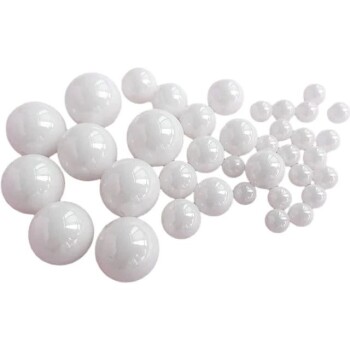
The planetary ball mill applies intense mechanical energy to the raw material mixture. Through a combination of centrifugal force and rotation, the grinding balls impact the powder with high velocity.
This action breaks down the agglomerates of LiOH, La(OH)3, and ZrO2, forcing them into intimate contact. The result is a uniform dispersion of reactants that manual mixing cannot achieve.
Particle Size Reduction
Beyond simple mixing, the mill significantly reduces the particle size of the powders. This physical refinement increases the specific surface area of the materials.
Smaller particles reduce the diffusion distances between ions. This facilitates a smoother and more complete reaction during the later stages of synthesis.
Impact on Synthesis Outcomes
Creating a High-Activity Precursor
The output of the milling process is described as a high-activity precursor powder. Because the particles are refined and intimately mixed, they possess higher surface energy.
This elevated reactivity is essential for the subsequent high-temperature solid-state reactions. Without this activation, the chemical reaction usually requires higher temperatures or longer dwell times to complete.
Ensuring Chemical Consistency
Uniformity in the green body (the compressed powder before heating) dictates the uniformity of the final ceramic. The ball mill ensures that the chemical composition is consistent throughout the entire batch.
This prevents localized segregation where one element might be over-concentrated. A homogeneous microstructure is critical for the ionic conductivity and stability of the final LLZ-CaSb electrolyte.
Critical Process Distinctions
Pre-Reaction vs. Mechanochemical Reaction
It is vital to distinguish the role of the mill here compared to other electrolyte types. In sulfide or halide synthesis, the mill often drives the chemical reaction to completion at room temperature (mechanochemical synthesis).
However, for oxide-based LLZ-CaSb, the primary reference indicates the mill generates a precursor. The actual formation of the final crystal phase typically occurs during a subsequent high-temperature step. The mill prepares the potential energy, but the furnace completes the phase formation.
Making the Right Choice for Your Goal
To optimize your synthesis of LLZ-CaSb, consider how the milling parameters align with your specific objectives:
- If your primary focus is Phase Purity: Ensure sufficient milling time to achieve maximum homogeneity, as localized inconsistencies will lead to impurity phases during sintering.
- If your primary focus is Sintering Activity: Prioritize high-energy settings that maximize particle size reduction, which lowers the energy barrier for the subsequent solid-state reaction.
The planetary ball mill is the bridge between raw, inert powders and a chemically active, homogeneous precursor capable of forming a high-performance solid electrolyte.
Summary Table:
| Process Function | Description | Key Benefit |
|---|---|---|
| Mechanical Mixing | High-energy impact and centrifugal forces | Uniform dispersion of LiOH, La(OH)3, and ZrO2 |
| Size Reduction | Breaking down agglomerates to sub-micron levels | Increased specific surface area and reduced ion diffusion distance |
| Mechanical Activation | Increasing surface energy of raw powders | Lowers energy barrier for high-temperature solid-state reactions |
| Homogenization | Ensuring consistent chemical distribution | Prevents localized segregation and impurity phases |
Elevate Your Solid-State Electrolyte Research with KINTEK
Precise synthesis of LLZ-CaSb requires the highest standards of material preparation. KINTEK specializes in advanced laboratory equipment designed to meet the rigorous demands of battery research and material science.
Our planetary ball mills and crushing/milling systems provide the high-energy mechanical activation necessary for uniform precursor preparation. To complete your workflow, we offer a comprehensive range of high-temperature furnaces (muffle, vacuum, tube) for precise sintering, alongside hydraulic pellet presses, isostatic presses, and PTFE/ceramic consumables.
Ready to optimize your synthesis outcomes? Contact KINTEK today to discover how our high-performance equipment can enhance your lab's efficiency and ensure chemical consistency in every batch.
Related Products
- Laboratory Planetary Ball Mill Rotating Ball Milling Machine
- Mini Planetary Ball Mill Machine for Laboratory Milling
- Laboratory Planetary Ball Mill Cabinet Planetary Ball Milling Machine
- High Energy Planetary Ball Mill for Laboratory Horizontal Tank Type Milling Machine
- High Energy Planetary Ball Mill Milling Machine for Laboratory
People Also Ask
- In what way does a laboratory ball mill affect material properties when modifying PHBV/pulp fiber composites?
- Why is a laboratory ball mill required for ultra-fine fly ash? Unlock Nano-Scale Adsorption Power
- Why is a laboratory ball mill used in Co-Ni catalyst research? Optimize CO2 Conversion with Precise Milling
- How does a laboratory ball mill ensure the mixing quality of Mn3Zn0.8Sn0.2N and Ti? Achieve Perfect Homogeneity
- What is the function of a laboratory ball mill in the preparation of AMMCs? Optimize Dispersion & Grain Refinement