Knowledge What is the process of electron beam? A Guide to Precision Material Processing
Author avatar

Tech Team · Kintek Solution

Updated 1 week ago

What is the process of electron beam? A Guide to Precision Material Processing


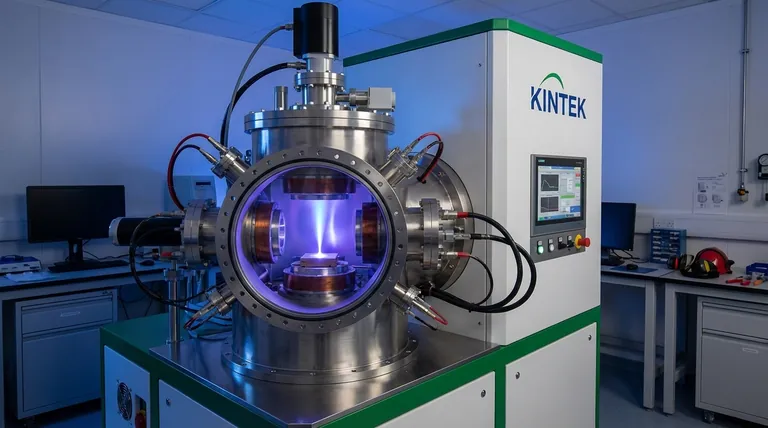
At its core, an electron beam process is a method that uses a highly focused stream of accelerated electrons inside a vacuum to alter a material's properties. This energy transfer can be used to heat, vaporize, chemically change, or sterilize a target object with incredible precision and speed. It is not a single technique but a versatile platform technology with applications ranging from manufacturing advanced optics to sterilizing medical devices.

The central concept is the controlled delivery of energy. By generating and directing a beam of high-energy electrons, engineers can induce specific physical or chemical changes in a material without direct contact or the use of chemical agents.
What is the process of electron beam? A Guide to Precision Material Processing

How an Electron Beam Works: The Core Principle

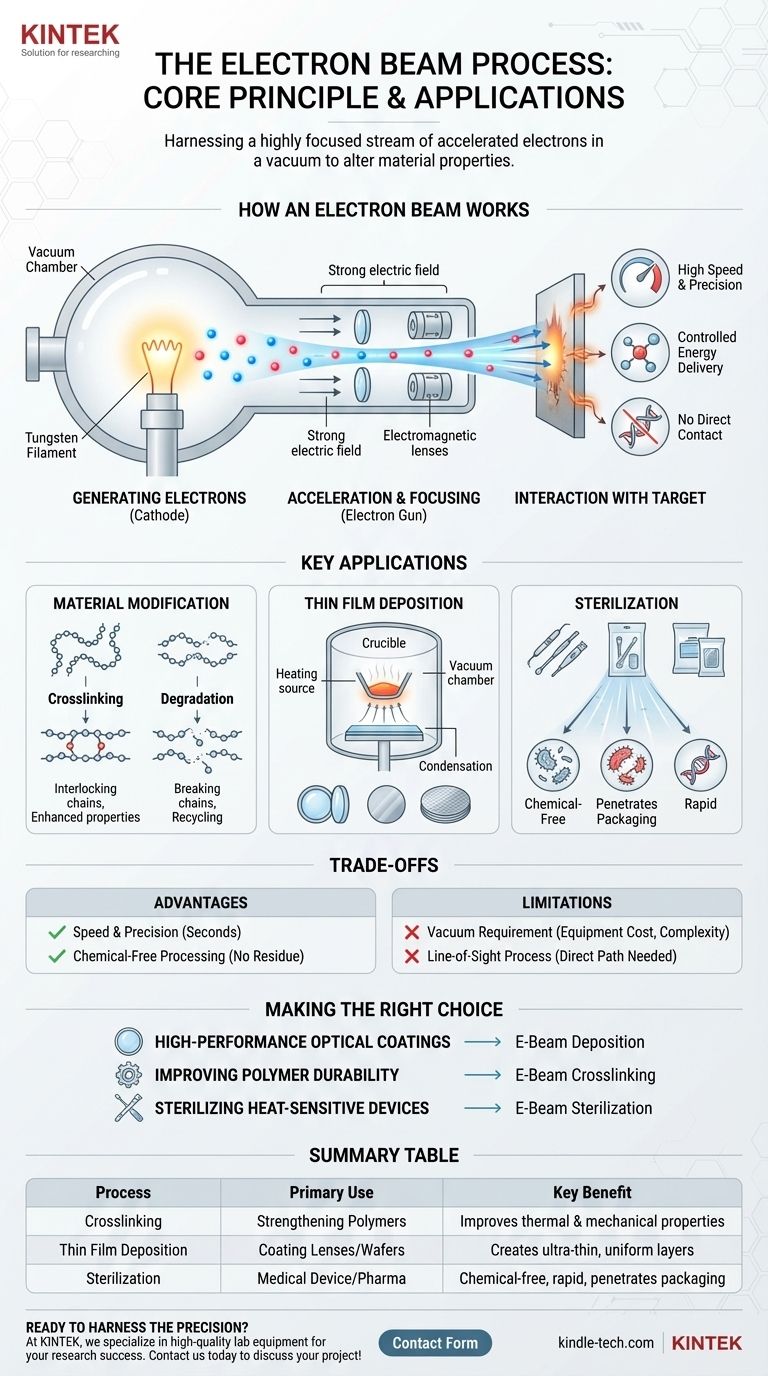
The fundamental technology behind any electron beam process is the electron gun, which operates in a high-vacuum environment.

Generating the Electrons

The process begins with a cathode, typically a tungsten filament. When heated to a very high temperature, this filament releases a cloud of electrons through a process called thermionic emission.

Acceleration and Focusing

These free electrons are then accelerated to extremely high speeds by a strong electric field, created by applying a high voltage. Electromagnetic lenses then focus these fast-moving electrons into a narrow, precise beam, much like a glass lens focuses light.

Interaction with the Target

When this high-energy beam strikes a target material, it rapidly transfers its kinetic energy. This energy transfer is what drives the desired modification, whether it's melting a substance, breaking chemical bonds, or destroying microbial DNA.

Key Applications of Electron Beam Technology

The versatility of the electron beam allows it to be adapted for several distinct industrial processes.

Material Modification: Crosslinking and Degradation

For polymer-based products, the electron beam can initiate crosslinking. The beam's energy creates free radicals, causing polymer chains to form new bonds with each other. This enhances the material's mechanical strength, chemical resistance, and thermal stability.

Conversely, at very high doses, the beam can be used for material degradation. It systematically breaks down long polymer chains, which is a useful technique in the recycling of certain materials.

Thin Film Deposition

In electron beam deposition, the beam is aimed at a source material (like a ceramic or metal) held in a crucible inside a vacuum chamber. The intense, localized heating causes the material to vaporize.

This vapor then travels and condenses as an extremely thin, uniform film on a cooler substrate, such as a lens or a silicon wafer. This process is essential for creating high-performance optical coatings and electronic components.

Sterilization

For medical and pharmaceutical goods, the electron beam provides a highly effective method of terminal sterilization. The high-energy electrons penetrate sealed packaging and irreversibly damage the DNA of bacteria, viruses, and other microorganisms, rendering the product sterile without high heat or residual chemicals.

Understanding the Trade-offs

While powerful, electron beam technology has specific requirements and limitations that determine its suitability for a given task.

Advantage: Speed and Precision

Electron beam processes are incredibly fast, delivering a full sterilization or curing dose in a matter of seconds. The beam can be controlled with magnetic fields, allowing for precise and repeatable energy application.

Advantage: Chemical-Free Processing

Because the modification is driven purely by energy, no chemical agents are required. This is a critical advantage in medical sterilization and food processing, as it eliminates concerns about residual toxins.

Limitation: Vacuum Requirement

Nearly all electron beam processes must occur in a high vacuum. This is necessary to prevent the electrons from colliding with and scattering off air molecules. The need for a vacuum chamber increases equipment cost, complexity, and can limit the size of the product being treated.

Limitation: Line-of-Sight Process

The electron beam travels in a straight line. This means it can only treat surfaces that it can directly "see." For products with complex, shadowed geometries, ensuring complete coverage can be a challenge and may require rotating the part during exposure.

Making the Right Choice for Your Goal

The "best" application of an electron beam depends entirely on your objective.

  • If your primary focus is creating high-performance optical coatings: E-beam deposition offers unparalleled precision for controlling film thickness and density.
  • If your primary focus is improving the durability of polymers: E-beam crosslinking is the ideal industrial process for enhancing thermal and mechanical properties.
  • If your primary focus is sterilizing heat-sensitive medical devices: E-beam sterilization provides a rapid, effective, and chemical-free method that works even after products are in their final packaging.

Ultimately, mastering an electron beam process is about harnessing a fundamental force of nature to build, change, or purify materials at an atomic level.

Summary Table:

Process Primary Use Key Benefit
Crosslinking Strengthening Polymers Improves thermal & mechanical properties
Thin Film Deposition Coating Lenses/Wafers Creates ultra-thin, uniform layers
Sterilization Medical Device/Pharma Chemical-free, rapid, penetrates packaging

Ready to harness the precision of electron beam technology for your lab?

At KINTEK, we specialize in providing high-quality lab equipment, including electron beam systems, to help you achieve superior results in material modification, thin film deposition, and sterilization. Our expertise ensures you get the right solution for your specific application, enhancing your research and production capabilities.

Contact us today to discuss your project needs and discover how KINTEK can support your laboratory's success!

Visual Guide
What is the process of electron beam? A Guide to Precision Material Processing Visual Guide

Related Products

People Also Ask

Related Products

Laboratory Sterilizer Lab Autoclave Pulse Vacuum Lifting Sterilizer

Laboratory Sterilizer Lab Autoclave Pulse Vacuum Lifting Sterilizer

The pulse vacuum lifting sterilizer is a state-of-the-art equipment for efficient and precise sterilization. It uses pulsating vacuum technology, customizable cycles, and a user-friendly design for easy operation and safety.

Laboratory Sterilizer Lab Autoclave Vertical Pressure Steam Sterilizer for Liquid Crystal Display Automatic Type

Laboratory Sterilizer Lab Autoclave Vertical Pressure Steam Sterilizer for Liquid Crystal Display Automatic Type

Liquid crystal display automatic vertical sterilizer is a safe, reliable and automatic control sterilization equipment, which is composed of heating system, microcomputer control system and overheating and overvoltage protection system.

Laboratory Test Sieves and Sieving Machines

Laboratory Test Sieves and Sieving Machines

Precision lab test sieves & sieving machines for accurate particle analysis. Stainless steel, ISO-compliant, 20μm-125mm range. Request specs now!

HFCVD Machine System Equipment for Drawing Die Nano-Diamond Coating

HFCVD Machine System Equipment for Drawing Die Nano-Diamond Coating

The nano-diamond composite coating drawing die uses cemented carbide (WC-Co) as the substrate, and uses the chemical vapor phase method ( CVD method for short ) to coat the conventional diamond and nano-diamond composite coating on the surface of the inner hole of the mold.

Three-dimensional electromagnetic sieving instrument

Three-dimensional electromagnetic sieving instrument

KT-VT150 is a desktop sample processing instrument for both sieving and grinding. Grinding and sieving can be used both dry and wet. The vibration amplitude is 5mm and the vibration frequency is 3000-3600 times/min.

Benchtop Laboratory Vacuum Freeze Dryer

Benchtop Laboratory Vacuum Freeze Dryer

Benchtop laboratory freeze dryer for efficient lyophilization of biological, pharmaceutical, and food samples. Features intuitive touchscreen, high-performance refrigeration, and durable design. Preserve sample integrity—consult now!

Benchtop Laboratory Freeze Dryer for Lab Use

Benchtop Laboratory Freeze Dryer for Lab Use

Premium benchtop laboratory freeze dryer for lyophilization, preserving samples with ≤ -60°C cooling. Ideal for pharmaceuticals & research.

915MHz MPCVD Diamond Machine Microwave Plasma Chemical Vapor Deposition System Reactor

915MHz MPCVD Diamond Machine Microwave Plasma Chemical Vapor Deposition System Reactor

915MHz MPCVD Diamond Machine and its multi-crystal effective growth, the maximum area can reach 8 inches, the maximum effective growth area of single crystal can reach 5 inches. This equipment is mainly used for the production of large-size polycrystalline diamond films, the growth of long single crystal diamonds, the low-temperature growth of high-quality graphene, and other materials that require energy provided by microwave plasma for growth.

Graphite Vacuum Furnace IGBT Experimental Graphitization Furnace

Graphite Vacuum Furnace IGBT Experimental Graphitization Furnace

IGBT experimental graphitization furnace, a tailored solution for universities and research institutions, with high heating efficiency, user-friendliness, and precise temperature control.

Graphite Vacuum Continuous Graphitization Furnace

Graphite Vacuum Continuous Graphitization Furnace

High-temperature graphitization furnace is a professional equipment for graphitization treatment of carbon materials. It is a key equipment for the production of high-quality graphite products. It has high temperature, high efficiency and uniform heating. It is suitable for various high-temperature treatments and graphitization treatments. It is widely used in metallurgy, electronics, aerospace, etc. industry.

Metallographic Specimen Mounting Machine for Laboratory Materials and Analysis

Metallographic Specimen Mounting Machine for Laboratory Materials and Analysis

Precision metallographic mounting machines for labs—automated, versatile, and efficient. Ideal for sample prep in research and quality control. Contact KINTEK today!

Small Vacuum Heat Treat and Tungsten Wire Sintering Furnace

Small Vacuum Heat Treat and Tungsten Wire Sintering Furnace

The small vacuum tungsten wire sintering furnace is a compact experimental vacuum furnace specially designed for universities and scientific research institutes. The furnace features a CNC welded shell and vacuum piping to ensure leak-free operation. Quick-connect electrical connections facilitate relocation and debugging, and the standard electrical control cabinet is safe and convenient to operate.

High Energy Vibratory Ball Mill for Lab Use

High Energy Vibratory Ball Mill for Lab Use

The high-energy vibrating ball mill is a high-energy oscillating and impacting multifunctional laboratory ball mill. The table-top type is easy to operate, small in size, comfortable and safe.

Laboratory Vibratory Sieve Shaker Machine Slap Vibrating Sieve

Laboratory Vibratory Sieve Shaker Machine Slap Vibrating Sieve

KT-T200TAP is a slapping and oscillating sieving instrument for laboratory desktop use, with 300 rpm horizontal circular motion and 300 vertical slapping motions to simulate manual sieving to help sample particles pass through better.

Anti-Cracking Press Mold for Lab Use

Anti-Cracking Press Mold for Lab Use

The anti-cracking press mold is a specialized equipment designed for molding various shapes and sizes of film using high pressure and electric heating.

Graphite Vacuum Furnace High Thermal Conductivity Film Graphitization Furnace

Graphite Vacuum Furnace High Thermal Conductivity Film Graphitization Furnace

The high thermal conductivity film graphitization furnace has uniform temperature, low energy consumption and can operate continuously.

Vacuum Heat Treat and Molybdenum Wire Sintering Furnace for Vacuum Sintering

Vacuum Heat Treat and Molybdenum Wire Sintering Furnace for Vacuum Sintering

A vacuum molybdenum wire sintering furnace is a vertical or bedroom structure, which is suitable for withdrawal, brazing, sintering and degassing of metal materials under high vacuum and high temperature conditions. It is also suitable for dehydroxylation treatment of quartz materials.

Variable Speed Peristaltic Pump

Variable Speed Peristaltic Pump

KT-VSP Series Smart Variable Speed Peristaltic Pumps offer precise flow control for labs, medical, and industrial applications. Reliable, contamination-free liquid transfer.

Vacuum Hot Press Furnace Machine for Lamination and Heating

Vacuum Hot Press Furnace Machine for Lamination and Heating

Experience clean and precise lamination with Vacuum Lamination Press. Perfect for wafer bonding, thin-film transformations, and LCP lamination. Order now!

Ultra-High Temperature Graphite Vacuum Graphitization Furnace

Ultra-High Temperature Graphite Vacuum Graphitization Furnace

The ultra-high temperature graphitization furnace utilizes medium frequency induction heating in a vacuum or inert gas environment. The induction coil generates an alternating magnetic field, inducing eddy currents in the graphite crucible, which heats up and radiates heat to the workpiece, bringing it to the desired temperature. This furnace is primarily used for graphitization and sintering of carbon materials, carbon fiber materials, and other composite materials.


Leave Your Message