Knowledge Vacuum Furnace What is the process of sintering in powder metallurgy? Transform Powder into Strong Metal Parts
Author avatar

Tech Team · Kintek Solution

Updated 3 months ago

What is the process of sintering in powder metallurgy? Transform Powder into Strong Metal Parts


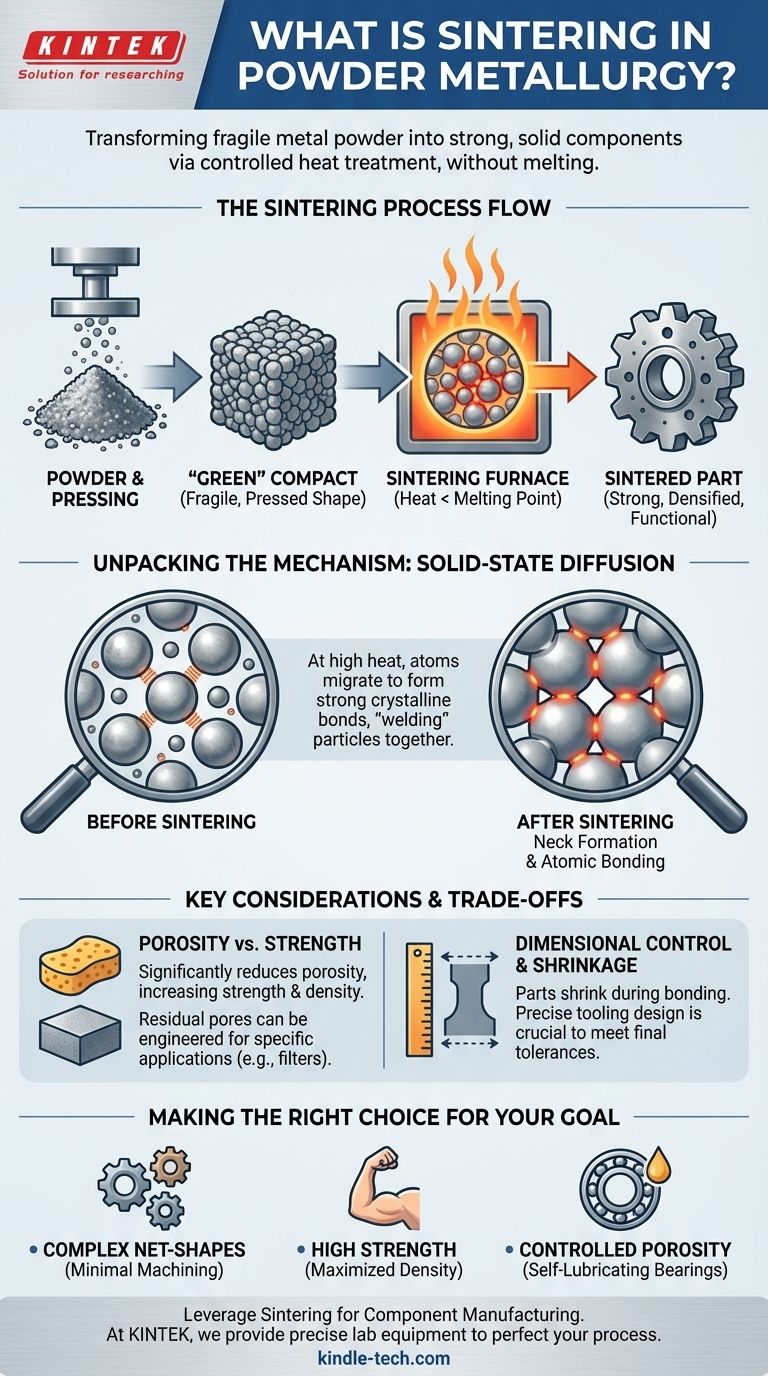
At its core, sintering is a heat treatment process used in powder metallurgy to transform a fragile, compressed powder shape into a strong, solid component. By heating the material in a furnace to a temperature just below its melting point, the individual metal particles fuse, creating strong metallurgical bonds that give the part its final strength and structural integrity.

Sintering is not about melting metal. It is the controlled process of using thermal energy to drive solid-state diffusion, causing adjacent powder particles to bond and densify, thereby converting a weakly-held powder compact into a robust, engineered part.
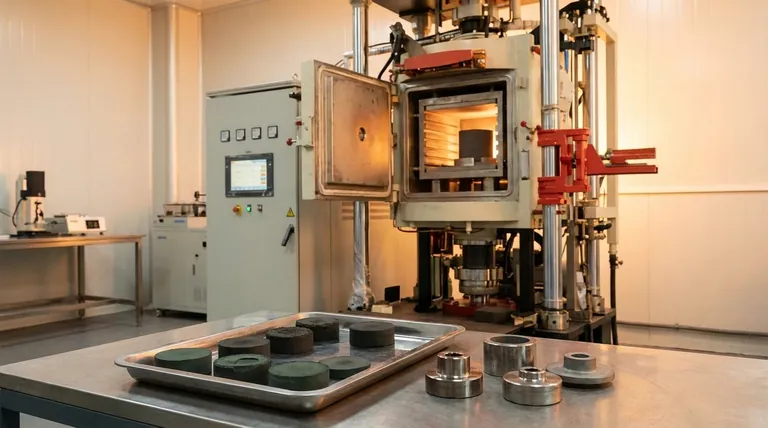
What is the process of sintering in powder metallurgy? Transform Powder into Strong Metal Parts

The Role of Sintering in Powder Metallurgy

Sintering is the critical transformation step that gives powder metal parts their useful mechanical properties. Without it, a compacted part would simply crumble.

From "Green" Compact to Finished Part

Before sintering, metal powder is pressed into a mold under high pressure. The resulting shape is called a "green" compact.

This green compact is fragile, held together only by the mechanical interlocking of the particles. It has the desired shape but lacks the strength needed for any application. Sintering is what provides this strength.

The Goal: Strength Through Bonding

The primary objective of sintering is to heat the green compact in a controlled furnace. This thermal energy causes the atoms at the contact points of the particles to diffuse across the boundaries.

This atomic transport creates strong, crystalline bonds, effectively "welding" the particles together on a microscopic level. The result is a significant increase in the part's hardness, strength, and density.

Unpacking the Sintering Mechanism

The process works through a principle known as solid-state diffusion, which occurs without ever melting the bulk material.

The Power of Solid-State Diffusion

At high temperatures, atoms become more mobile. During sintering, atoms from adjacent particles migrate and rearrange to form connections, or "necks," at their points of contact.

Think of how two ice cubes left in a glass of water will slowly fuse at their contact points. Sintering achieves a similar effect for metal particles, but at much higher temperatures and resulting in a far stronger bond.

The Critical Role of Temperature

The sintering temperature is precisely controlled to be below the melting point of the primary metal.

This is crucial because it allows the part to densify and strengthen while maintaining its precise, compacted shape. If the material were to melt, dimensional control would be lost entirely.

A Controlled Furnace Environment

Sintering is performed in specialized furnaces with a carefully controlled atmosphere. This atmosphere is typically inert or reducing, preventing oxidation of the metal surfaces, which would otherwise inhibit proper bonding between particles.

Understanding the Trade-offs

While powerful, the sintering process involves key considerations that impact the final product.

Porosity vs. Strength

Sintering significantly reduces the empty space (porosity) between powder particles, but it rarely eliminates it completely.

This residual porosity means that a sintered part is often less dense and may have lower ultimate strength than a part made from solid, wrought metal. However, this porosity can be a design advantage for creating products like self-lubricating bearings or filters.

Dimensional Control

As the particles fuse and the pores shrink, the entire component undergoes a degree of shrinkage. This change must be accurately predicted and accounted for during the initial design of the compaction tooling to ensure the final part meets its required dimensional tolerances.

Making the Right Choice for Your Goal

Understanding sintering allows you to leverage the powder metallurgy process to achieve specific engineering outcomes.

  • If your primary focus is producing complex, net-shape parts: Sintering is ideal, as it allows you to form intricate geometries that require little to no subsequent machining.
  • If your primary focus is achieving high strength: Careful control over powder composition, compaction pressure, and sintering time, temperature, and atmosphere is critical to maximize density.
  • If your primary focus is creating controlled porosity: Sintering is a unique process that enables the deliberate engineering of porous materials for applications like filters and oil-impregnated bearings.

Ultimately, sintering is the essential process that unlocks the potential of metal powders, transforming them into precise and durable engineered components.

Summary Table:

Sintering Aspect Key Detail
Primary Goal Transform a fragile 'green' compact into a strong, solid part.
Core Mechanism Solid-state diffusion bonds particles at temperatures below melting.
Key Outcome Increased strength, hardness, and density of the final component.
Critical Factor Controlled furnace atmosphere to prevent oxidation and ensure bonding.
Design Consideration Predictable part shrinkage must be accounted for in tooling design.

Ready to leverage sintering for your component manufacturing?

At KINTEK, we specialize in the precise lab equipment and consumables needed to perfect your powder metallurgy processes. Whether you are developing complex net-shape parts, optimizing for maximum strength, or engineering controlled porosity, our expertise and products support your goals.

Contact our experts today to discuss how we can help you achieve superior results in your laboratory.

Visual Guide
What is the process of sintering in powder metallurgy? Transform Powder into Strong Metal Parts Visual Guide

Related Products

People Also Ask

Related Products

Vacuum Heat Treat and Sintering Furnace with 9MPa Air Pressure

Vacuum Heat Treat and Sintering Furnace with 9MPa Air Pressure

The air pressure sintering furnace is a high-tech equipment commonly used for the sintering of advanced ceramic materials. It combines vacuum sintering and pressure sintering techniques to achieve high-density and high-strength ceramics.

Spark Plasma Sintering Furnace SPS Furnace

Spark Plasma Sintering Furnace SPS Furnace

Discover the benefits of Spark Plasma Sintering Furnaces for rapid, low-temperature material preparation. Uniform heating, low cost & eco-friendly.

Vacuum Heat Treat and Molybdenum Wire Sintering Furnace for Vacuum Sintering

Vacuum Heat Treat and Molybdenum Wire Sintering Furnace for Vacuum Sintering

A vacuum molybdenum wire sintering furnace is a vertical or bedroom structure, which is suitable for withdrawal, brazing, sintering and degassing of metal materials under high vacuum and high temperature conditions. It is also suitable for dehydroxylation treatment of quartz materials.

Small Vacuum Heat Treat and Tungsten Wire Sintering Furnace

Small Vacuum Heat Treat and Tungsten Wire Sintering Furnace

The small vacuum tungsten wire sintering furnace is a compact experimental vacuum furnace specially designed for universities and scientific research institutes. The furnace features a CNC welded shell and vacuum piping to ensure leak-free operation. Quick-connect electrical connections facilitate relocation and debugging, and the standard electrical control cabinet is safe and convenient to operate.

Vacuum Heat Treat and Pressure Sintering Furnace for High Temperature Applications

Vacuum Heat Treat and Pressure Sintering Furnace for High Temperature Applications

Vacuum pressure sintering furnaces are designed for high temperature hot pressing applications in metal and ceramic sintering. Its advanced features ensure precise temperature control, reliable pressure maintenance, and a robust design for seamless operation.

Dental Porcelain Zirconia Sintering Ceramic Furnace Chairside with Transformer

Dental Porcelain Zirconia Sintering Ceramic Furnace Chairside with Transformer

Experience top-notch sintering with Chairside Sintering Furnace with Transformer. Easy to operate, noise-free pallet, and automatic temperature calibration. Order now!

Dental Porcelain Zirconia Sintering Ceramic Vacuum Press Furnace

Dental Porcelain Zirconia Sintering Ceramic Vacuum Press Furnace

Get precise dental results with Dental Vacuum Press Furnace. Automatic temperature calibration, low noise tray, and touch screen operation. Order now!

2200 ℃ Tungsten Vacuum Heat Treat and Sintering Furnace

2200 ℃ Tungsten Vacuum Heat Treat and Sintering Furnace

Experience the ultimate refractory metal furnace with our Tungsten vacuum furnace. Capable of reaching 2200℃, perfect for sintering advanced ceramics and refractory metals. Order now for high-quality results.

High Temperature Muffle Oven Furnace for Laboratory Debinding and Pre Sintering

High Temperature Muffle Oven Furnace for Laboratory Debinding and Pre Sintering

KT-MD High temperature debinding and pre-sintering furnace for ceramic materials with various molding processes. Ideal for electronic components such as MLCC and NFC.

Vacuum Heat Treat Sintering Brazing Furnace

Vacuum Heat Treat Sintering Brazing Furnace

A vacuum brazing furnace is a type of industrial furnace used for brazing, a metalworking process that joins two pieces of metal using a filler metal that melts at a lower temperature than the base metals. Vacuum brazing furnaces are typically used for high-quality applications where a strong, clean joint is required.

Mesh belt controlled atmosphere furnace

Mesh belt controlled atmosphere furnace

Discover our KT-MB mesh belt sintering furnace - perfect for high-temperature sintering of electronic components & glass insulators. Available for open air or controlled atmosphere environments.

600T Vacuum Induction Hot Press Furnace for Heat Treat and Sintering

600T Vacuum Induction Hot Press Furnace for Heat Treat and Sintering

Discover the 600T Vacuum Induction Hot Press Furnace, designed for high-temperature sintering experiments in vacuum or protected atmospheres. Its precise temperature and pressure control, adjustable working pressure, and advanced safety features make it ideal for nonmetal materials, carbon composites, ceramics, and metal powders.

2200 ℃ Graphite Vacuum Heat Treat Furnace

2200 ℃ Graphite Vacuum Heat Treat Furnace

Discover the power of the KT-VG Graphite Vacuum Furnace - with a maximum working temperature of 2200℃, it's perfect for vacuum sintering of various materials. Learn more now.

Ultra-High Temperature Graphite Vacuum Graphitization Furnace

Ultra-High Temperature Graphite Vacuum Graphitization Furnace

The ultra-high temperature graphitization furnace utilizes medium frequency induction heating in a vacuum or inert gas environment. The induction coil generates an alternating magnetic field, inducing eddy currents in the graphite crucible, which heats up and radiates heat to the workpiece, bringing it to the desired temperature. This furnace is primarily used for graphitization and sintering of carbon materials, carbon fiber materials, and other composite materials.

Controlled Nitrogen Inert Hydrogen Atmosphere Furnace

Controlled Nitrogen Inert Hydrogen Atmosphere Furnace

KT-AH Hydrogen atmosphere furnace - induction gas furnace for sintering/annealing with built-in safety features, dual housing design, and energy-saving efficiency. Ideal for lab and industrial use.

Vacuum Heat Treat Furnace with Ceramic Fiber Liner

Vacuum Heat Treat Furnace with Ceramic Fiber Liner

Vacuum furnace with polycrystalline ceramic fiber insulation liner for excellent heat insulation and uniform temperature field. Choose from 1200℃ or 1700℃ max. working temperature with high vacuum performance and precise temperature control.

Vertical High Temperature Graphite Vacuum Graphitization Furnace

Vertical High Temperature Graphite Vacuum Graphitization Furnace

Vertical high temperature graphitization furnace for carbonization and graphitization of carbon materials up to 3100℃.Suitable for shaped graphitization of carbon fiber filaments and other materials sintered in a carbon environment.Applications in metallurgy, electronics, and aerospace for producing high-quality graphite products like electrodes and crucibles.

Non Consumable Vacuum Arc Induction Melting Furnace

Non Consumable Vacuum Arc Induction Melting Furnace

Explore the benefits of Non-Consumable Vacuum Arc Furnace with high melting point electrodes. Small, easy to operate & eco-friendly. Ideal for laboratory research on refractory metals & carbides.

Large Vertical Graphite Vacuum Graphitization Furnace

Large Vertical Graphite Vacuum Graphitization Furnace

A large vertical high-temperature graphitization furnace is a type of industrial furnace used for the graphitization of carbon materials, such as carbon fiber and carbon black. It is a high-temperature furnace that can reach temperatures of up to 3100°C.

Vacuum Arc Induction Melting Furnace

Vacuum Arc Induction Melting Furnace

Discover the power of Vacuum Arc Furnace for melting active & refractory metals. High-speed, remarkable degassing effect, and free of contamination. Learn more now!


Leave Your Message



















