Knowledge What is the purpose of applying a compression load in dissimilar alloy brazing? Ensure Defect-Free Joint Integrity
Author avatar

Tech Team · Kintek Solution

Updated 3 days ago

What is the purpose of applying a compression load in dissimilar alloy brazing? Ensure Defect-Free Joint Integrity


Applying a compression load is a critical process control for ensuring the structural integrity of brazed joints. By exerting a moderate force via a pressure device, you physically compel the molten brazing alloy to maintain intimate contact with the base metal surfaces, specifically when joining materials like Titanium and Zircaloy-4. This mechanical assistance is the primary driver for overcoming surface roughness and ensuring a continuous metallurgical bond.

The application of pressure serves to bridge microscopic gaps and irregularities on the metal surfaces. This ensures the necessary contact for mutual diffusion and wetting, effectively eliminating internal defects such as porosity or lack of fusion in the brazing seam.

The Mechanics of Interface Contact

Overcoming Surface Irregularities

Even carefully machined components possess microscopic peaks and valleys on their surfaces.

Without intervention, these irregularities can prevent the brazing alloy from fully touching the base metal. Applying a compression load forces the materials together, overcoming these microscopic gaps to establish a uniform interface.

Promoting Wetting and Diffusion

For a brazed joint to be strong, the filler metal must not just sit on top of the base metal; it must interact with it chemically.

The pressure ensures the molten alloy remains in close contact with the Titanium and Zircaloy-4 components. This proximity allows for mutual diffusion, where atoms migrate across the boundary, and promotes wetting, ensuring the alloy spreads evenly rather than beading up.

Defect Prevention and Structural Integrity

Eliminating Internal Voids

One of the most significant risks in brazing is the formation of internal defects that are invisible from the outside.

A lack of pressure can leave pockets where the alloy does not penetrate. The compression load acts to squeeze out these potential voids, significantly reducing the risk of pores forming within the seam.

Preventing "Lack of Fusion"

A joint that looks sound externally may lack internal continuity, a defect known as lack of fusion.

By maintaining constant pressure during the heating cycle, you ensure that the seam is solid throughout. This guarantees that the joint is fully fused rather than merely adhered at specific points.

Understanding the Operational Constraints

The Necessity of "Moderate" Load

The reference specifically advises the use of a moderate compression load.

The goal is to facilitate contact, not to mechanically deform the base components. Excessive force is not required to achieve the desired wetting and diffusion; the focus must remain on uniform contact pressure.

Material-Specific Requirements

While valid for various applications, this technique is explicitly highlighted for Titanium and Zircaloy-4 components.

These reactive alloys require precise process controls to ensure successful joining. The pressure device is an essential tool in their specific brazing protocol to manage their diffusion characteristics.

Optimizing the Brazing Process

To ensure high-quality joints when brazing dissimilar alloys, consider the following regarding the application of pressure:

  • If your primary focus is defect reduction: Apply compression to forcibly eliminate air pockets and prevent porosity within the internal seam.
  • If your primary focus is bond strength: Use moderate pressure to maximize the surface area available for mutual diffusion between the alloy and base metals.

Controlling the contact pressure is the key factor in transforming a superficial connection into a fully fused, defect-free interface.

Summary Table:

Key Function Impact on Brazed Joint
Interface Contact Overcomes microscopic surface roughness to ensure uniform alloy contact.
Mutual Diffusion Facilitates atom migration between base metals and filler for a strong bond.
Wetting Promotion Ensures the molten alloy spreads evenly across Titanium and Zircaloy-4 surfaces.
Defect Prevention Eliminates internal porosity, voids, and "lack of fusion" in the seam.
Structural Integrity Guarantees a continuous, fully fused metallurgical bond.

Elevate Your Advanced Material Joining with KINTEK

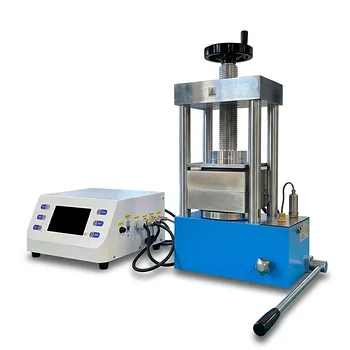
Precision brazing of reactive alloys like Titanium and Zircaloy-4 requires world-class thermal and mechanical control. KINTEK provides the specialized high-temperature vacuum furnaces, induction melting systems, and high-precision hydraulic presses necessary to maintain the exact moderate compression loads required for perfect metallurgical bonding.

Whether you are conducting battery research, dental material fabrication, or advanced aerospace component joining, our portfolio of furnaces, crushing systems, and cooling solutions (ULT freezers and freeze dryers) is designed to meet the most rigorous laboratory standards.

Ready to eliminate defects and optimize your bond strength? Contact KINTEK today to discover how our high-performance equipment can transform your material processing outcomes.

References

  1. Siyoung Lee, Jung Gu Lee. Microstructural and Corrosion Properties of Ti-to-Zr Dissimilar Alloy Joints Brazed with a Zr-Ti-Cu-Ni Amorphous Filler Alloy. DOI: 10.3390/met11020192

This article is also based on technical information from Kintek Solution Knowledge Base .

Related Products

People Also Ask

Related Products

Vacuum Hot Press Furnace Machine Heated Vacuum Press

Vacuum Hot Press Furnace Machine Heated Vacuum Press

Discover the advantages of Vacuum Hot Press Furnace! Manufacture dense refractory metals & compounds, ceramics, and composites under high temp and pressure.

Vacuum Hot Press Furnace Heated Vacuum Press Machine Tube Furnace

Vacuum Hot Press Furnace Heated Vacuum Press Machine Tube Furnace

Reduce forming pressure & shorten sintering time with Vacuum Tube Hot Press Furnace for high-density, fine-grain materials. Ideal for refractory metals.

600T Vacuum Induction Hot Press Furnace for Heat Treat and Sintering

600T Vacuum Induction Hot Press Furnace for Heat Treat and Sintering

Discover the 600T Vacuum Induction Hot Press Furnace, designed for high-temperature sintering experiments in vacuum or protected atmospheres. Its precise temperature and pressure control, adjustable working pressure, and advanced safety features make it ideal for nonmetal materials, carbon composites, ceramics, and metal powders.

Vacuum Heat Treat Sintering Brazing Furnace

Vacuum Heat Treat Sintering Brazing Furnace

A vacuum brazing furnace is a type of industrial furnace used for brazing, a metalworking process that joins two pieces of metal using a filler metal that melts at a lower temperature than the base metals. Vacuum brazing furnaces are typically used for high-quality applications where a strong, clean joint is required.

Vacuum Heat Treat and Sintering Furnace with 9MPa Air Pressure

Vacuum Heat Treat and Sintering Furnace with 9MPa Air Pressure

The air pressure sintering furnace is a high-tech equipment commonly used for the sintering of advanced ceramic materials. It combines vacuum sintering and pressure sintering techniques to achieve high-density and high-strength ceramics.

Touchscreen Automatic Vacuum Heat Press

Touchscreen Automatic Vacuum Heat Press

Precision vacuum heat press for labs: 800°C, 5-ton pressure, 0.1MPa vacuum. Ideal for composites, solar cells, aerospace.

Vacuum Heat Treat and Molybdenum Wire Sintering Furnace for Vacuum Sintering

Vacuum Heat Treat and Molybdenum Wire Sintering Furnace for Vacuum Sintering

A vacuum molybdenum wire sintering furnace is a vertical or bedroom structure, which is suitable for withdrawal, brazing, sintering and degassing of metal materials under high vacuum and high temperature conditions. It is also suitable for dehydroxylation treatment of quartz materials.

2200 ℃ Tungsten Vacuum Heat Treat and Sintering Furnace

2200 ℃ Tungsten Vacuum Heat Treat and Sintering Furnace

Experience the ultimate refractory metal furnace with our Tungsten vacuum furnace. Capable of reaching 2200℃, perfect for sintering advanced ceramics and refractory metals. Order now for high-quality results.

Dental Porcelain Zirconia Sintering Ceramic Vacuum Press Furnace

Dental Porcelain Zirconia Sintering Ceramic Vacuum Press Furnace

Get precise dental results with Dental Vacuum Press Furnace. Automatic temperature calibration, low noise tray, and touch screen operation. Order now!

1800℃ Muffle Oven Furnace for Laboratory

1800℃ Muffle Oven Furnace for Laboratory

KT-18 muffle furnace with Japan Al2O3 polycrystalline fibe and Silicon Molybdenum heating element, up to 1900℃, PID temperature control and 7" smart touch screen. Compact design, low heat loss, and high energy efficiency. Safety interlock system and versatile functions.

1700℃ Muffle Oven Furnace for Laboratory

1700℃ Muffle Oven Furnace for Laboratory

Get superior heat control with our 1700℃ Muffle Furnace. Equipped with intelligent temperature microprocessor, TFT touch screen controller & advanced insulation materials for precise heating up to 1700C. Order now!

1400℃ Controlled Atmosphere Furnace with Nitrogen and Inert Atmosphere

1400℃ Controlled Atmosphere Furnace with Nitrogen and Inert Atmosphere

Achieve precise heat treatment with KT-14A controlled atmosphere furnace. Vacuum sealed with a smart controller, it's ideal for lab and industrial use up to 1400℃.

1200℃ Controlled Atmosphere Furnace Nitrogen Inert Atmosphere Furnace

1200℃ Controlled Atmosphere Furnace Nitrogen Inert Atmosphere Furnace

Discover our KT-12A Pro Controlled atmosphere furnace - high precision, heavy duty vacuum chamber, versatile smart touch screen controller, and excellent temperature uniformity up to 1200C. Ideal for both laboratory and industrial application.

1700℃ Laboratory High Temperature Tube Furnace with Alumina Tube

1700℃ Laboratory High Temperature Tube Furnace with Alumina Tube

Looking for a high-temperature tube furnace? Check out our 1700℃ Tube Furnace with Alumina Tube. Perfect for research and industrial applications up to 1700C.

Ultra-High Temperature Graphite Vacuum Graphitization Furnace

Ultra-High Temperature Graphite Vacuum Graphitization Furnace

The ultra-high temperature graphitization furnace utilizes medium frequency induction heating in a vacuum or inert gas environment. The induction coil generates an alternating magnetic field, inducing eddy currents in the graphite crucible, which heats up and radiates heat to the workpiece, bringing it to the desired temperature. This furnace is primarily used for graphitization and sintering of carbon materials, carbon fiber materials, and other composite materials.

Vacuum Dental Porcelain Sintering Furnace

Vacuum Dental Porcelain Sintering Furnace

Get precise and reliable results with KinTek's Vacuum Porcelain Furnace. Suitable for all porcelain powders, it features hyperbolic ceramic furnace function, voice prompt, and automatic temperature calibration.

Mesh belt controlled atmosphere furnace

Mesh belt controlled atmosphere furnace

Discover our KT-MB mesh belt sintering furnace - perfect for high-temperature sintering of electronic components & glass insulators. Available for open air or controlled atmosphere environments.

Horizontal High Temperature Graphite Vacuum Graphitization Furnace

Horizontal High Temperature Graphite Vacuum Graphitization Furnace

Horizontal Graphitization Furnace: This type of furnace is designed with the heating elements placed horizontally, allowing for uniform heating of the sample. It's well-suited for graphitizing large or bulky samples that require precise temperature control and uniformity.

Vacuum Sealed Continuous Working Rotary Tube Furnace Rotating Tube Furnace

Vacuum Sealed Continuous Working Rotary Tube Furnace Rotating Tube Furnace

Experience efficient material processing with our vacuum-sealed rotary tube furnace. Perfect for experiments or industrial production, equipped with optional features for controlled feeding and optimized results. Order now.

1700℃ Controlled Atmosphere Furnace Nitrogen Inert Atmosphere Furnace

1700℃ Controlled Atmosphere Furnace Nitrogen Inert Atmosphere Furnace

KT-17A Controlled atmosphere furnace: 1700℃ heating, vacuum sealing technology, PID temperature control, and versatile TFT smart touch screen controller for laboratory and industrial use.


Leave Your Message