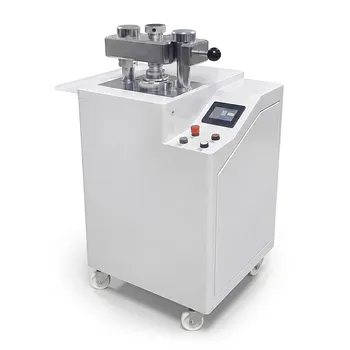
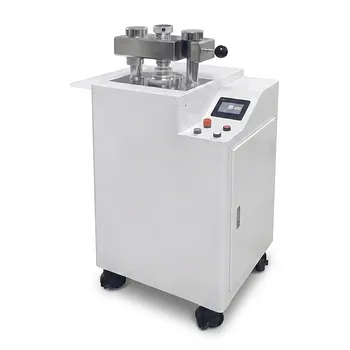
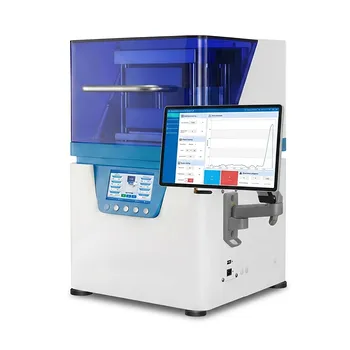
Using a laboratory hydraulic press is a critical preparatory step to ensure efficient solid-state reaction and high phase purity. By compressing loose $Na_2Fe_2F_7$ powders into dense pellets, researchers maximize the contact surface area between individual reactant particles. This proximity significantly reduces the distance atoms must travel (diffusion paths) during the annealing process, facilitating the rapid formation of the desired Weberite crystal structure and improving the overall crystallinity of the material.
Central Takeaway: Pelletization transforms loose powder into a high-density medium, shortening atomic diffusion paths and increasing solid-solid contact interfaces to ensure a thorough, uniform chemical reaction during heat treatment.
Maximizing Particle-to-Particle Contact
Creating a Solid-Solid Interface
A hydraulic press applies several tons of mechanical force to bind loose, milled powders into a cohesive unit. This process significantly increases the number of physical contact points between the reactants.
Enhancing Surface Reactivity
By eliminating large voids between grains, the press ensures that the reaction occurs across the entire interface of the particles. This high-density state is essential for triggering the chemical transformations required to form the Weberite phase.
Optimizing Diffusion and Reaction Kinetics
Shortening Atomic Diffusion Paths
In solid-state synthesis, atoms must move through the crystal lattice to react, which is a slow process in loose powders. Pelleting reduces the physical gaps, allowing ions to migrate more efficiently over shorter distances during annealing.
Accelerating Phase Formation
Increased contact and shorter diffusion paths lead to faster reaction kinetics. This promotes the rapid emergence of the $Na_2Fe_2F_7$ phase, preventing the formation of undesired intermediate phases or unreacted precursors.
Improving Crystalline Quality
The close proximity of reactants under high pressure supports the growth of a well-crystallized structure. This result is a more uniform material with the specific layered or complex lattice characteristic of the Weberite family.
Ensuring Thermal and Chemical Stability
Preventing Component Volatilization
At the high temperatures required for annealing, certain chemical components can become volatile and escape the system. A dense pellet acts as a physical barrier that helps suppress this volatilization, maintaining the correct stoichiometry of the material.
Avoiding Material Stratification
In a loose powder state, different components may settle or separate based on density during heating. Compressing the mixture into a pellet "locks" the homogeneous distribution of particles in place, ensuring the final product is chemically uniform throughout.
Understanding the Trade-offs
The Risk of Over-Compression
While high density is beneficial, applying excessive pressure can lead to "capping" or internal cracks within the pellet. These structural defects can cause the pellet to crumble during annealing, potentially leading to uneven heating or localized reaction failures.
Maintaining Die Cleanliness
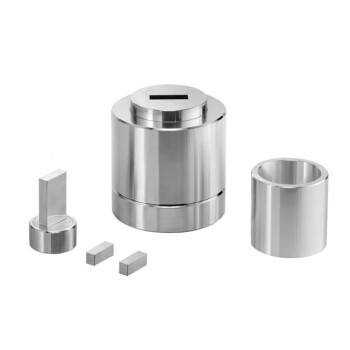
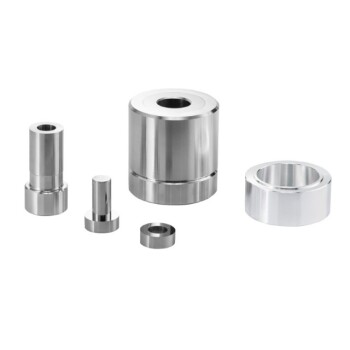
The use of a hydraulic press introduces a risk of contamination from the metal die or lubricants. Any foreign matter introduced during the pressing stage can be incorporated into the $Na_2Fe_2F_7$ lattice during high-temperature treatment, compromising the purity of the sample.
How to Apply This to Your Synthesis
To achieve the best results when preparing Weberite $Na_2Fe_2F_7$ powders, align your pressing strategy with your specific research objectives.
- If your primary focus is phase purity: Ensure the initial powder is ground to a sub-micron level before pressing to maximize the homogeneity of the pellet.
- If your primary focus is rapid synthesis: Use the highest recommended pressure for your specific die size to minimize diffusion distances as much as possible.
- If your primary focus is structural uniformity: Increase the "dwell time" (the duration the pressure is held) to allow particles to rearrange into the most stable, dense configuration before release.
Proper pelletization serves as the physical foundation for successful solid-state chemistry, turning a simple mixture into a high-performance crystalline material.
Summary Table:
| Key Objective | Mechanism of Action | Impact on Material Quality |
|---|---|---|
| Maximize Contact | Increases solid-solid interface via mechanical force | Enhances reaction kinetics and phase uniformity |
| Optimize Diffusion | Shortens atomic migration paths between particles | Accelerates formation of the Weberite crystal structure |
| Chemical Stability | Creates a physical barrier against component loss | Prevents volatilization and maintains stoichiometry |
| Structural Integrity | Eliminates voids and prevents stratification | Ensures a homogeneous, well-crystallized final product |
Achieve Unmatched Material Purity with KINTEK
Precision in pellet preparation is the foundation of successful solid-state synthesis. KINTEK specializes in high-performance laboratory hydraulic presses (pellet, hot, and isostatic) and precision dies designed to ensure the density and homogeneity required for advanced research.
Whether you are synthesizing Weberite $Na_2Fe_2F_7$ or developing next-generation battery materials, our comprehensive range—including high-temperature furnaces, milling systems, and crucibles—provides the reliability your lab demands.
Ready to elevate your research results? Contact our laboratory specialists today to find the perfect pressing and thermal processing solutions tailored to your specific application!
References
- Emily Foley, Raphaële J. Clément. Polymorphism in Weberite Na<sub>2</sub>Fe<sub>2</sub>F<sub>7</sub> and its Effects on Electrochemical Properties as a Na-Ion Cathode. DOI: 10.1021/acs.chemmater.3c00233
This article is also based on technical information from Kintek Solution Knowledge Base .
Related Products
- Automatic Laboratory Hydraulic Press for XRF & KBR Pellet Press
- Laboratory Hydraulic Pellet Press for XRF KBR FTIR Lab Applications
- Automatic Laboratory Hydraulic Pellet Press Machine for Lab Use
- Laboratory Manual Hydraulic Pellet Press for Lab Use
- Laboratory Hydraulic Press Lab Pellet Press Machine for Glove Box
People Also Ask
- What is the significance of applying 200 MPa of pressure with a laboratory hydraulic pellet press for composite ceramics?
- What is the role of a laboratory hydraulic pellet press and stainless steel molds in the fabrication of RuO2/NbC anodes?
- How does a laboratory hydraulic pellet press contribute to SiCw/2024 aluminum composite preforms? Optimize Densification
- What is the necessity of using a laboratory hydraulic pellet press in the preparation of biomass fuel pellets? Guide
- What is the function of a laboratory hydraulic pellet press in supercapacitor electrode fabrication? Optimize 3D VNCN.