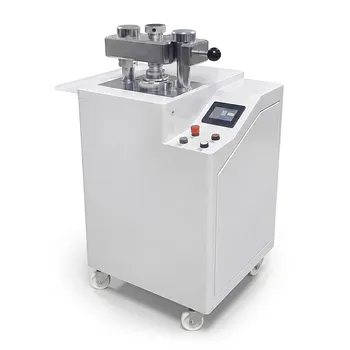
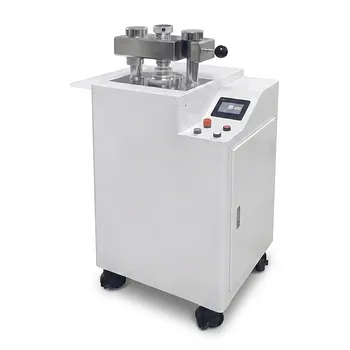
The primary purpose of using a manual hydraulic press and pellet die is to create a sample with uniform density and thickness.
By compressing powder into a dense, flat disk, the press ensures a consistent optical path length for the X-ray beam. This process minimizes scattering interference and eliminates signal fluctuations caused by gaps in loose powder, which is essential for obtaining the high-quality data required for X-ray Absorption Fine Structure (XAFS) analysis.
Preparing samples via a hydraulic press transforms loose powder into a stable, homogeneous pellet. This standardization is critical for accurate spectral normalization and the precise analysis of atomic coordination environments.
Optimizing the Optical Path for X-ray Transmission
Achieving Uniform Sample Thickness
XAFS measurements, particularly in transmission mode, rely on a constant sample thickness. A pellet die ensures the X-ray beam encounters the same amount of material across the entire irradiation area, preventing data distortion.
Ensuring Consistent X-ray Penetration
Variations in sample density can cause the X-ray beam to penetrate unevenly. High-pressure compression creates a homogeneous medium, preventing "leaks" or gaps that would otherwise lead to inaccurate absorption coefficients.
Eliminating Particle Size Effects
Loose powders often suffer from "shadowing" or matrix effects due to irregular particle sizes. The hydraulic press eliminates these inconsistencies by creating a dense, flat surface that facilitates uniform irradiation.
Enhancing Spectral Data Quality
Reducing Scattering and Interference
A smooth, polished pellet surface minimizes X-ray scattering losses. This reduction in background noise is vital for capturing the subtle oscillations in Extended X-ray Absorption Fine Structure (EXAFS) data.
Stabilizing the Coordination Environment
By tightly packing the sample (often mixed with a binder like graphite), the press ensures the structural integrity of the material. This stability allows for the precise measurement of atomic spacing and metal oxidation states.
Improving Signal-to-Noise Ratios
Dense pellets maximize the excitation efficiency of the X-ray signal. This leads to cleaner raw data, which is necessary for identifying complex bimetallic site structures and coordination numbers.
Understanding the Trade-offs and Pitfalls
The Risk of Over-Compression
Applying excessive pressure can occasionally alter the crystal structure of a sensitive catalyst or lead to "preferred orientation" effects. Users must calibrate the pressure—often between 6 and 20 tons—to ensure density without compromising the sample's physical properties.
Binder Selection and Ratio
Mixing the sample with a binder like graphite or wax powder is common to improve structural stability. However, an incorrect ratio can either make the pellet too fragile or dilute the signal so much that the edge jump becomes difficult to detect.
Surface Irregularities
Even with a hydraulic press, dirty or scratched die pellets can transfer imperfections to the sample. Smooth, high-strength steel dies are required to ensure the pellet surface is free of defects that could scatter the X-ray beam.
Guidelines for Successful XAFS Sample Preparation
Effective pelletizing requires a systematic approach to pressure, binder selection, and sample thickness.
- If your primary focus is high-resolution EXAFS data: Prioritize a high binder-to-sample ratio and sufficient pressure to ensure the smoothest possible surface and minimum scattering.
- If your primary focus is sensitive oxidation state analysis (XANES): Carefully calculate the mass of the sample to ensure the pellet thickness keeps the total absorption within the linear range of the detector.
- If your primary focus is reproducibility across multiple samples: Use an automated or highly calibrated manual press to apply the exact same pressure and duration (e.g., 60 seconds) to every pellet.
A well-prepared pellet is the foundation of credible synchrotron data, turning raw powder into a stable medium for atomic-level discovery.
Summary Table:
| Feature | Purpose in XAFS Sample Prep | Impact on Data Quality |
|---|---|---|
| Uniform Density | Eliminates gaps and "leaks" in the sample | Ensures consistent X-ray penetration |
| Controlled Thickness | Standardizes the optical path length | Critical for accurate spectral normalization |
| Flat Surface | Minimizes X-ray scattering and noise | Vital for high-resolution EXAFS oscillations |
| Structural Stability | Maintains atomic coordination environment | Accurate measurement of atomic spacing |
| Pressure Control | Optimizes pellet density (typically 6-20 tons) | Prevents structural damage or orientation effects |
Elevate Your XAFS Research with Precision Sample Preparation
High-quality synchrotron data begins with a perfect pellet. KINTEK specializes in providing the reliable laboratory equipment you need to ensure sample uniformity and data reproducibility. Our precision-engineered manual and automated hydraulic presses, along with high-strength pellet dies, are designed to create the dense, homogeneous samples required for advanced X-ray Absorption Fine Structure (XAFS) analysis.
Beyond pelletizing, KINTEK offers a comprehensive suite of solutions for your lab, including:
- Crushing & Milling Systems: For achieving optimal particle size before pressing.
- High-Temperature Furnaces: Muffle, tube, and vacuum systems for sample synthesis.
- Essential Consumables: High-purity ceramics, crucibles, and PTFE products.
- Cooling & Processing: ULT freezers, freeze dryers, and homogenizers for sensitive materials.
Don't let poor sample preparation compromise your research results. Trust KINTEK for durable, high-performance tools that meet the rigorous standards of modern material science.
Contact our specialists today to find the perfect press for your application!
References
- Jun‐Xi Wu, Jie‐Peng Zhang. Atomically Dispersed Dual-Metal Sites Showing Unique Reactivity and Dynamism for Electrocatalysis. DOI: 10.1007/s40820-023-01080-y
This article is also based on technical information from Kintek Solution Knowledge Base .
Related Products
- Laboratory Manual Hydraulic Pellet Press for Lab Use
- Laboratory Manual Hydraulic Pellet Press for Lab Use
- Automatic XRF Pellet Press 40 Ton Hydraulic Sample Preparation Press for Fluorescent Spectroscopy Analysis
- Automatic Laboratory Hydraulic Press for XRF & KBR Pellet Press
- Automatic Laboratory Hydraulic Pellet Press Machine for Lab Use
People Also Ask
- What is the role of a laboratory hydraulic pellet press and stainless steel molds in the fabrication of RuO2/NbC anodes?
- How does a laboratory hydraulic pellet press contribute to SiCw/2024 aluminum composite preforms? Optimize Densification
- What is the significance of applying 200 MPa of pressure with a laboratory hydraulic pellet press for composite ceramics?
- What is the necessity of using a laboratory hydraulic pellet press in the preparation of biomass fuel pellets? Guide
- What key role does a laboratory pellet press play in FTIR analysis? Master KBr Sample Preparation Excellence