The primary purpose of a transparent polycarbonate mold is to provide direct visual access to the interface between the lithium metal anode and the solid-state electrolyte during high-pressure pressing. This transparency allows researchers to move beyond theoretical assumptions and actually observe the physical contact, ensuring that microscopic gaps are eliminated through a process known as pressure-induced wetting.
In solid-state battery research, the quality of the contact between layers defines performance. A transparent mold serves as a critical diagnostic tool, verifying that the applied pressure is sufficient to deform the lithium metal and create a seamless, gap-free interface.
The Challenge of the Solid-Solid Interface
The "Black Box" Problem
In traditional battery assembly, molds made of steel or opaque materials create a "black box" environment. Researchers apply pressure and assume contact is made, but they cannot verify the physical state of the interface without disassembling the cell.
This lack of visibility makes it difficult to distinguish between electrochemical failure and simple mechanical failure due to poor contact.
The Necessity of Visual Confirmation
A transparent polycarbonate mold solves this by providing a visual environment for the pressing process.
It allows operators to look directly at the junction where the lithium metal meets the solid electrolyte pellet. This turns a blind mechanical procedure into an observable experiment.
Validating Pressure-Induced Wetting
Observing Gap Elimination
The core technical goal of using this mold is to confirm the elimination of interfacial gaps.
Solid surfaces are rarely perfectly flat; at a microscopic level, they are rough. Without sufficient pressure, voids remain between the anode and the electrolyte, leading to high resistance.
Confirming the "Wetting" Phenomenon
"Wetting" in this context refers to the plastic deformation of the lithium metal. Under high pressure, the lithium acts like a viscous fluid, flowing into the surface irregularities of the harder electrolyte.
Through the transparent mold, researchers can visually validate the effectiveness of pressure-induced wetting. They can see the exact moment the interface becomes uniform, confirming that the applied pressure was sufficient to maximize the active contact area.
Understanding the Trade-offs
Material Strength vs. Visibility
While polycarbonate offers excellent transparency, it possesses significantly lower tensile and compressive strength compared to tool steel.
There is a physical limit to the pressure a polycarbonate mold can withstand before deforming or cracking. This restricts its use to research ranges and prevents testing at extreme industrial pressures.
Observation vs. Electrochemical Stability
The transparent mold is primarily a mechanical observation tool. Polycarbonate may not have the same chemical inertness or long-term stability as materials used in final battery casing.
Therefore, data derived from these molds focuses on physical contact mechanics, rather than long-term electrochemical cycling performance.
Making the Right Choice for Your Goal
To maximize the utility of a transparent polycarbonate mold, align its use with your specific research phase:
- If your primary focus is establishing baseline parameters: Use the transparent mold to determine the minimum pressure required to achieve 100% visible contact area.
- If your primary focus is long-term cycling: Transfer the pressure parameters established in the transparent setup to a more robust, opaque test cell to ensure structural integrity during extended testing.
Ultimately, the transparent mold is a calibration tool that bridges the gap between theoretical mechanics and physical reality at the anode interface.
Summary Table:
| Feature | Transparent Polycarbonate Mold | Traditional Steel Mold |
|---|---|---|
| Visibility | Full visual access to interface | None (Black Box) |
| Primary Function | Mechanical calibration & wetting observation | Long-term electrochemical testing |
| Pressure Limit | Moderate (limited by material strength) | High industrial-grade pressures |
| Key Benefit | Eliminates microscopic interfacial gaps | High structural & chemical stability |
Advance Your Solid-State Battery Research with KINTEK
Achieving a seamless interface is critical for the performance of all-solid-state batteries. KINTEK specializes in providing high-precision laboratory equipment, including specialized molds, hydraulic presses, and battery research tools designed to optimize your material characterization.
Whether you need to observe pressure-induced wetting or perform long-term electrochemical cycling, our comprehensive range of high-temperature furnaces, crushing systems, and specialized consumables ensures your lab has the reliability it needs. Maximize your active contact area and eliminate research guesswork today.
Contact our experts to find the right equipment for your lab
Related Products
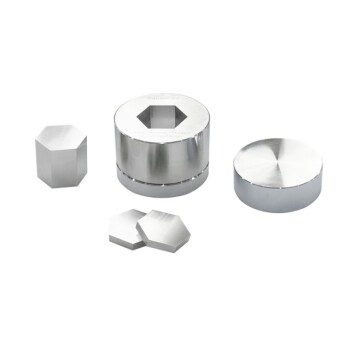
- Polygon Press Mold for Lab
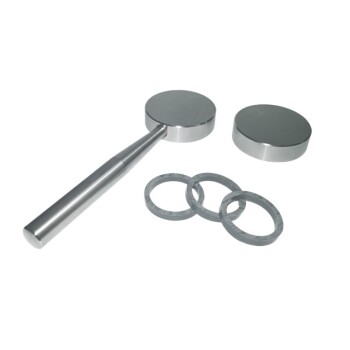
- XRF & KBR plastic ring lab Powder Pellet Pressing Mold for FTIR
- Lab Infrared Press Mold
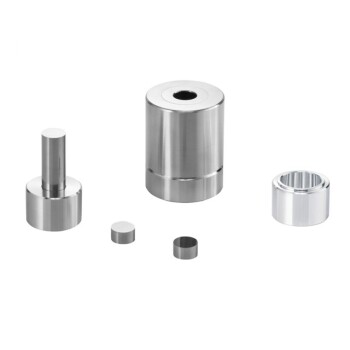
- Carbide Lab Press Mold for Laboratory Applications
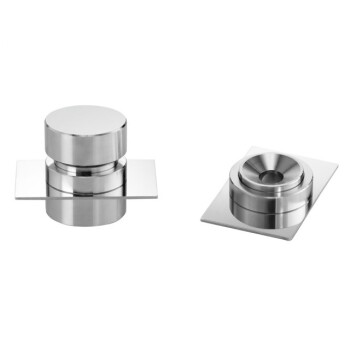
- No Demolding Lab Infrared Press Mold for Laboratory Applications
People Also Ask
- What is the press mould method? A Guide to Consistent, Detailed Ceramic Forms
- How to use a press mold? Master the Art of Creating Consistent Ceramic Forms
- Why are pressure molds with non-conductive resin inner walls required for battery testing? Ensure Data Accuracy
- What is the purpose of specialized pressure devices in sulfide solid-state batteries? Ensure Chemo-Mechanical Stability
- What is the function of press molds during the preparation of SiCf/Ti-43Al-9V composites? Achieve Structural Precision