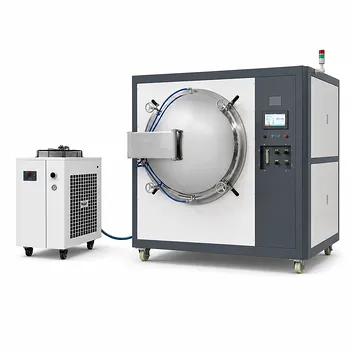
The primary function of a vacuum drying oven in this context is to thoroughly remove residual solvents, such as ethanol, and adsorbed moisture from the NaSICON precursor slurry. By lowering the ambient pressure, the oven depresses the boiling point of the liquid media, enabling rapid evaporation at significantly lower temperatures than would be required in a standard atmospheric oven.
Vacuum drying serves as a crucial quality control step, not just a drying method. By enabling low-temperature evaporation, it preserves the chemical homogeneity of the mixture and prevents the formation of hard agglomerates before the material enters high-temperature synthesis.
Preserving Chemical Homogeneity
The transition from a wet slurry to a dry powder is a critical phase where precursor quality can be easily compromised. Vacuum drying mitigates specific chemical risks.
Preventing Component Segregation
When precursor slurries dry slowly or at high temperatures, the different chemical components can separate or precipitate at different rates.
Vacuum drying accelerates the removal of the solvent (e.g., ethanol). This "locks in" the uniform distribution achieved during ball milling, ensuring the stoichiometry remains consistent throughout the batch.
Avoiding Premature Reactions
Standard drying often requires heat levels that can inadvertently trigger chemical reactions.
Because the vacuum environment lowers the boiling point of the liquid, the powder can be dried at a temperature low enough to keep the precursors chemically inert. This ensures that phase formation only occurs during the subsequent, controlled calcination stage.
Optimizing Physical Characteristics
Beyond chemical composition, the physical state of the dried powder dictates how well it will process in later steps.
Minimizing Agglomeration
High-temperature drying at atmospheric pressure often causes particles to bind together tightly, forming hard "clumps" or agglomerates.
Low-temperature vacuum drying produces a softer, more friable powder. This loose structure is essential for obtaining a uniform particle size distribution, which leads to better packing density and sintering behavior later on.
Protection from Impurities
While the primary goal is solvent removal, the vacuum chamber also isolates the material from the external environment.
This isolation minimizes the risk of the powder adsorbing atmospheric moisture or reacting with oxygen (oxidation), thereby maintaining the high purity of the raw materials required for NaSICON synthesis.
Operational Considerations and Trade-offs
While vacuum drying is superior for quality, it introduces variables that must be managed to ensure success.
Complexity of Process Control
Unlike a standard convection oven, a vacuum oven requires monitoring of both temperature and pressure.
If the pressure is not sufficiently low, the boiling point will not drop enough to protect the material from heat. Conversely, dropping pressure too rapidly can cause the solvent to boil violently, potentially displacing powder.
Throughput vs. Quality
Vacuum drying is generally a batch process that may be volume-limited compared to continuous drying methods.
However, the trade-off is justified by the elimination of defects—such as segregation and hard agglomeration—that would otherwise degrade the final electrochemical performance of the NaSICON material.
Applying This to Your Process
To maximize the quality of your NaSICON precursors, align your drying parameters with your specific material goals.
- If your primary focus is Phase Purity: Prioritize a deep vacuum to allow for the lowest possible temperature, ensuring no premature reactions alter the stoichiometry.
- If your primary focus is Microstructure and Sintering: Focus on the speed of solvent removal to prevent particle segregation, ensuring a homogeneous powder that sinters uniformly.
Controlled vacuum drying converts a volatile slurry into a stable, high-quality powder ready for successful synthesis.
Summary Table:
| Feature | Vacuum Drying Benefit | Impact on NaSICON Quality |
|---|---|---|
| Boiling Point | Reduced via low pressure | Enables low-temp drying; prevents premature reactions |
| Drying Speed | Accelerated solvent removal | "Locks in" chemical homogeneity and stoichiometry |
| Powder Structure | Minimal thermal stress | Prevents hard agglomerates; ensures uniform sintering |
| Environment | Isolated vacuum chamber | Protects against oxidation and atmospheric moisture |
Elevate Your Battery Material Synthesis with KINTEK
Precision in the drying stage is the difference between a high-performance NaSICON electrolyte and a failed batch. KINTEK specializes in advanced laboratory equipment designed for the rigorous demands of material science. Our high-performance vacuum ovens and high-temperature furnaces ensure the exact thermal and atmospheric control required to maintain chemical homogeneity and prevent agglomeration.
From high-energy ball milling systems to precision hydraulic presses and battery research tools, KINTEK provides the end-to-end solutions researchers need for consistent, scalable results.
Ready to optimize your precursor processing? Contact our technical experts today to discover how KINTEK’s comprehensive range of laboratory equipment and high-purity consumables can enhance your research efficiency.
Related Products
- 56L Vertical Laboratory Vacuum Drying Oven
- 23L Laboratory Vacuum Drying Oven
- Laboratory Scientific Electric Heating Blast Drying Oven
- Benchtop Laboratory Vacuum Freeze Dryer
- Dental Porcelain Zirconia Sintering Ceramic Vacuum Press Furnace
People Also Ask
- Why is a laboratory vacuum drying oven recommended for rice straw residues? Protect Your Biomass Integrity
- What role does a laboratory vacuum drying oven play in the preparation of modified multi-walled carbon nanotubes?
- What is the importance of using a laboratory vacuum drying oven? Preserving Slow-Release Microcapsule Integrity
- Why is a Laboratory Vacuum Drying Oven recommended for PBAT microspheres? Protect Sensitive Polymer Integrity
- What role does a laboratory vacuum drying oven play in processing nanoparticle powder samples? Protect Sample Integrity