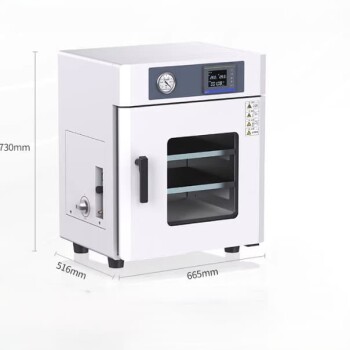
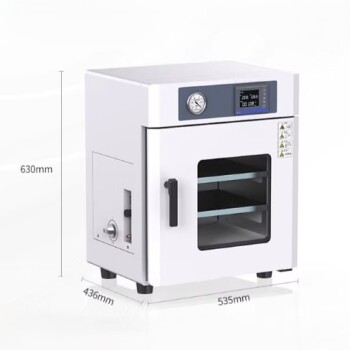
The primary purpose of using a vacuum oven is to create a controlled, low-pressure heating environment that thoroughly eliminates organic solvents and trace moisture from composite polymer electrolyte membranes without exposing them to damaging heat.
By significantly lowering the boiling point of solvents like acetonitrile, the vacuum oven allows for complete evaporation at moderate temperatures (typically around 60°C). This extended process, often lasting several days, ensures the final membrane is chemically pure, structurally sound, and free of volatiles that could compromise battery performance.
Core Takeaway Achieving a high-performance solid-state electrolyte requires absolute purity. The vacuum oven enables the removal of stubborn solvents and dangerous moisture at temperatures low enough to preserve the polymer matrix, directly enabling high ionic conductivity and safe cycling with lithium metal.
The Mechanism of Solvent Removal
Accelerating Evaporation at Low Temperatures
The fundamental advantage of a vacuum environment is the reduction of the boiling point of liquids.
In a standard oven, removing a solvent with a high boiling point might require temperatures that would degrade the polymer matrix. Vacuum drying allows these solvents to evaporate rapidly at much lower temperatures, such as 45°C to 60°C.
Ensuring Complete Desolvation
Solvents can become trapped deep within the polymer chains, making them difficult to remove through surface heating alone.
The negative pressure of the vacuum continuously draws volatiles out of the material. Extended drying periods (often 48 hours or more) are critical to ensure that absolutely no residual solvent remains, as even trace amounts can lead to side reactions during battery operation.
Preserving Physical Structure
Preventing Bubble Formation
If a membrane is dried too quickly or at ambient pressure, solvent vapor can get trapped, forming bubbles or voids.
A vacuum oven prevents this by extracting air and vapor simultaneously. This results in a dense, self-supporting solid electrolyte with a smooth surface, uniform thickness, and a homogenous distribution of ceramic fillers.
Avoiding Thermal Degradation
Polymers commonly used in electrolytes, such as polyethylene oxide (PEO), are sensitive to high heat.
Excessive temperatures can cause phase separation or thermal breakdown of the polymer chains. By utilizing vacuum to dry at lower temperatures, you maintain the structural integrity of the polymer matrix while still achieving a completely dry state.
Critical Impacts on Electrochemical Performance
Eliminating Trace Moisture
Beyond solvents, the vacuum oven is essential for removing microscopic traces of water. PEO and other electrolyte materials are often hygroscopic (water-absorbing).
Because moisture reacts violently with lithium metal and degrades electrochemical stability, deep vacuum drying is a non-negotiable safety step for solid-state batteries.
Maximizing the Electrochemical Window
Residual solvents and moisture act as impurities that lower the performance ceiling of the battery.
These impurities can decompose at lower voltages, narrowing the electrochemical stability window. Thorough vacuum drying ensures the widest possible electrochemical window, allowing the battery to operate at higher voltages with better long-term cycling stability.
Understanding the Trade-offs
Process Bottlenecks
While effective, vacuum drying is a time-intensive batch process.
Requiring 48 hours or more for a single drying cycle creates a significant bottleneck in manufacturing throughput compared to continuous drying methods used in conventional liquid electrolyte production.
Sensitivity to Re-absorption
The material leaving the vacuum oven is in a highly "thirsty" state.
Because the membrane is perfectly dry, it is hypersensitive to the ambient environment. Strict atmosphere control is required immediately upon opening the oven, as the membrane will rapidly re-absorb moisture from the air, negating the benefits of the drying process.
Making the Right Choice for Your Goal
When optimizing your membrane preparation process, consider which parameter is most critical to your final application:
- If your primary focus is Safety and Stability: Prioritize extended drying times to eliminate every trace of moisture, as this prevents dendritic growth and reactions with lithium anodes.
- If your primary focus is Mechanical Integrity: Focus on controlling the ramp rate of the vacuum and temperature to prevent rapid bubbling, ensuring a dense and uniform film.
- If your primary focus is Conductivity: Ensure the drying temperature is high enough to mobilize the solvent but strictly below the polymer's melting or degradation point to maintain the ion-transport pathways.
A vacuum oven is not just a drying tool; it is a precision instrument for defining the ultimate quality and safety of your solid-state electrolyte.
Summary Table:
| Feature | Benefit for Polymer Electrolytes |
|---|---|
| Low-Pressure Environment | Lowers solvent boiling points, enabling evaporation at safe, low temperatures. |
| Extended Drying Time | Ensures complete removal of trapped volatiles and trace moisture (desolvation). |
| Negative Pressure | Prevents bubble formation and voids, resulting in a dense, uniform membrane. |
| Thermal Control | Protects sensitive polymers like PEO from thermal degradation or phase separation. |
| Purity Achievement | Widens the electrochemical stability window for safer lithium-metal battery cycling. |
Elevate Your Solid-State Battery Research with KINTEK
Precision drying is the difference between a failing cell and a high-performance electrolyte. KINTEK specializes in advanced laboratory solutions designed for the most demanding material science applications. Our high-performance vacuum ovens and high-temperature furnaces provide the thermal stability and pressure control necessary to produce chemically pure, structurally sound composite polymer membranes.
Beyond drying, KINTEK offers a comprehensive ecosystem for battery researchers and lab professionals, including:
- Battery Research Tools: Specialized consumables, electrolytic cells, and electrodes.
- Material Processing: Crushing and milling systems, hydraulic presses (pellet, hot, isostatic), and sieving equipment.
- Specialized Hardware: High-temperature high-pressure reactors, autoclaves, and cooling solutions like ULT freezers and freeze dryers.
- Essential Consumables: High-purity ceramics, crucibles, and PTFE products.
Don't let residual moisture compromise your results. Partner with KINTEK for reliable, high-quality equipment tailored to your lab's needs. Contact our specialists today to find the perfect drying solution for your project!
Related Products
- 56L Vertical Laboratory Vacuum Drying Oven
- 23L Laboratory Vacuum Drying Oven
- Vacuum Heat Treat Sintering Brazing Furnace
- 2200 ℃ Graphite Vacuum Heat Treat Furnace
- Dental Porcelain Zirconia Sintering Ceramic Vacuum Press Furnace
People Also Ask
- Why is a laboratory vacuum drying oven recommended for rice straw residues? Protect Your Biomass Integrity
- What role does a laboratory vacuum drying oven play in the preparation of modified multi-walled carbon nanotubes?
- What is the importance of using a laboratory vacuum drying oven? Preserving Slow-Release Microcapsule Integrity
- Why is a Laboratory Vacuum Drying Oven recommended for PBAT microspheres? Protect Sensitive Polymer Integrity
- What role does a laboratory vacuum drying oven play in processing nanoparticle powder samples? Protect Sample Integrity