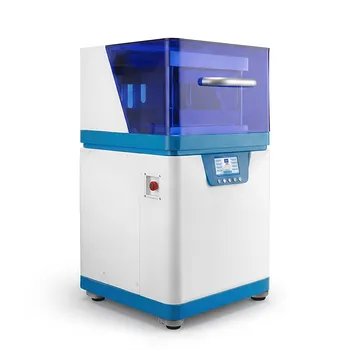
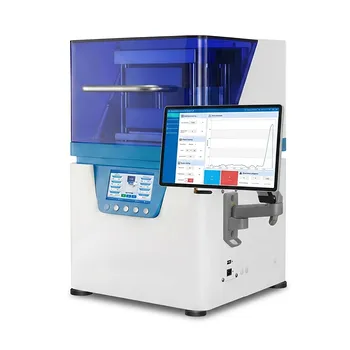
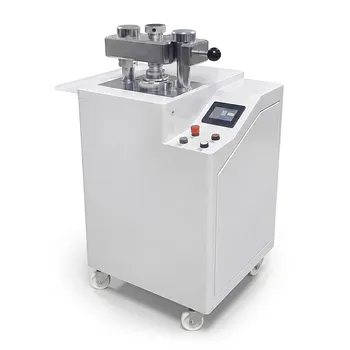
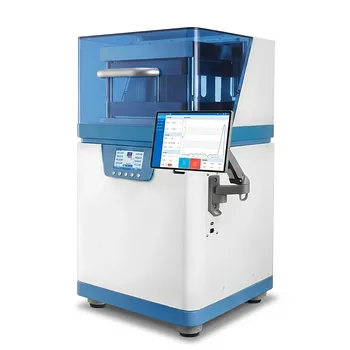
The primary purpose of an axial hydraulic press in forming alumina-zirconia composites is to consolidate loose ceramic powder into a dense, structurally stable "green body." By applying high molding pressure—typically around 100 MPa—the press forces granulated particles into a tight arrangement, eliminating large internal voids. This high-precision compaction provides the uniform initial density and mechanical strength required for the material to withstand the subsequent high-temperature sintering stage.
The axial hydraulic press acts as the critical bridge between raw powder and a viable ceramic component. It ensures that the alumina and zirconia phases are in sufficiently close contact to facilitate strong interfacial bonding and predictable shrinkage during firing.
Achieving Structural Integrity Through Compaction
The Elimination of Internal Porosity
The high-precision loads provided by a hydraulic press promote particle rearrangement and densification. By removing large-scale internal pores at the "cold-press" stage, you prevent structural defects that would otherwise become permanent weaknesses in the final composite.
Establishing "Green Strength"
A "green body" is the unsintered, shaped ceramic that must be handled and moved into a furnace. The axial press applies enough mechanical force to create preliminary strength, ensuring the specimen maintains its geometry and does not crumble before the final thermal treatment.
Standardizing Specimen Geometry
For research and industrial quality control, the hydraulic press allows for the creation of standardized specimens, such as cylindrical pellets or disks. This consistency eliminates random errors associated with manual forming and provides a reliable benchmark for evaluating how different sintering processes affect the material's properties.
Optimizing the Sintering Foundation
Enhancing Interfacial Bonding
The physical proximity of alumina and zirconia particles is a prerequisite for a successful composite. High-pressure compaction ensures tight contact between the two distinct phases, which is essential for achieving the chemical and physical bonding that gives these composites their high toughness and wear resistance.
Improving Heat Conduction Efficiency
Uniformly compacted green bodies exhibit better thermal conductivity during the heating cycle. This ensures that heat is distributed evenly throughout the mass during plasma calcination or sintering, preventing internal stresses caused by temperature gradients.
Increasing Final Relative Density
In some advanced applications, high-tonnage hydraulic presses are used to overcome the rheological resistance of the material. This induced plastic deformation helps close remaining micropores, potentially raising the relative density from 90% to nearly 96% of the theoretical maximum.
Understanding the Trade-offs and Limitations
The Risk of Pressure Gradients
A common pitfall of axial (uniaxial) pressing is the creation of density gradients. Friction between the powder and the mold walls can cause the top of the sample to be denser than the bottom, which may lead to warping or cracking during the sintering process.
Geometric Constraints
Axial pressing is generally limited to simple geometries, such as disks, cylinders, or rectangular blocks. For complex parts with undercut features or varying wall thicknesses, axial pressing may result in uneven density distribution compared to methods like Cold Isostatic Pressing (CIP).
Tooling Wear and Contamination
The high pressures required for alumina-zirconia—which is an inherently abrasive material—can lead to significant mold wear. If the mold material is not sufficiently hard, metallic contaminants can be introduced into the ceramic green body, compromising its purity and performance.
Applying This Process to Your Material Goals
How to Apply This to Your Project
- If your primary focus is R&D benchmarking: Use an automated axial press to produce standardized pellets (e.g., 0.3g) to ensure that variations in your data result from material composition rather than forming inconsistencies.
- If your primary focus is maximizing mechanical toughness: Prioritize high molding pressures (near 100 MPa) to ensure maximum particle-to-particle contact, which is the foundation for strong interfacial bonding between the alumina and zirconia phases.
- If your primary focus is producing large, simple shapes: Ensure your hydraulic press has sufficient tonnage to overcome the rheological resistance of the powder volume to maintain a uniform relative density across the entire cross-section.
The axial hydraulic press is the foundational tool that converts a powder mixture into a coherent, high-density preform ready for the transformative heat of the kiln.
Summary Table:
| Key Function | Benefit to Alumina-Zirconia Composites | Impact on Sintering |
|---|---|---|
| Powder Compaction | Eliminates internal voids and porosity | Prevents structural defects and warping |
| Green Body Forming | Establishes high preliminary mechanical strength | Ensures safe handling before heat treatment |
| Standardization | Creates uniform specimen geometry (pellets/disks) | Ensures reproducible results in R&D |
| Interfacial Contact | Forces alumina and zirconia phases together | Facilitates strong bonding and high toughness |
| Phase Densification | Increases relative density (up to ~96%) | Enhances final mechanical and wear resistance |
Elevate Your Material Research with KINTEK Precision
Achieving the perfect green body is the first step toward high-performance ceramics. KINTEK provides the specialized equipment needed for every stage of your process. Whether you require high-precision hydraulic presses (pellet, hot, or isostatic) to reach 100 MPa compaction or advanced sintering solutions like our muffle, vacuum, and atmosphere furnaces, we have you covered.
Our comprehensive range also includes:
- Material Preparation: Crushing, milling systems, and sieving equipment.
- Advanced Reactivity: High-temperature high-pressure reactors and autoclaves.
- Consumables: High-purity ceramics, crucibles, and PTFE products.
Ready to eliminate density gradients and maximize your composite toughness? Contact our technical experts today to find the ideal press and furnace configuration for your laboratory or production line.
References
- N. Yu. Cherkasova, Yulia Zobova. Features of calcium hexaaluminate formation in alumina-zirconia ceramics. DOI: 10.15826/chimtech.2023.10.3.17
This article is also based on technical information from Kintek Solution Knowledge Base .
Related Products
- Automatic Hydraulic Hot Press with 500x500mm Heating Plates and Multi Stage PLC Control for Material Sintering
- Laboratory Hydraulic Pellet Press for XRF KBR FTIR Lab Applications
- Automatic Laboratory Hydraulic Press for XRF & KBR Pellet Press
- Fully Automatic Heated Hydraulic Lab Press for Materials Sintering and Sample Preparation
- Laboratory Hydraulic Press Split Electric Lab Pellet Press
People Also Ask
- How do hydraulic presses facilitate material solidification in Low-Temperature LPS? Optimize Your Material Densification
- Why is 800 MPa required for TiNiPdCu alloy green bodies? Master High-Density Compaction for Superior Material Strength
- How does KBr pellet preparation facilitate FTIR of high-ash mud? Precision Sample Prep for Structural Analysis
- Why is an industrial hydraulic press with precision stainless steel molds used? For Uniform Mo-Fe Precursor Compacts.
- Purpose of Coaxial Ring Molds & Presses in EM Testing? Achieve Precise VNA Data & Fit