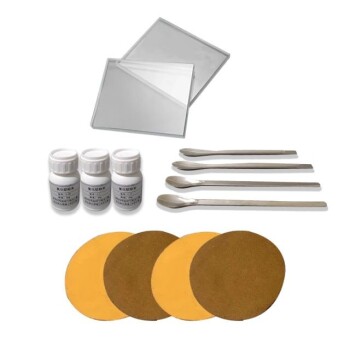
The primary purpose of an electrolytic polishing and etching system is to prepare the surface of a material for high-precision microstructural analysis by removing physical imperfections and chemically revealing internal features.
For Lead-cooled Fast Reactor (LFR) candidate materials, this system is essential because it eliminates the distorted "stress layers" created by mechanical grinding. By applying controlled voltage (such as 6V) through a specific electrolyte (like a 10% oxalic acid solution), the system dissolves the surface metal to expose the true grain structure without introducing artifacts.
Core Insight: In the context of LFR material testing, electrolytic preparation is not just about cleaning; it is a critical diagnostic step. It provides the clarity required to visualize specific degradation markers—such as carbide precipitates and deformation lines—that indicate how liquid lead is chemically and physically attacking the reactor material.
The Mechanics of Surface Preparation
To understand the necessity of this system, one must first look at the limitations of standard mechanical preparation.
Eliminating Surface Stress
Mechanical polishing involves abrasion, which inevitably smears the metal surface and creates a deformed layer. This layer can mask the true microstructure of the material.
The electrolytic system removes these stress layers entirely. It dissolves the surface atoms, leaving a pristine cross-section of the material that is representative of its internal state.
Controlled Electrochemical Attack
The process relies on a precise balance of electrical potential and chemical reactivity. By using specific parameters, such as a 10% oxalic acid solution and 6V of potential, the system acts selectively.
It does not simply erode the material; it targets high-energy areas like grain boundaries, creating the contrast needed for microscopic examination.
Unveiling Microstructural Degradation
For candidate materials like 316L austenitic stainless steel, the stakes are high. Engineers must identify exactly how the material holds up against the harsh environment of liquid lead.
Visualizing Austenite Grains
The etching process reveals the boundaries of austenite grains. This visualization is the baseline for understanding the material's fundamental structure before and after exposure to reactor conditions.
Detecting Carbide Precipitates
Contact with liquid lead can induce chemical changes in the steel. The electrolytic system highlights carbide precipitates, which are small particles that form within the metal matrix and can significantly alter its mechanical properties.
Identifying Deformation Lines
Perhaps most importantly for structural integrity, this method reveals deformation lines. These lines are physical evidence of stress and degradation caused by the liquid lead environment, providing early warning signs of material failure.
Understanding the Process Sensitivity
While highly effective, electrolytic polishing and etching is a sensitive technique that requires strict adherence to operational parameters.
The Importance of Specific Parameters
Success depends on the exact combination of voltage and electrolyte composition. As noted, a 6V setting with 10% oxalic acid is effective for 316L stainless steel.
Deviating from these specific voltages or concentrations can lead to poor results, such as pitting (over-etching) or a lack of contrast (under-etching). The method requires precise calibration to distinguish between a polishing action (smoothing) and an etching action (revealing structure).
Making the Right Choice for Your Analysis
When evaluating LFR candidate materials, your preparation method dictates the reliability of your data.
- If your primary focus is baseline structural analysis: Use this system to remove mechanical stress layers and clearly define austenite grain boundaries.
- If your primary focus is degradation and failure analysis: Rely on the specific etching parameters to reveal deformation lines and carbide precipitates caused by liquid lead exposure.
Precision in preparation is the prerequisite for precision in performance evaluation.
Summary Table:
| Feature | Electrolytic Polishing & Etching | Conventional Mechanical Polishing |
|---|---|---|
| Surface Integrity | Removes all distorted stress layers | Often leaves smeared, deformed layers |
| Structural Clarity | Reveals precise grain boundaries & precipitates | Can mask microstructural details |
| Primary Agent | Electrochemical dissolution (e.g., Oxalic Acid) | Physical abrasion (Abrasive paper/pads) |
| Key Outcome | Detects deformation lines and carbide phases | General surface smoothing only |
Precision Sample Preparation for Nuclear Research
Unlock the true microstructure of your reactor materials with KINTEK’s advanced laboratory solutions. Whether you are analyzing 316L stainless steel for LFR applications or evaluating material failure, our high-precision electrolytic cells and electrodes, alongside our comprehensive range of high-temperature furnaces and crushing systems, provide the reliability your research demands.
Why partner with KINTEK?
- Comprehensive Range: From vacuum furnaces and CVD systems to hydraulic presses and high-pressure reactors.
- Expert Solutions: Specialized equipment for battery research, cooling solutions, and premium consumables like PTFE and ceramics.
- Unmatched Clarity: Our tools are designed to eliminate artifacts and deliver diagnostic-grade results for the most demanding environments.
Contact KINTEK Today to Optimize Your Lab Workflow
References
- Dumitra Lucan, GHEORGHIŢA JINESCU. Corrosion of some candidate structural materials for lead fast reactors. DOI: 10.56958/jesi.2018.3.4.313
This article is also based on technical information from Kintek Solution Knowledge Base .
Related Products
- Electrode Polishing Material for Electrochemical Experiments
- Electrolytic Electrochemical Cell for Coating Evaluation
- Three-dimensional electromagnetic sieving instrument
- Quartz Electrolytic Electrochemical Cell for Electrochemical Experiments
- Side Window Optical Electrolytic Electrochemical Cell
People Also Ask
- How do you prepare the polishing setup for an electrode? Achieve a Flawless Mirror Finish for Reliable Electrochemistry
- What is the general procedure and what precautions should be taken during the polishing process? Achieve a Flawless Electrode Finish
- What are the electrode materials? A Guide to Choosing the Right Conductor for Your Application
- What are the examples of electrode materials? From Platinum to Graphite for Your Application
- How is a polished electrode tested for quality? Validate Performance with Cyclic Voltammetry